Italian startup Paradigma released its first model, Limite 1B Violetto — a dense autoregressive transformer with 1 billion parameters, trained from scratch on fewer than 300 billion curated tokens in six weeks. The model is created exclusively for solving math problems: on olympiad benchmarks, it shows results at the level of systems dozens of times larger, spending significantly less compute on training. The weights are open on Hugging Face under the Apache 2.0 license along with a separate value model for evaluating reasoning, but the model can currently only be run via the Paradigma vLLM plugin on Linux with an NVIDIA GPU.

What happened
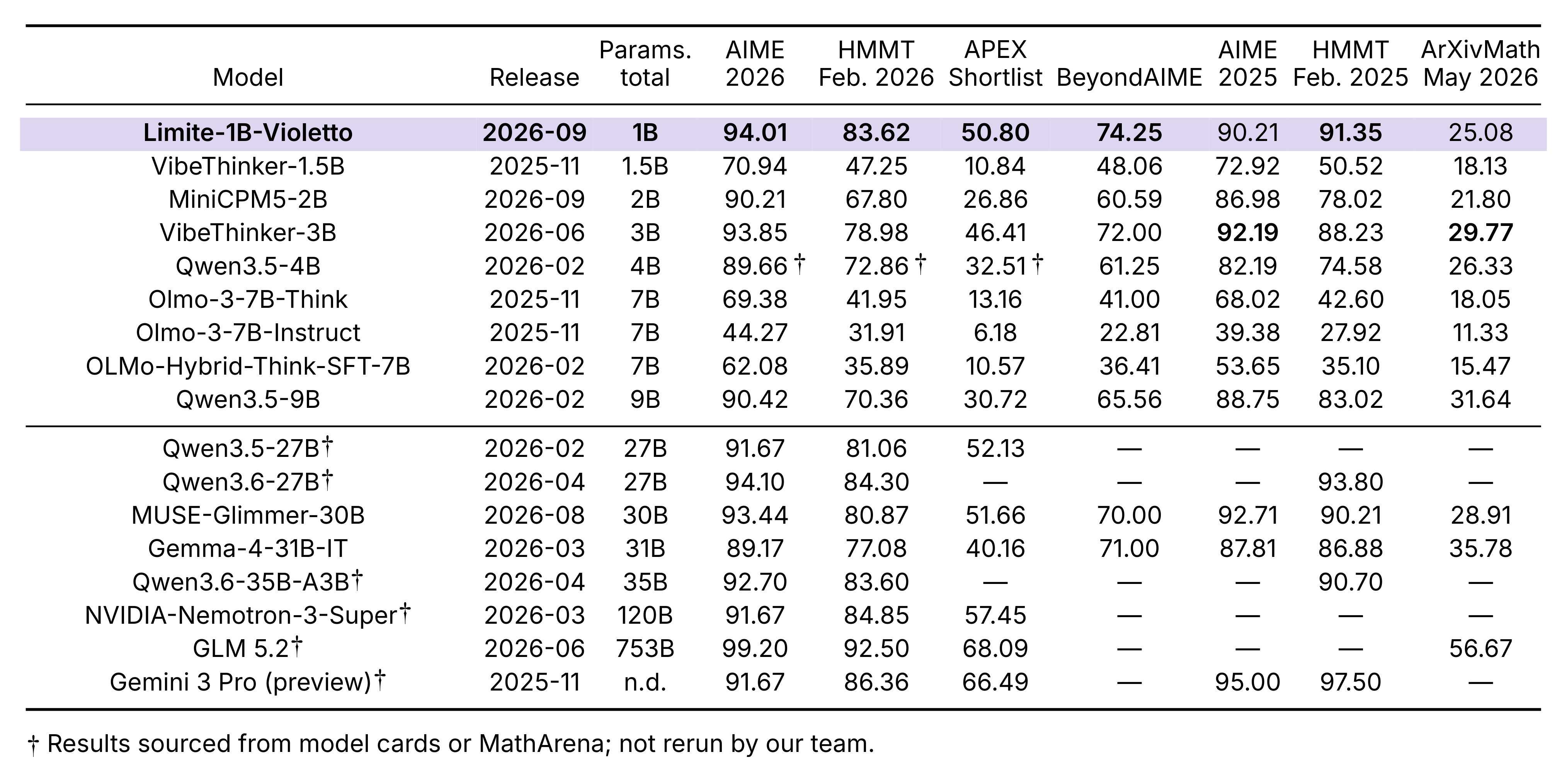
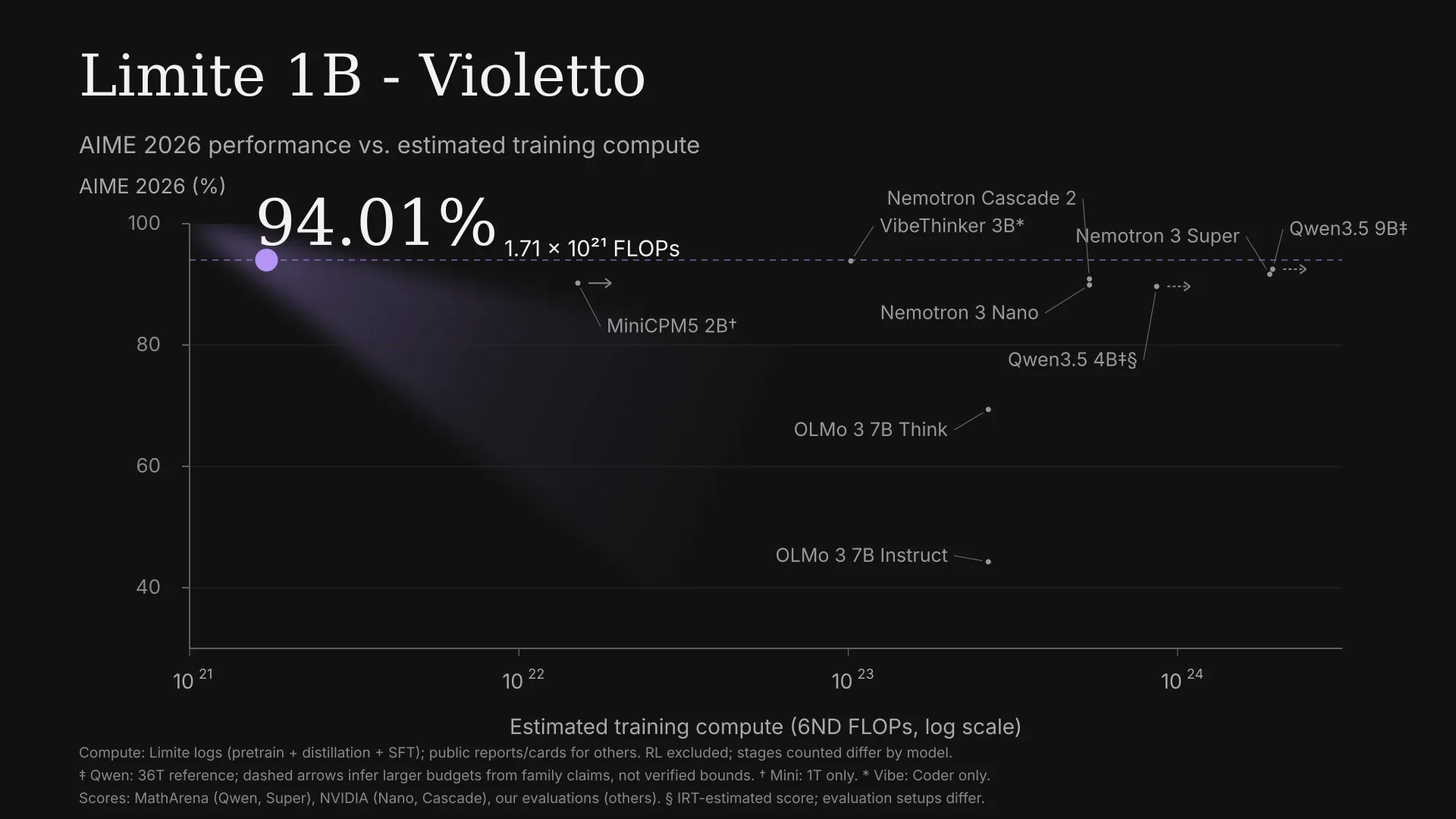
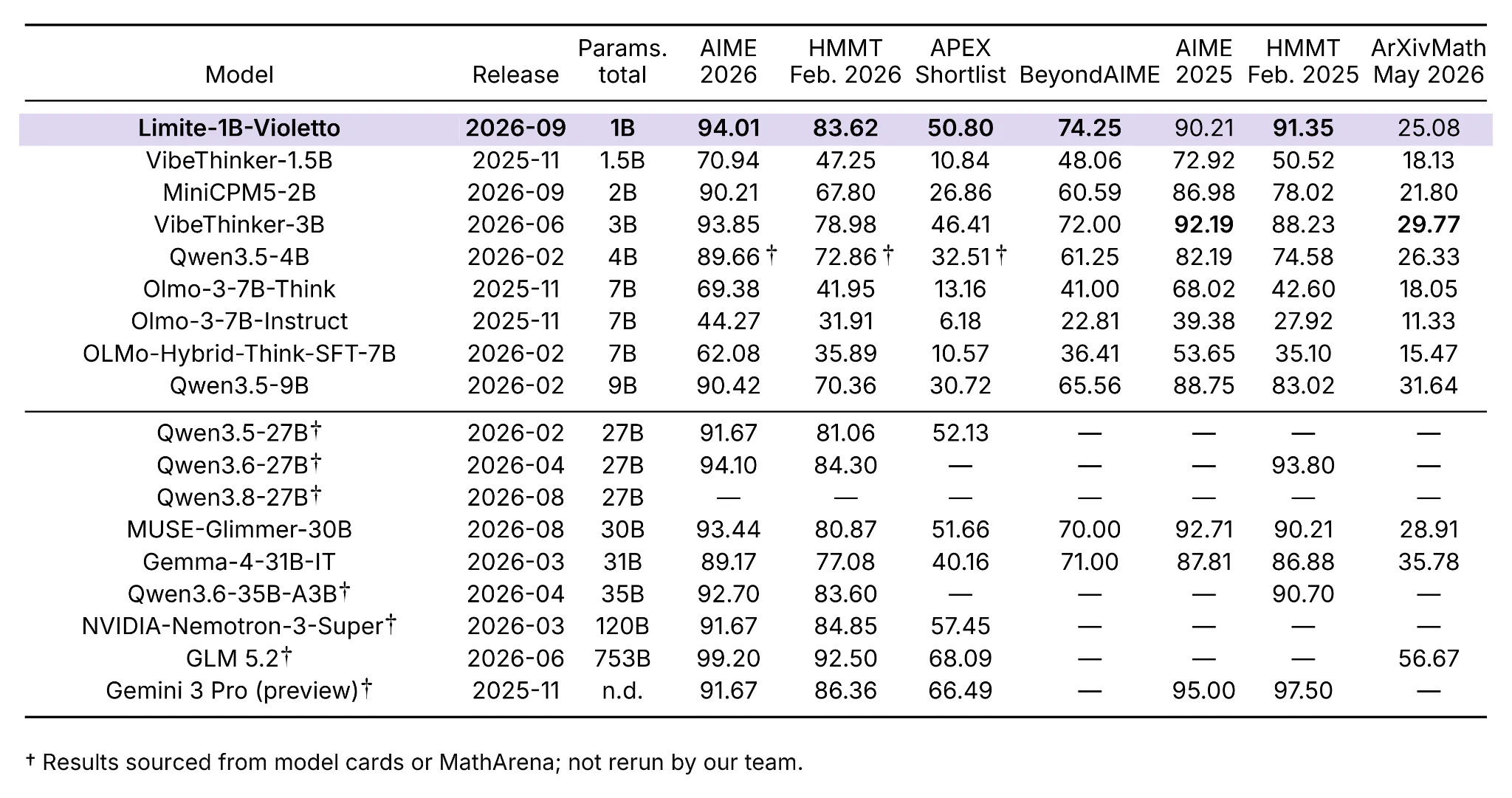
Paradigma published a release breakdown of its first model along with the weights, model card, and launch instructions. The model has a context of up to 131,072 tokens; on the AIME 2026 benchmark, it scores 94.01% at a calculated 1.71×10²¹ FLOPs, and on BeyondAIME — 74.25% versus 70% for MUSE-Glimmer-30B. According to the company's calculations, this level was achieved with a compute budget one to three orders of magnitude lower than models in the same league — Nemotron 3 Super, Qwen3.5 9B, VibeThinker 3B, and Nemotron Cascade 2. Along with the solver, the Limite Value Model with 1.035 billion parameters was published, which for each token of the answer outputs a regression estimate of whether the reasoning leads to the correct answer. A design feature of the release: the model is intentionally minimally tuned for instructions and works in a single turn — problem in, finished solution out.
Context
The release responds to a long-standing debate about what determines model quality — the scale of parameters and compute, or the quality of curated data. Paradigma's bet is on "speedrun" approaches to pretraining: a short training cycle on strictly selected tokens instead of a long run on large corpora. Minimal instruction tuning here is not a marketing detail but a falsifiable research thesis: modern practice assumes that models need an assistant "mode" to work effectively, while Paradigma deliberately builds a solver that lacks this mode. Math was chosen for this test not by chance: it is a verifiable domain where the correctness of the answer can be checked automatically. The publication of the value model also fits into the existing industry toolkit — token-level critics have long been considered a standard element of reinforcement learning pipelines.
Why this matters for the industry
For the industry, this is a claim of curation efficiency, not scale: if the claimed results are confirmed by independent checks, a narrow model trained from scratch in six weeks reaches the level of large general-purpose systems in a verifiable domain, meaning the entry into specialized model development is cheaper than generally assumed. A separate building block for engineers — the combination of a "single-turn solver plus Limite Value Model with per-token reasoning evaluation" under Apache 2.0: it sets a workflow template in which the system generates n solutions, ranks them with the value model, and returns the best one. If the "speedrun pretraining plus strict data curation" recipe is reproduced in other verifiable domains, the market may shift toward routing — cheap, narrow small models under the orchestration of large general-purpose ones. For now, this is a signal, not a finished product: integration costs are high due to the dependency on the Paradigma plugin.
Why this matters for users
You can try the model today: the weights are on Hugging Face, and launch instructions are collected in the Paradigma GitHub repository. You will need Linux, an NVIDIA GPU with a driver for CUDA 13.0, and vLLM 0.26.0 via the limite plugin, with the stack pinned to PyTorch 2.11.0; the weights themselves take up about 2 GB, and at the full 131k context, the model requires about 7.5 GB of VRAM. The main thing is to remember its character: this is not a chatbot but a single-turn solver, so the prompt should be a math problem. To ordinary questions, the model often responds by reinterpreting them into math: asked to explain photosynthesis, it reasoned about dividing a cell into two. The practical value for the reader is a cheap local solver for olympiad math, on the basis of which, together with the value model, you can already build a best-of-n ranking prototype. There is no Managed API, and no Transformers support either — it is promised later.
What is still unknown / limitations
The key methodological gap is the lack of an evaluation protocol: available sources do not specify whether the 94.01% on AIME 2026 is a single run (pass@1) or the result of a combination with the value model and candidate selection, there is no data on temperature, number of runs, or benchmark contamination checks. All key figures were published by the vendor itself, there are no independent replications in the sources, and no data on latency on real hardware has been published. The Limite Value Model evaluates the plausibility of the path to the answer but does not check the calculations themselves — it cannot be relied upon as a verifier. One successful case in one narrow domain does not establish a scaling law: generalizations will require independent repetitions in other domains. Finally, the stack is still narrow: without Transformers support and alternative serving frameworks, use in production is limited to the combination of vLLM 0.26.0 with the Paradigma plugin on Linux and NVIDIA with CUDA 13.0.
Sources
- Limite 1B - Violetto — Paradigma's First Model (release blog)
- paradigma-inc/limite-1b-violetto — Hugging Face model card
- paradigma-inc/limite-violetto — GitHub (vLLM serving plugin)
Author
Look at AI, editorial team