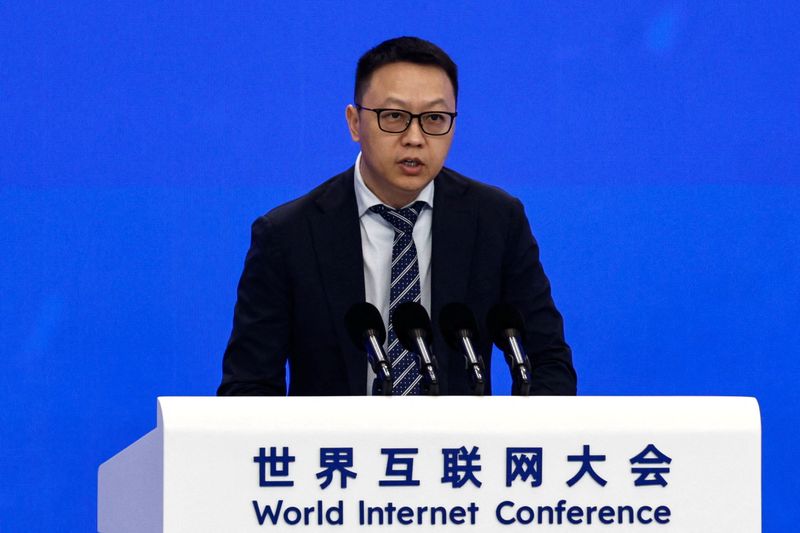
At the annual Apsara Conference in Hangzhou, Alibaba and its CEO Eddie Wu presented one of the most aggressive AI roadmaps in the industry: Qwen 4 is already training, and future Qwen 4.5 and Qwen 5 are planned to scale to 5–10 trillion parameters compared to 2.4 trillion in the current flagship Qwen 3.8 Max. The company also unveiled the Zhenwu V900 accelerator, claimed as China's most powerful AI chip, and set a goal to exceed 20 GW of global data center capacity by 2032. This is currently a roadmap, not a product: the announcement did not include new models, benchmarks, or available artifacts, so key claims about capabilities remain company promises.

What happened
The announcements were made at the annual Apsara Conference in Hangzhou. Eddie Wu confirmed that Qwen 4 is in the training stage and outlined the parameter target for the next versions of the lineup: Qwen 4.5 and Qwen 5 are planned to reach 5–10 trillion parameters. The Qwen team announced "significant progress" in recursive self-improvement — a mode in which the model itself identifies its weaknesses, designs experiments, and synthesizes training data for the next cycle, and at Alibaba this mechanism is directly linked to the path to artificial superintelligence (ASI). The semiconductor division T-Head unveiled the Zhenwu V900 accelerator, named China's most powerful AI chip: a threefold performance increase over M890 and support for clusters of up to 500,000 accelerators are claimed, but mass production has been moved from Q3 to Q1 2027. The only operational fact of the announcement concerns already working hardware: M890 accelerators currently provide inference for models larger than 2 trillion parameters. Alibaba Cloud announced a goal to reach over 20 GW of global data center capacity by 2032, and the market responded with a rise in BABA shares by about 5%.
Context
Alibaba's plan should be read as a claim to vertical integration: the company is simultaneously developing its own T-Head accelerators, the Alibaba Cloud platform, and the Qwen model lineup, available both with open weights and via API. Against the backdrop of US export restrictions on NVIDIA, such a self-sufficient Chinese stack becomes not an engineering luxury, but a strategic necessity, and the Apsara Conference became the platform where Alibaba solidified the scaling agenda. The claimed growth means an approximately fourfold increase compared to the current flagship with its 2.4 trillion parameters. A separate layer is recursive self-improvement: if the model really does identify its weaknesses itself, set up experiments, and synthesize data for the next training cycle, this is a claim not to another size increase, but to a reproducible mechanism for quality growth. This is why the company links this direction with the idea of artificial superintelligence (ASI), not just a parameter race.
Why this matters for the industry
For the industry, this is the most specific claim to date for "supermodel" scale with a full stack: its own T-Head accelerators, working M890 supernodes, and a plan for multiple expansion of Alibaba Cloud capacity by 2032. If successfully executed, the vertically integrated Chinese stack of T-Head + Alibaba Cloud + Qwen will become a factual alternative to the NVIDIA-dependent path, and intensified competition will accelerate the decline in inference prices. For product builders, the working signal today is one: training of a new flagship version of Qwen is already underway, and the lineup will remain available both as open weights and via API — this can be factored into roadmaps for agentic scenarios. Everything else, including Zhenwu V900 and the ASI thesis, remains company promises, not products: there is nothing to implement in production today. The nearest checkpoint is the release of Qwen 4 in a horizon of about six months: independent benchmarks, API prices, and serving stability will show how well the promises align with measurable results.
Why this matters for users
For users, there are no direct changes today: previous Qwen models are working, and Zhenwu V900 will reach the series no earlier than Q1 2027. If the plan is realized, open and API-available Qwen models will become noticeably smarter in "long" tasks — agentic scenarios, code, multi-step research — and competition will continue to lower inference prices. It makes sense to prepare now: fix a model abstraction layer in the product, design agentic scenarios so that a model upgrade is a config replacement, not a separate project, and update your own eval set for your scenarios so that when Qwen 4 is released, the comparison takes days, not months. This approach turns a future release from a stress test into planned routine.
What is still unknown / limitations
Claims about model capabilities are currently not verifiable. The number of parameters without architecture — dense or MoE, active parameters, data volume, compute budget — does not predict quality, and the announcement does not include any of these elements. Recursive self-improvement is described only procedurally, without metrics, task sets, and number of cycles; the formulation of "significant progress" and the ASI framework are the company's interpretation, not a reproducible result. Zhenwu V900 has no independent benchmarks, and its mass production deadline has already been shifted, indicating schedule risks. Only the infrastructure part of the plan is specific and partially verifiable, while parameter scaling historically gives diminishing returns without a comparable increase in data.
Sources
- Reuters — Alibaba plans AI model with 5 trillion to 10 trillion parameters, unveils new chip
- Yahoo Finance (Reuters) — Alibaba plans AI model with 5 trillion to 10 trillion parameters, unveils new chip
- The Economic Times (Reuters) — Alibaba plans AI model with 5 trillion to 10 trillion parameters, unveils new chip
Author
Look at AI, editorial team