The author of the AP Security blog described how the LLM agent Grok Build, connected to the IDA disassembler via an MCP server, cracked both a training VM crackme and a commercial application owned by the author — it took about four minutes for each target. According to the author's assessment, agents provide a '10x multiplier' in productivity with basic reverse engineering experience, and the barrier to entry for cracking for beginners has practically collapsed.
What happened
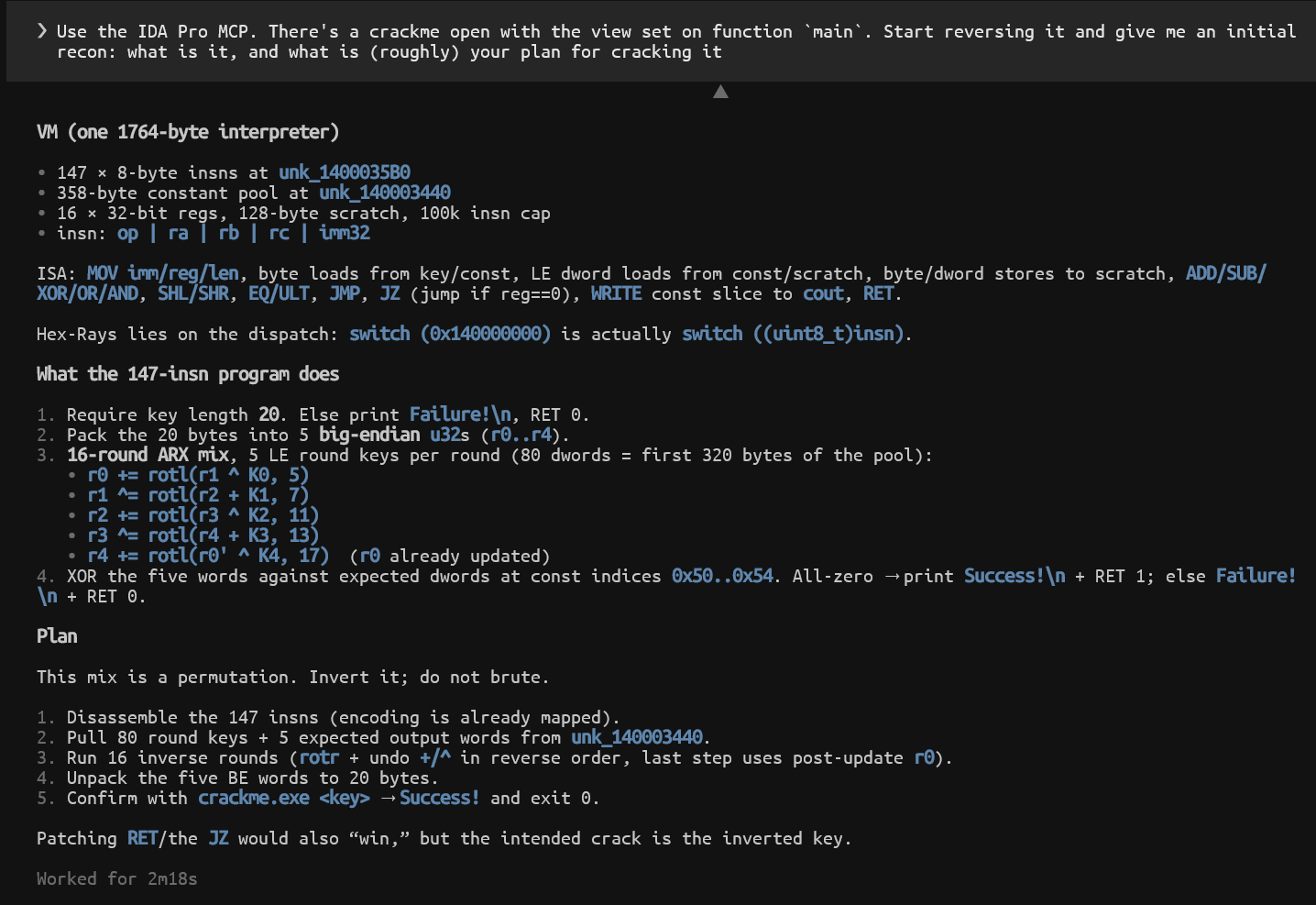
The case study consists of two episodes. The first is a training crackme based on a virtual machine with 23 opcodes and a 16-round key verification algorithm, built on 'GPT-6 Astra'. A simple request was enough: the Grok Build agent with the connected IDA MCP server solved the problem in about four minutes, without special prompting. The second episode concerned commercial software, the name of which is hidden because the program belongs to the author himself: the agent annotated the pseudocode of licensing functions and restored data structures in a comparable amount of time. The code contained the instruction 'movzx eax, dil', which returned 1 for a valid license; a patch that made it always return 1 removed the protection and opened access to the full version.
Context
The case should be understood against the backdrop of how client software protection is structured. For decades, its bet was built on the cost of analysis: VM packers and obfuscation turned code into a hard-to-parse structure that stopped everyone except experienced reversers willing to spend hours on manual work. The working tool for this audience remained the IDA Pro disassembler. The key link in the new pipeline is not so much the model itself as the integration: the MCP server acts as a bridge between the desktop tool and the agent, giving the model programmatic access to the editor. This is a typical pattern of growth in agentic capabilities — new capabilities arise at the intersection of the model and mature professional tools, not in isolation, so the result is replicated as an engineering solution, not as a one-off success of a specific model.
Why this matters for the industry
For the industry, the main thing is a shift in the threat model. Client-side license checks and VM packer-level obfuscation, which previously served as a barrier for beginners, are ceasing to be protection: the recipe can be reproduced today by any engineer with IDA and an MCP server, without waiting for the next version of models. Any client-side license check should now reasonably be considered compromised by default, and protection system and DRM vendors should immediately review their architecture: the bet shifts from obfuscation as a moat to server-side validation and multi-layer checks without a single point of failure. A separate design lesson is that in the commercial episode, the protection was ruined by a single check instruction: a bottleneck in licensing logic is more dangerous than any 'intelligence' of the model. For builders, the case demonstrates a universal product pattern: any niche expert tool wrapped in an MCP connector becomes an agent-controlled tool, and a prototype of 'agentic binary analysis' for legitimate audit can be assembled in a day. In the coming months, MCP wrappers for reverse engineering tools, the first evals for the 'agent plus disassembler' combination, and a counter-movement from model vendors, who will have to decide on a policy for such tasks, are expected.
Why this matters for users
For the reader, the post is valuable as an analysis of a real 'agentic' reverse engineering recipe: specify the license check function to the agent, ask it to annotate the pseudocode and restore structures, then look for the single return point. This is an honest benchmark of what LLM agents can really do in security right now, not in staged demos. The barrier to entry is reduced to basic reverse engineering experience and access to an agent with MCP support: tasks that previously required hours of manual work are solved in minutes. The author links this to the end of the classic era of cracking — instead of cracking Photoshop, it is now easier to rebuild the software from scratch with the help of an agent. For the ordinary reader, the case gives a reason to recalibrate the understanding of where the boundary between 'protected' and 'not cracked' actually lies.
What is still unknown / limitations
This is a case study, not a benchmark: two successful episodes are described, from which repeatability cannot be inferred — the source has no number of attempts, share of failures, or comparison with the time of a human expert, as well as details of prompts, cost metrics, and tokens. Publishing only wins creates selection bias, and the claimed '10x multiplier' remains an anecdotal assessment by one author. The training crackme is a compact search space, inherently favorable to the agent, and the result cannot be directly transferred to industrial VM packers; moreover, the attack target itself was built by AI, and the symmetry of 'AI protection against AI attack' may distort the assessment of robustness. Forecasts about systematic benchmarks of agentic reverse engineering and a mass shift of protection to server-side validation are interpretations requiring verification, not established facts.
Sources
Author
Look at AI, editorial team