On September 7, 2026, QuiverAI released the second generation of its vector graphics generator — two models, Arrow 2 and the flagship Arrow 2 Telos. The company states that generation has become faster and SVG geometry cleaner: fewer anchor points, extra nodes, and overlapping contours, while element spacing and alignment are maintained without additional prompt instructions. Telos supplements the result with refinement using top-tier (frontier) language models. The models can be tried through a 14-day trial period on the Go plan.
What happened
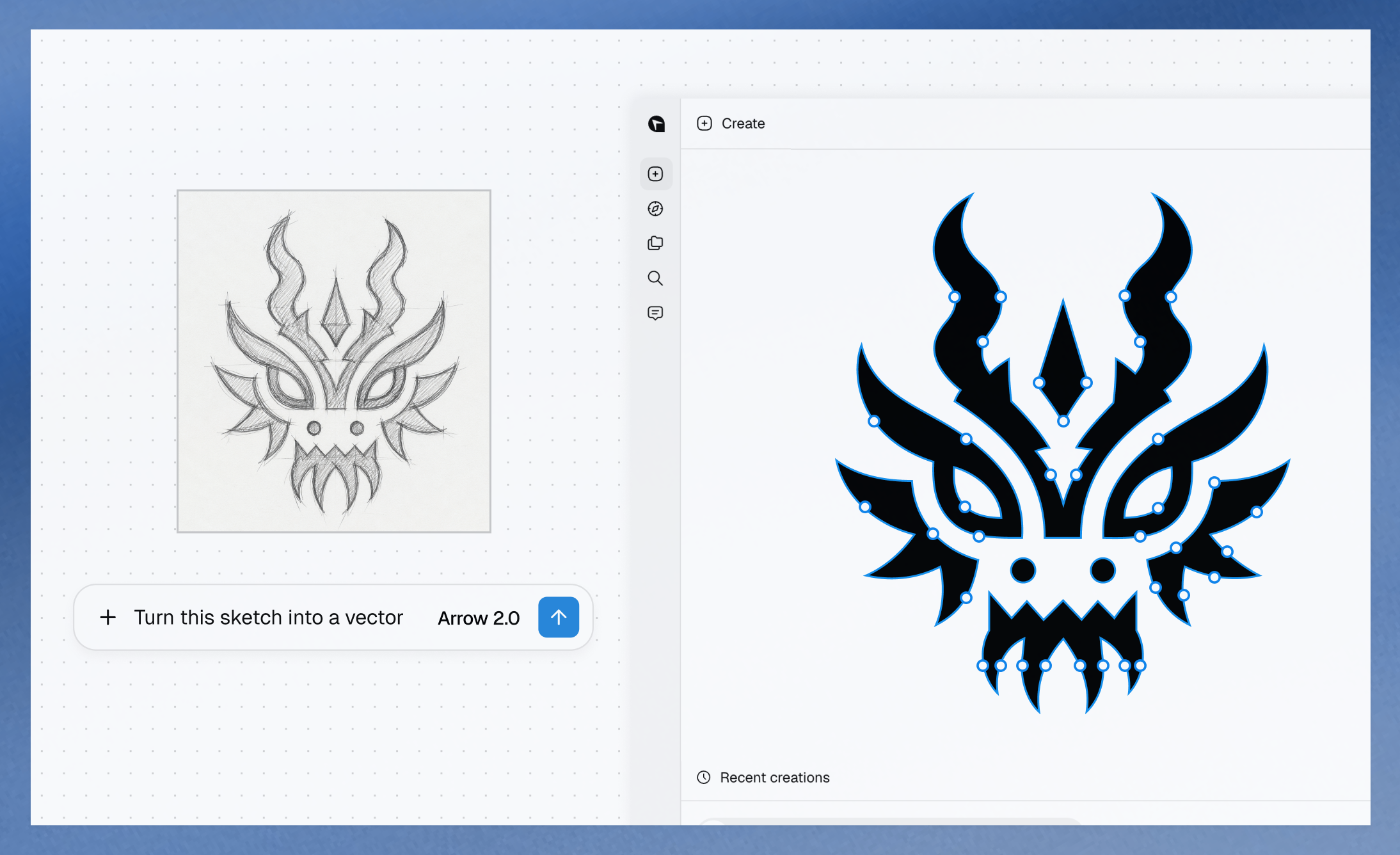
QuiverAI updated its vector graphics generator lineup: the September 7, 2026 release brought two models — Arrow 2 and its flagship version Arrow 2 Telos. Arrow 2 works faster and, according to the company, produces cleaner geometry: the final SVGs have fewer anchor points, extra nodes, and overlapping contours, while element spacing and alignment are maintained without special phrasing in prompts. Arrow 2 Telos supplements this basic generation with a stage of result refinement using top-tier (frontier) language models. The stated set of scenarios covers illustration series based on a reference with palette preservation, diagrams with element highlighting, technical drawings, vectorization of raster sketches into editable SVG, and micro-animations of static SVGs — logo reveals, loading states, animated icons. The pricing lineup includes Go at $8 per month with a weekly quota of $5, Basic at $20 with a quota of $15, and Pro at $40 with a quota of $40; the weekly quota resets on Mondays UTC and does not carry over to the next week. The models work in the app.quiver.ai application, where Arrow 2 is open to all users, and API access is arranged on a prepaid basis.
Context
Vector graphics generation has long remained a weak link in generative tools: raster models output a pixel image that cannot be edited like a drawing, and manual vector layout requires time and skills in working with contours. The division of the lineup into a fast, cheap model and a flagship with “refinement” reproduces the practice of language model providers, who keep an inexpensive working model and an expensive one for complex tasks side by side; at QuiverAI, the role of the refiner is played by the Arrow 2 Telos combination with a frontier-LLM, although the technical implementation of this refinement is not disclosed. The claimed ability to maintain spacing and alignment without prompt hacks relates to the structural quality of the geometry: if it is real, the result can be edited in an editor and integrated into design pipelines, rather than used as a one-time image. The release itself continues the development of the first version of Arrow, but the company accompanies it only with qualitative descriptions — there are no benchmarks, comparison methodologies, or technical reports in public sources.
Why this matters for the industry
For design pipelines and product teams, this is not “just another image generator,” but a potential building block: clean, editable SVG with maintained spacing and alignment, plus a prepaid API, allow building automated pipelines for illustrations, diagrams, and micro-animations. The division into a cheap, fast model and a flagship with LLM refinement reduces the cost per asset in mass scenarios like sketch vectorization and interface animation: routine tasks go to Arrow 2, and complex ones to Telos. For startups, this is a noticeable cost reduction and acceleration of one link in the design process, not a platform shift: the generation itself is quickly commoditizing, so protected value makes sense to build higher up the stack — in vertical pipelines and services, not in a thin wrapper around the generator. At the same time, the product's economics will have to be designed taking into account the quota-based billing model, which complicates cost forecasting.
Why this matters for users
The models can be tried immediately in the app.quiver.ai application: Arrow 2 is available to all users, and the Go plan provides a 14-day trial period with card binding. The practical benefit is to quickly get a series of stylistically consistent illustrations based on a reference, a clean, editable SVG from a raster sketch, or a ready-made micro-animation of a logo and icon without manual layout. The cheapest way to separate fact from marketing is to run your own cases in the trial: vectorize real sketches, assemble a batch of illustrations based on your own brief, create a micro-animation, and evaluate the cleanliness of the geometry on your own examples. For programmatic access, a separate API is provided, which allows integrating generation into your own tools and services.
What is still unknown / limitations
All claimed improvements are described qualitatively: there are no benchmarks, comparison methodologies with the previous version, or technical reports with architecture, training data, and eval sets in public sources, so “clean geometry” remains a vendor claim, not a measured characteristic. There are no independent evaluations of the models at the time of release; the technical implementation of the refinement in Telos is also not disclosed — it is unclear where the generative model ends and LLM post-processing begins, and how this affects price and latency. For production solutions, there is a lack of data on latency and limits, and billing with a weekly quota reset without carryover complicates cost forecasting in pipelines. The models can only be evaluated in practice independently — through the trial period and your own measurements on representative cases.
Sources
- Introducing Arrow 2 and Arrow 2 Telos – QuiverAI (official blog)
- Pricing – QuiverAI (official pricing page)
Author
Look at AI, editorial team