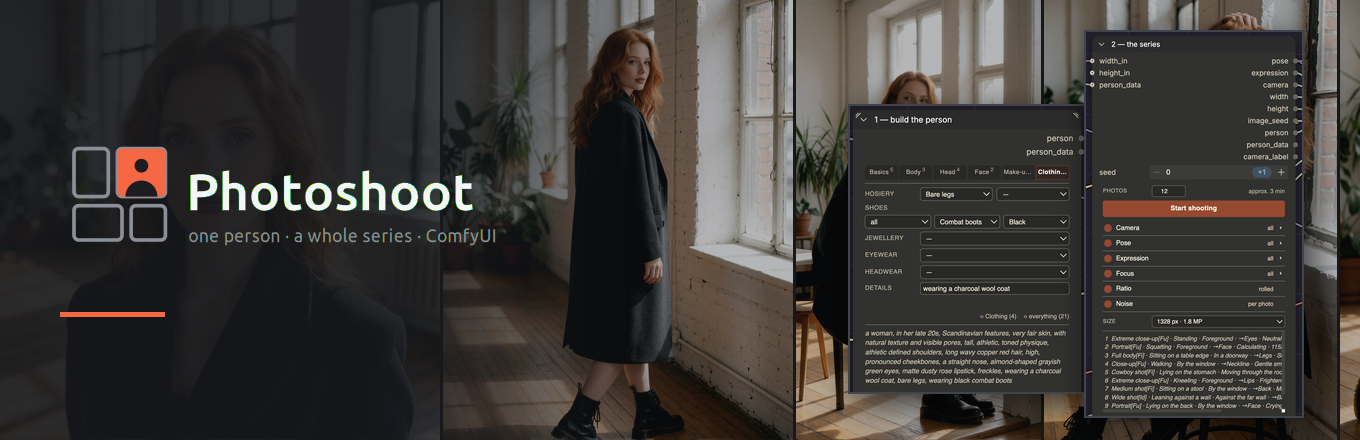
The ralksta/ComfyUI-Photoshoot repository has been published on GitHub (MIT license, approximately 78 stars) — a set of ComfyUI nodes that assembles a character's "photoshoot": the hero only needs to be described once across 44 fields and saved by name, after which the node builds a series of up to 40 frames with different framing, poses, and expressions. The nodes output only prompt text, so they are suitable for any model that accepts a prompt, and the series is calculated deterministically — it can be continued later without duplicates. LoRA training and reference photos are not needed for this.


What happened
The ralksta/ComfyUI-Photoshoot repository contains a set of nodes for generating a character's "photoshoot." The character is described once across 44 fields in six tabs — body, face, hair, makeup, clothing — and saved by name for reuse. The Photoshoot node assembles a series of up to 40 frames across six axes: camera (7 framings from extreme close-up to wide shot), pose (18 poses in 4 families plus placement in the scene), expression (90 moods in 9 groups), focus (12 points), aspect ratio (9 formats), and noise. The current version 2.3.0, dated September 2, 2026, brought the Style and Monochrome nodes, a starting series number setting, and a FAQ.
Context
The mechanics are built on pure prompt engineering: the nodes do not draw images but generate only text — from 760 to 1000 characters, averaging around 840, i.e., approximately 190–250 tokens. The stability of the series relies on two techniques. The first is deterministic combination using the Kronecker sequence: the seventh frame is always the same, and the series can be expanded later without duplicates. The second is automatic shortening of the character description with distance: for a wide shot, details that cannot be resolved from that angle are cut from the card, such as lipstick, eyeliner, and cheekbone shape (303 characters instead of 376), so they do not pull the composition toward the face. This approach is an alternative to common ways of maintaining a character, where consistency is usually provided by LoRA weights or reference images.
Why this matters for the industry
For the industry, this is an example of how character consistency in ComfyUI is achieved through prompt structure rather than training: open MIT code makes character content production cheaper and simultaneously means that the technique itself cannot be protected — it is compatible with any stack. Since the output is text, the set works with any model that accepts a prompt, but it is best revealed with T5/LLM encoders (Flux, SD 3.5, Qwen-Image, Krea 2); in CLIP models SD 1.5 and SDXL, details at the end of the prompt lose weight due to the 77-token limit per chunk. This is a building block, not a service: there is no public API, latency metrics and prices are not documented, so teams will have to integrate it into their own ComfyUI pipeline. At the same time, the "character as a structured 44-field card" scheme and the "prompt budget for frame resolvability" technique are portable patterns that can migrate to other node packs, video, and multi-scene pipelines.
Why this matters for users
The practical scenario starts with installing the set through ComfyUI Manager. Then the reader receives a series of up to 40 frames of the same character with different framing, poses, emotions, and formats, without training LoRA or uploading reference photos. The character is saved by name and reused between sessions, so one described hero can be shot in different projects. The repository already contains a ready-made workflow photoshoot-series.json, examples, a prompting guide, and matrix posters. The quality of the frames entirely depends on the base model: the posters in the README were rendered on Krea 2 Turbo with 8 steps and CFG 1.0.
What is currently unknown / limitations
The stability of character identity between frames has not been measured anywhere: there are no quantitative metrics in the material, and the only evidence is rendered posters on one configuration (Krea 2 Turbo, fp8, 8 steps, CFG 1.0). Prompt shortening with distance remains an engineering hypothesis — the documentation contains no ablations or measurements confirming the effect. The project is young: about 78 stars, a solo author, no public API, so it should be considered a local tool rather than a supported service.
Sources
- GitHub — ralksta/ComfyUI-Photoshoot: Build a person once, then shoot a whole series (official repository, README, ready-made workflow photoshoot-series.json)
- Release v2.3.0 — Photoshoot 2.3.0: Style and Monochrome nodes, starting series number, FAQ
- Full node reference — docs/nodes.md: all controls, focus/framing links, shortening of the person block with distance
Author
Look at AI, editorial team