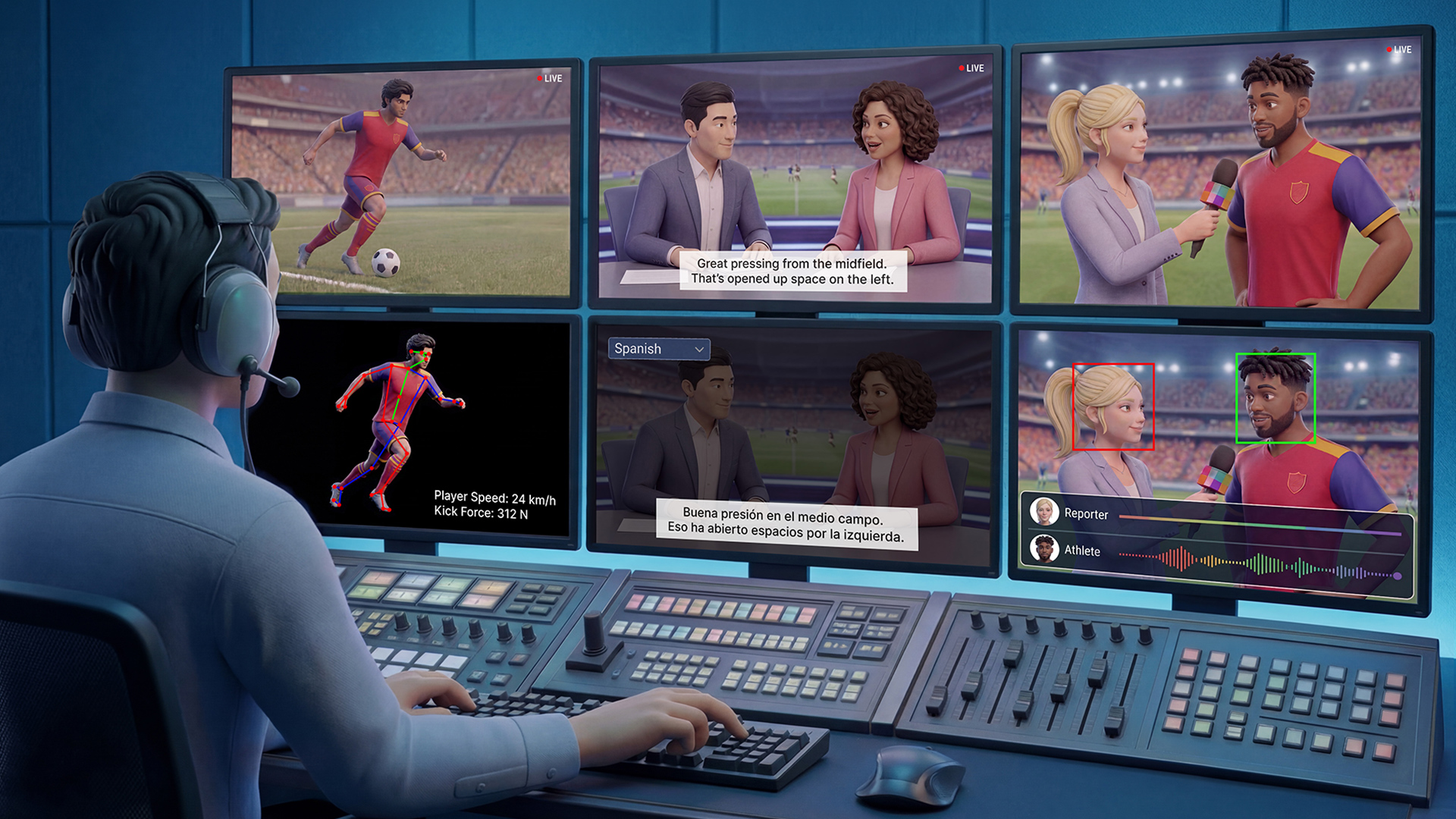
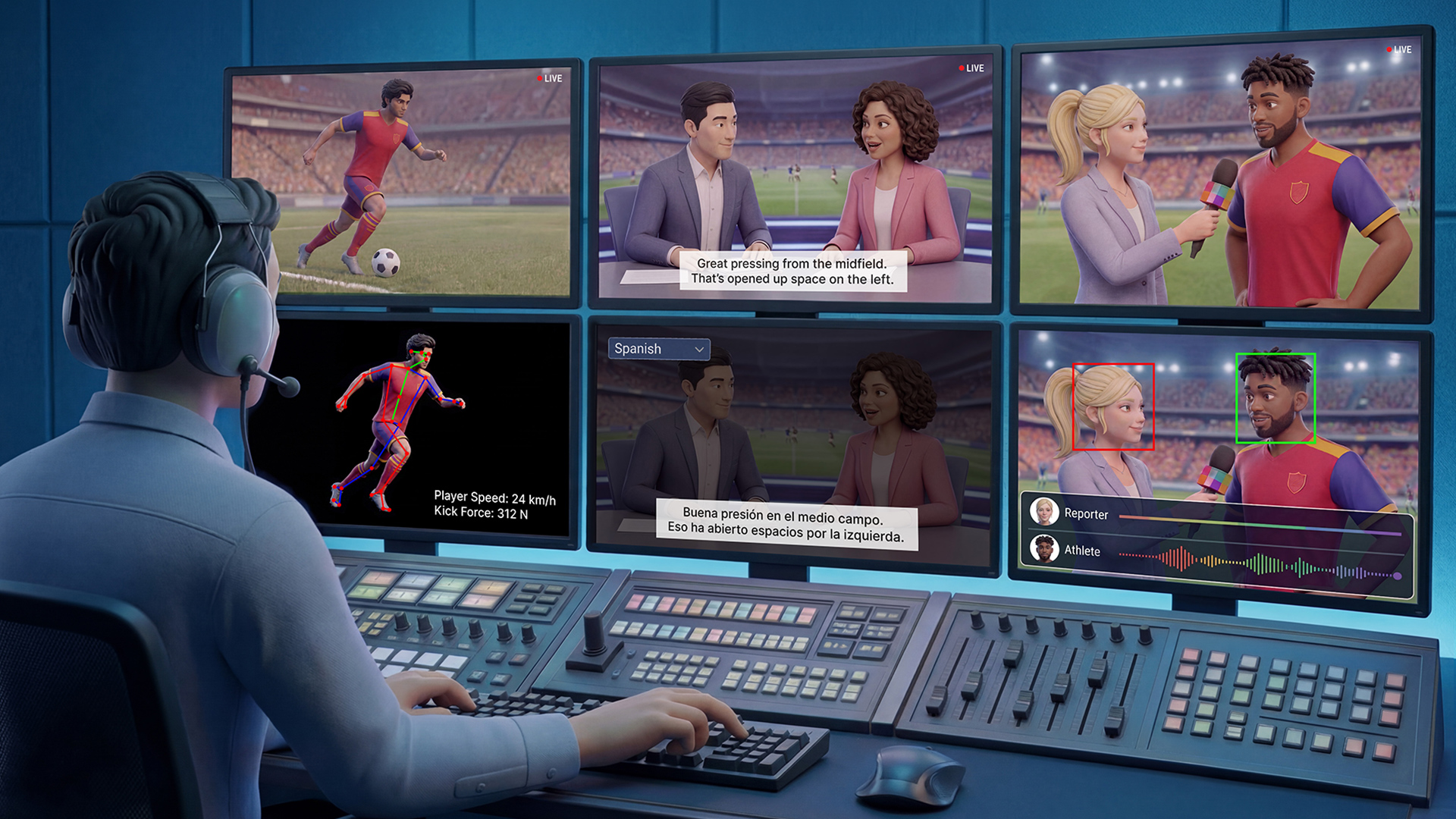
On September 9, 2026, ahead of the IBC 2026 conference in Amsterdam (September 11–14), NVIDIA announced a major expansion of its AI for Media platform: GPU-accelerated SDKs, NIM microservices, and blueprints for real video production stages — markerless motion capture, frame interpolation, upscaling to 8K, dubbing with lip-sync, audio cleanup, and synthetic video verification. Some tools are already available for free on build.nvidia.com.
What happened
The package included six new components and a synthetic video detector. 3D Body Pose performs markerless body motion capture from a single standard camera and tracks 77 skeleton points. Video Frame Generation generates intermediate frames, increasing frame rate by 2x–4x, and supports slow motion up to 6x; an 8x multiplier is in development. Video Super Resolution increases resolution from 480p up to 8K at a 16:9 aspect ratio and adds support for 10-bit video. LipSync adjusts mouth movement to new voiceovers for dubbing and operates according to the SMPTE ST 2110 broadcast standard for live broadcasts. Active Speaker Detection identifies the speaker without mandatory diarization, while Studio Voice cleans speech from noise and echo, taking microphone profiles into account. The new Synthetic Video Detector distinguishes AI-generated content from real video with a stated accuracy of 99.3% and 97.7%. Officially, Video Super Resolution, Video Frame Generation, and TrueHDR (SDR to HDR conversion up to approximately 2000 nits) are combined into a single pipeline for processing entire content libraries.
Context
Each of these areas — markerless motion capture, frame interpolation, super-resolution, and lip-sync — is a well-known research direction, so the shift here is engineering rather than algorithmic. The progress lies in established methods being packaged into NIM microservices and blueprints that work within production constraints: real time, live broadcast, streaming standards, plus support for Holoscan for Media. The materials do not disclose architectures, training data, or scientific papers: this is a product platform announcement, not a research publication.
Why this matters for the industry
NVIDIA is not addressing "generating a film with a single prompt," but rather individual professional video production stages in the form of microservices, and partners are already integrating them into their products. Ross Video is connecting the tools to the Rio Replay platform for AI slow motion, Vizrt — to virtual studios where actor movement controls 3D lighting in real time, NDI — to real-time translation with synchronized dubbing, Dalet and Wowza — to frame authenticity verification via the Synthetic Video Detector. The microservice delivery format through NIM and blueprints reduces integration costs: single-task AI video tools become standardized components, and competition shifts to orchestrating pipelines from ready-made modules. If the claims hold up to scrutiny, video AI inference will become an infrastructure layer of video production, similar to today's encoding and transport, and specialized stages will enter broadcast pipelines on par with generative models.
Why this matters for users
Most tools can be tested right now. Studio Voice and Active Speaker Detection work for free with an API key on build.nvidia.com, and Video Super Resolution is available in a cloud demo at build.nvidia.com/nvidia/vsr/experience. LipSync and Video Frame Generation are open via an Early Access request. Local deployment requires an NVIDIA RTX graphics card, and Mac users may find it easier to maintain a remote NVIDIA machine. Prototyping can be done at no cost: get an API key, test Studio Voice and Active Speaker Detection on your own recordings, and evaluate the upscaler on your content. Early Access components should be considered as replaceable modules in the architecture, and before production launch, measure latency, quality, and processing costs on your own material.
What is still unknown / limitations
The stated 99.3% and 97.7% accuracy of the Synthetic Video Detector was published without methodology: test generators, data distribution, false positive rate, and robustness to adversarial mutations are not specified, and in this field, such metrics have historically degraded on models that were not present during training. The 8x multiplier for slow motion is still in development. The materials do not analyze error accumulation between the stages of the VSR + Video Frame Generation + TrueHDR pipeline, for example, interpolation artifacts during fast movement and occlusions, which are then amplified by upscaling. LipSync and Video Frame Generation do not have public pricing until they exit Early Access, so the cost of processing an hour of video through this pipeline cannot currently be calculated.
Sources
- NVIDIA Brings Real-Time AI to Broadcast, Sports and Global Streaming at IBC | NVIDIA Blog
- NVIDIA AI For Media | NVIDIA Developer
- Video Super Resolution NIM Model by NVIDIA | NVIDIA NIM
Author
Look at AI, editorial team