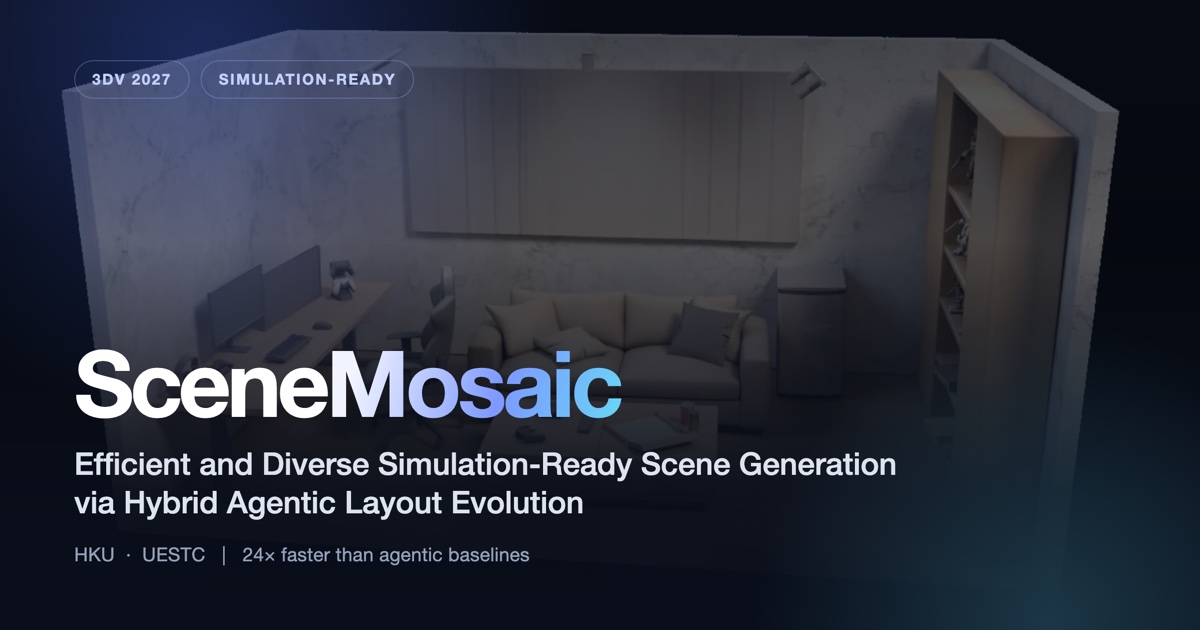
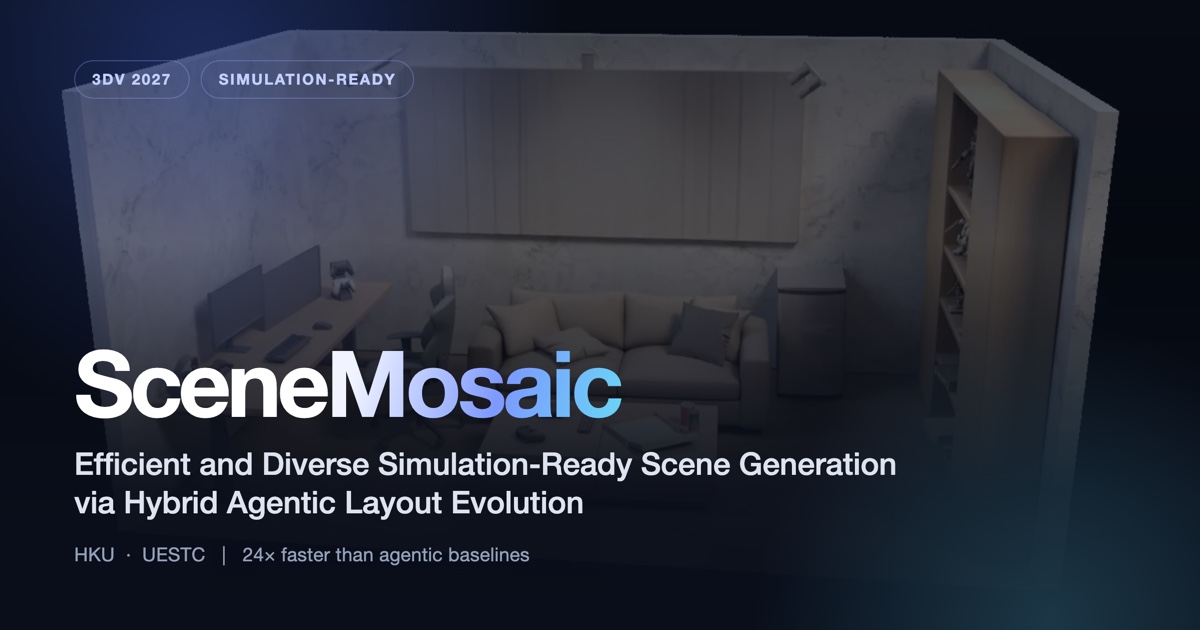
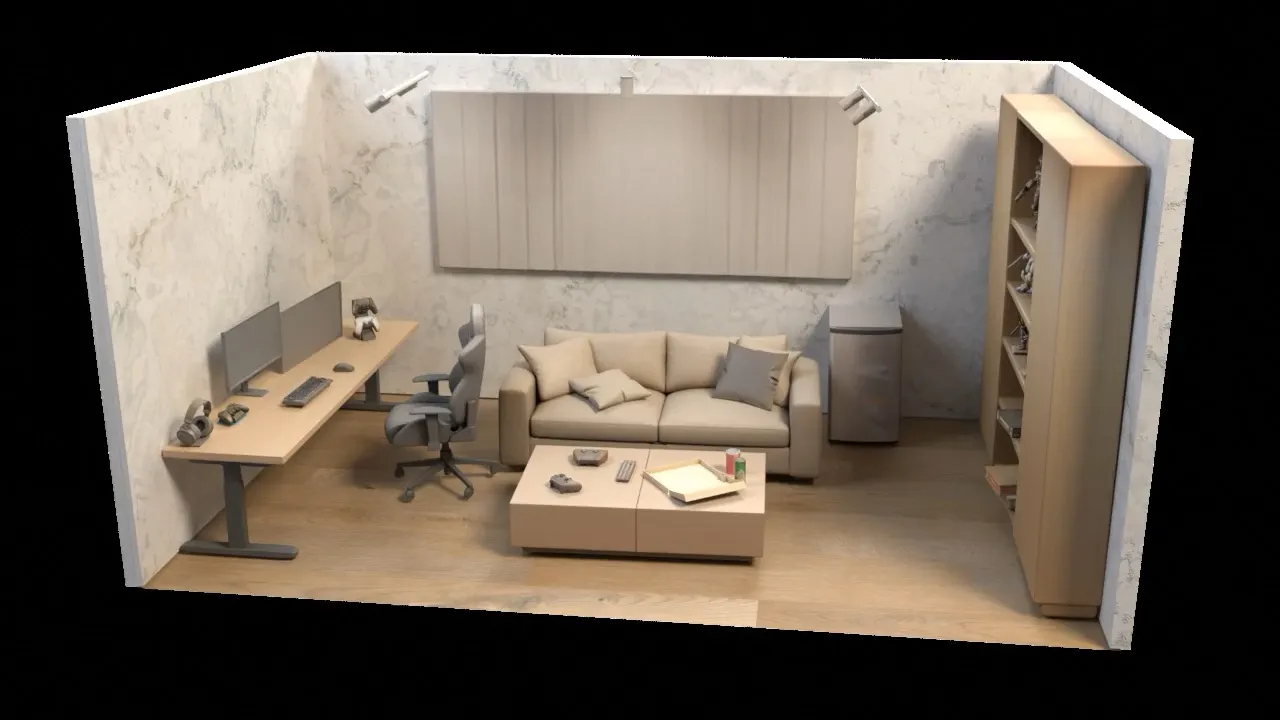
A team from the University of Hong Kong (HKU) and the University of Electronic Science and Technology of China (UESTC) has released the open SceneMosaic pipeline: from a single room photo, it assembles a simulation-ready 3D scene and layout variants in about 8 minutes, and the code is released under the MIT license.

What happened
The authors — Xinjian Zhan, Xiaoye Mo and colleagues, Bo Dai — published the project along with the preprint “Efficient and Diverse Simulation-Ready Scene Generation via Hybrid Agentic Layout Evolution.” The pipeline takes a room photo as input and outputs a 3D scene in .glb format suitable for placement in a simulator, along with a set of six valid layout variants. The project page lists the timings: the base scene is assembled on average in 8 minutes, and each additional variant takes approximately 2 minutes. The code is hosted in the rxjfighting/SceneMosaic repository on GitHub under the MIT license; the first commit with the pipeline is dated September 3, 2026, and at the time of publication the project has 38 stars.
Context
Generating simulation-ready environments involves a trade-off: agentic text-to-3D produces physically consistent scenes but requires hours of iterative work with tools, while fast image-to-3D methods produce floating, intersecting, and clipping objects. SceneMosaic solves this with a hybrid approach: for fast initialization, it uses ready-made visual modules — SAM3 segmentation and Meta’s SAM 3D Objects 3D reconstruction (connected as submodules with pinned commits), the MoGe depth model, and DINOv2. The scene is then decomposed into independent “local units,” each of which is physically stabilized — by gravity, with collision checking and container correction — and VLM agents in a Critic–Actor scheme correct semantics and physics based on orthographic projections. The authors’ novelty lies not in the modules themselves, but in this composition.
Why this matters for the industry
For the industry, this is a concrete mechanism-primitive for offline sim-data generation: fast image priors provide initialization speed, agentic correction provides semantics and physics, and local decomposition with Cartesian assembly makes diversity nearly free, because the combination of valid units inherits their validity. A family of valid environments becomes a cheap byproduct rather than a separate expensive procedure, providing a direct way to generate environments for robot training and to populate game engines. The MIT license makes the reference implementation a free baseline for everyone: for teams developing their own sim-data pipelines, this is a signal of a collapse in the cost of valid environments rather than months of development from scratch.
Why this matters for users
For readers working with embodied AI and robot learning, the project can already be cloned and run on their own GPU: pinned submodules provide a reproducible stack, and their own room photos are turned into simulation-ready .glb scenes in about 8 minutes for the base scene plus about 2 minutes for each additional variant. A separate value is the proven pattern of “independent unit stabilization plus Cartesian combination,” which can be transferred to their own data generation pipelines. However, there is no end-user product: this is neither an API nor a SaaS, but a research reference implementation.
What is still unknown / limitations
Scene validity is currently checked only by the pipeline’s own checks — collisions, gravity, and container correction — there is no external validator or accepted standard by which the “simulation-ready” status can be confirmed in available sources. Comparisons with baselines are absent: there are no tables, datasets, or quality metrics, only its own run times. The project is very new — the first commit with the pipeline is dated September 3, 2026 — and remains research-grade: there is no API, Docker wrapper, SLA, or documented hardware requirements, and the community is just beginning to notice it (38 stars).
Sources
- SceneMosaic project page (HKU + UESTC)
- GitHub repository rxjfighting/SceneMosaic — code, MIT license, SAM3 and SAM 3D Objects submodules
- Preprint “Efficient and Diverse Simulation-Ready Scene Generation via Hybrid Agentic Layout Evolution” (PDF)
Author
Look at AI, editorial team