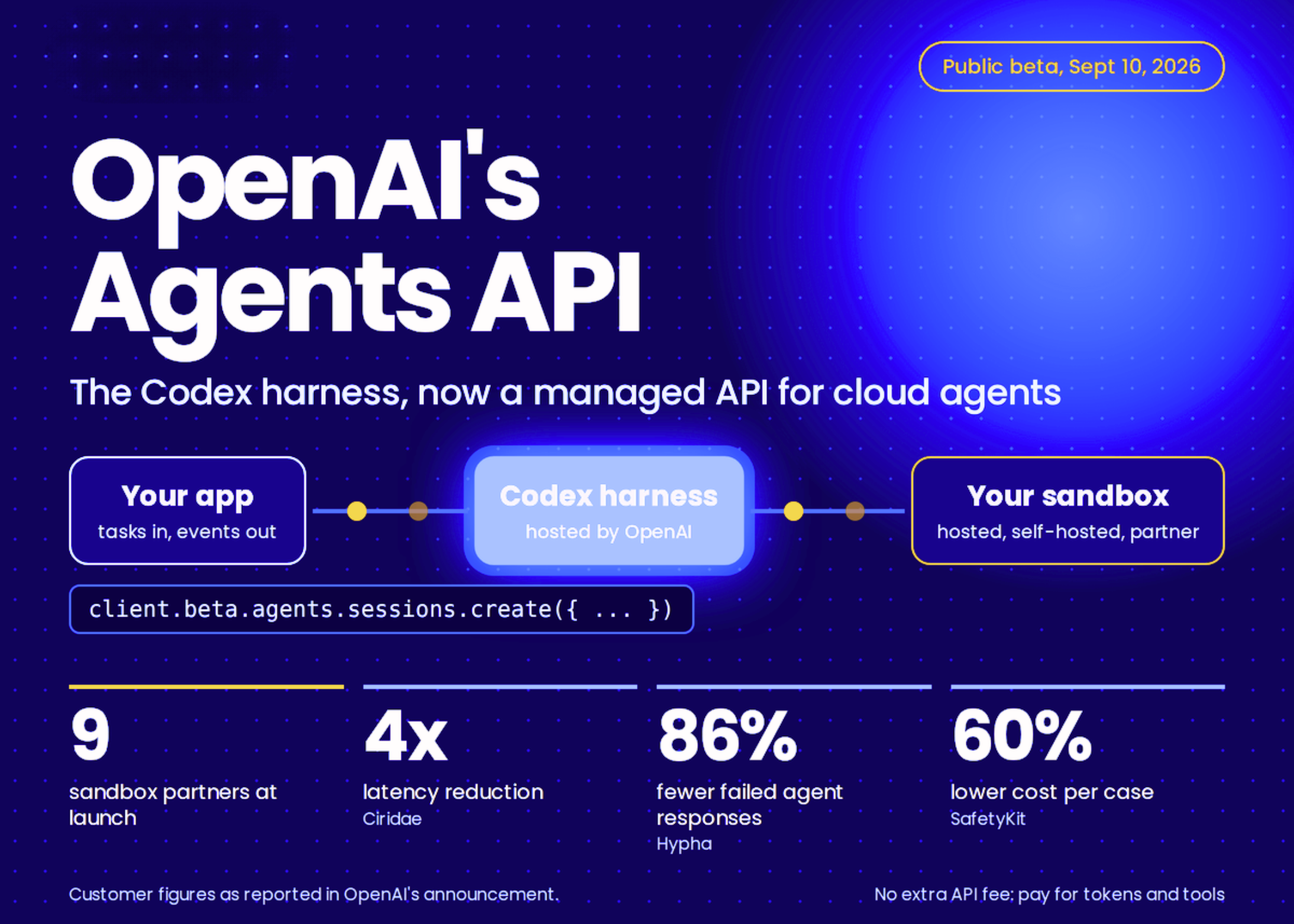
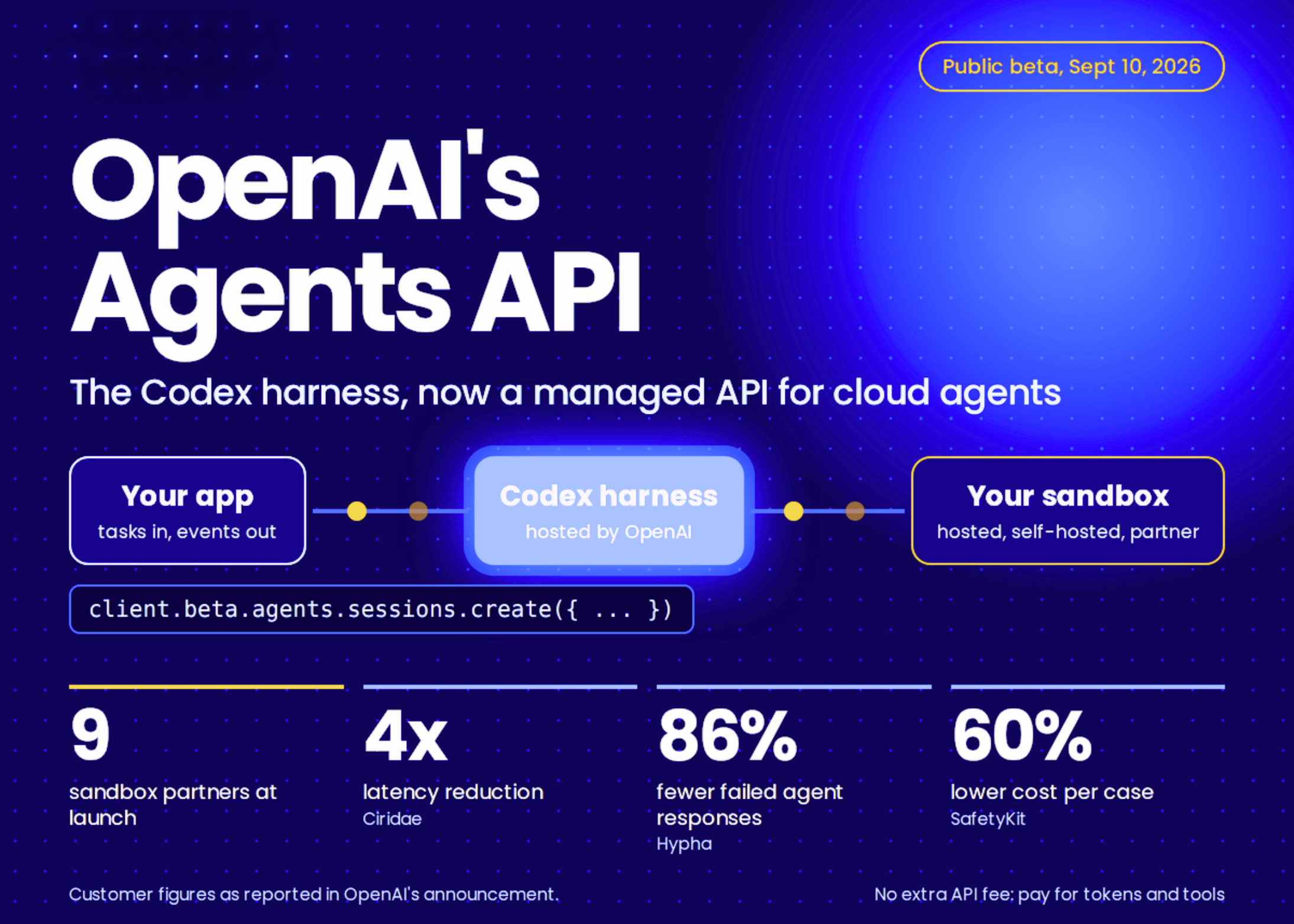
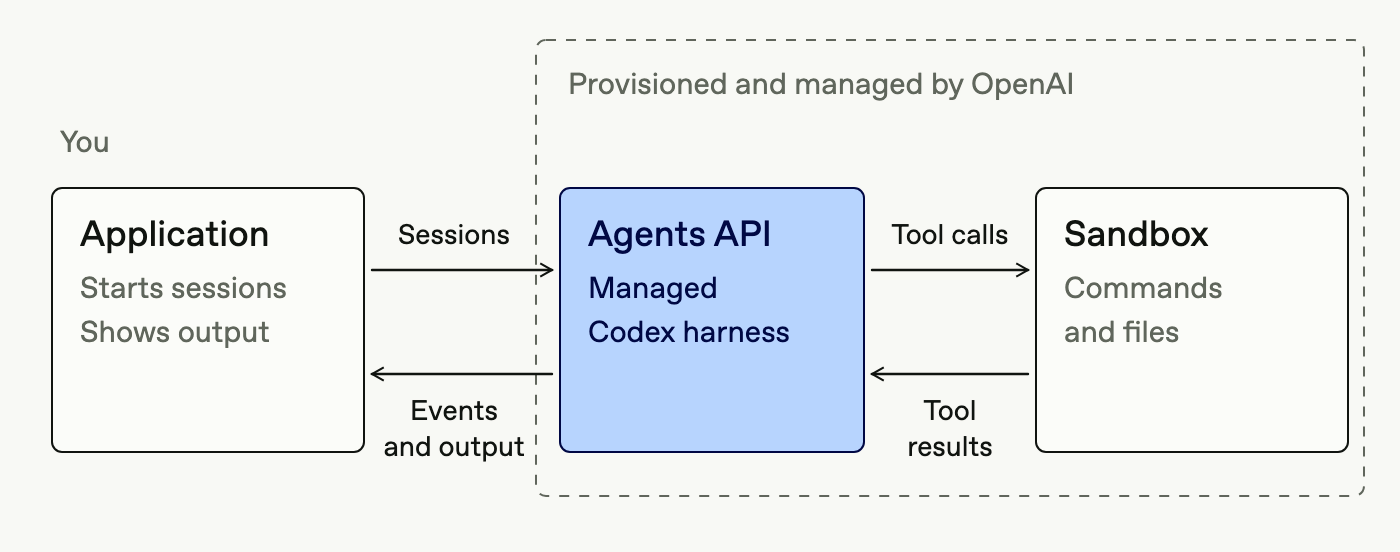
On September 10, 2026, OpenAI launched the public beta of the Agents API — a managed service that provides via API the harness (orchestration layer) powering Codex and ChatGPT for Work. An agent is created with a single call specifying the model, tools, and environment, while OpenAI handles sessions, orchestration, context compression, recovery, and delegation to subagents.
What happened
OpenAI launched the Agents API into public beta on September 10, 2026. It is a managed service: an agent is created with a single call specifying the model, tools, and environment. On OpenAI's side, sessions, orchestration, automatic compression of early context, recovery, and task delegation to subagents are handled. In the sandbox, the agent executes code, edits files, and connects to MCP servers. Compute can be kept in OpenAI's sandbox, self-hosted via codex exec-server, or in the environment of nine partners: Blaxel, Cloudflare, Daytona, DigitalOcean, E2B, Modal, Oracle, Runloop, and Vercel. There is no separate fee for the API: billing is based only on tokens and tool usage. Stated limitations: data is stored only in the US, and Zero Data Retention is not supported.
Context
The release does not introduce a new model, architecture, or training method, and no benchmarks have been published: the novelty here is product-based, not scientific. The orchestration layer — sessions, context compression, tool selection and execution, subagents — already worked inside OpenAI's products and is now exposed outside the application as a managed service. The technical essence, relevant for long sessions, lies in context management mechanisms: automatic compression of early context as the limit approaches, on-demand loading of tool descriptions, and programmatic tool calls in parallel, in chains, and with result filtering. The statement "the same harness as Codex and ChatGPT for Work" has not been confirmed by any paper, benchmark, or methodology as of the release. The promise to keep the harness in sync with model releases is convenient for the product but raises reproducibility concerns: agent behavior is tied to a moving target, and pinning harness versions in source code is not described.
Why this matters for the industry
OpenAI is turning the agent orchestration layer into a managed cloud service and directly competing with the "build your own agent framework" approach. The goal is long corporate agent sessions, where custom harnesses previously meant weeks of development and separate infrastructure contracts. For teams in the agent framework layer, this is direct pressure: launching an agent product no longer requires a custom harness, and a wave of migration of prototypes and some production workloads to the managed harness is expected. At the same time, the choice of environment — hosted, self-hosted via codex exec-server, or nine partner sandboxes — reduces lock-in to OpenAI's infrastructure. If the "agent with one call plus sandbox choice" pattern takes hold, the orchestration layer risks becoming a commodity service similar to managed databases: differentiation will shift to the tools, data, and business processes that developers bring themselves, and lock-in will increase — leaving someone else's harness will be more expensive than switching models.
Why this matters for users
Developers no longer need to write their own harness around an LLM: the public beta is available now, there is a quickstart and official documentation, a session with a sandbox can be launched with a single API call, and you only pay for tokens and tool usage. This is immediately applicable to prototypes and non-critical pipelines: product teams can check in a few days whether an agent session provides real value to the user and build a pilot for a specific client. When choosing, it is worth considering the limitations: data is stored only in the US, Zero Data Retention is not supported, and for some corporate scenarios these conditions block usage.
What is still unknown / limitations
The match of the harness with the Codex and ChatGPT for Work harness is claimed but not independently confirmed: no paper, benchmark, or methodology has been presented, and based on available data, this is a black box. The release does not bring a new model or new capability — it is packaging of an already proven layer. The public beta status means that there are no production guarantees yet, and the stated synchronization of the harness with model releases is a promise that will become verifiable later. Pinning harness versions in source code is not described, so reproducibility of agent behavior across releases is not guaranteed. Data residency only in the US and the absence of Zero Data Retention narrow the range of acceptable corporate scenarios.
Sources
- Introducing the Agents API — OpenAI
- Agents API Overview — OpenAI API (official documentation)
- OpenAI Launches the Agents API in Public Beta — MarkTechPost
Author
Look at AI, editorial team