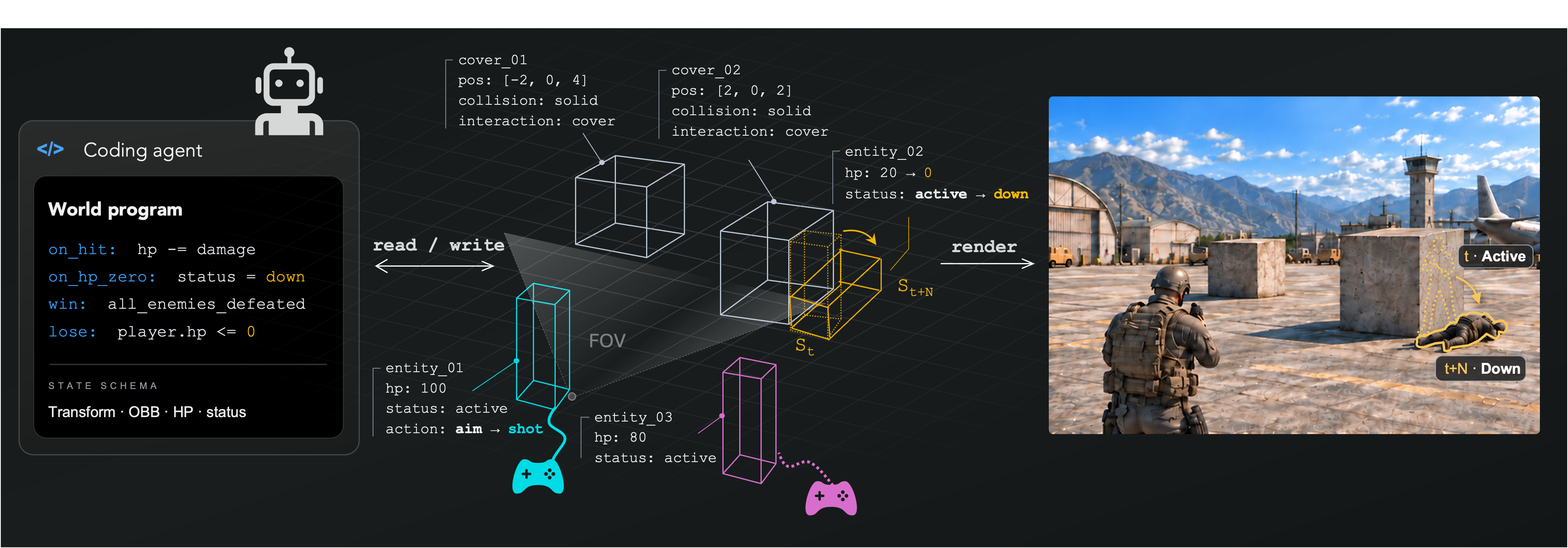
Alaya Lab published the technical report for Programmable World Model (PWM, arXiv:2609.10540, submitted September 9, 2026) and a project page. The framework separates the evolution of world state from the generation of video observations: the world exists as an explicit, programmable state, and the video model merely renders it.

What Happened
The report describes a three-part pipeline. An agent translates text instructions and a single reference frame into an executable program: entity states and their transition rules. A lightweight engine maintains an explicit global state, including objects that have left the frame and invisible attributes. A deterministic compiler projects the state, represented by oriented 3D OBBs (oriented bounding boxes) with attributes, into pixel-aligned control signals for a pretrained video model, which serves as the renderer in the system. Along with the report, playable scenes with defined mechanics were shown: entities persist after leaving the frame, events are irreversible, a single state controls any cameras and styles, and the demonstration ran for 897 frames without degradation.
Context
The approach grew out of a known weakness of generative world models, including the Genie, Cosmos, and Sora lines. In such systems, world memory is stored implicitly in the frame history: entities that leave the frame are effectively forgotten, and interaction rules cannot be explicitly defined. PWM proposes a different architecture in which state is stored as data and deterministically compiled into control signals, and video is generated from this state. At the time of publication, the repository contains only the project page and the PDF report, meaning the material is released as a report and demo, not as a finished product.
Why This Matters for the Industry
Separating state and rendering makes the world queryable, modifiable, and verifiable, opening a direct path to simulations, game mechanics, and learning environments where state reproducibility and verifiability are more important than frame plausibility. For developers, the pattern of "text plus one reference frame transitioning into an executable world program" sets a new UX template that can be borrowed into existing 3D and video stacks. Further down the chain, this is a claim to a shift in the value layer: if the "state — renderer" separation takes hold, the video model will become a replaceable renderer, and defensibility will shift to state engines, compilers, and world authoring tools.
Why This Matters for Users
The report can be read and the demo viewed right now: the PDF is on the project page, the demo is available as a video, and the full text is published on arXiv:2609.10540. It makes sense to watch the AlayaLab/PWM repository, because the roadmap expects inference code and pretrained weights as the next step. Until they appear, PWM cannot be deployed or reproduced: there is no code, weights, API, or latency data.
What Is Still Unknown / Limitations
The claim of a queryable, modifiable, and verifiable world is an architectural concept, not a proven property: the degree of verifiability is limited by the state representation itself, since oriented 3D OBBs with attributes are geometrically and semantically coarse, and the actual ceiling of the approach is not yet clear. The demonstrations are qualitatively convincing, but there is not a single quantitative metric in the available sources, no comparison with baseline world models, and no ablations showing the contribution of each component. The result cannot be reproduced: the roadmap at the time of publication only lists the project page and PDF report, with code and pretrained weights promised as the next step, so all claimed properties remain hypotheses for now.
Sources
- Programmable World Model — project page (Alaya Lab)
- Alaya Lab, Programmable World Model — technical report on arXiv:2609.10540
- GitHub — AlayaLab/PWM: repository, PDF report, roadmap
Author
Look at AI, editorial team