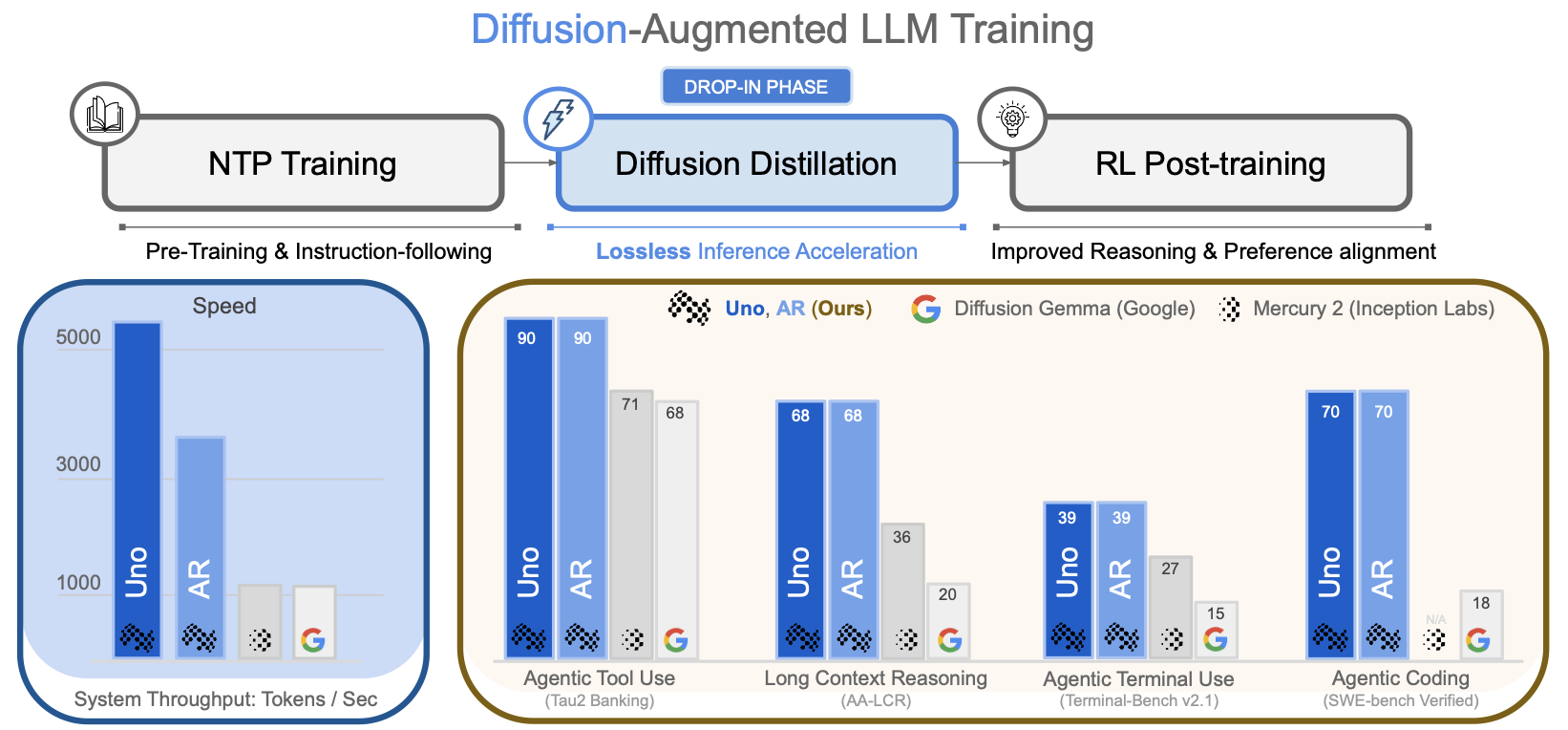
Institute of Foundation Models and Cerebras Systems introduced Uno — a family of diffusion-augmented LLMs that, according to the authors, accelerate inference by up to 3x without a separate draft model and without quality loss. Code and weights are open.
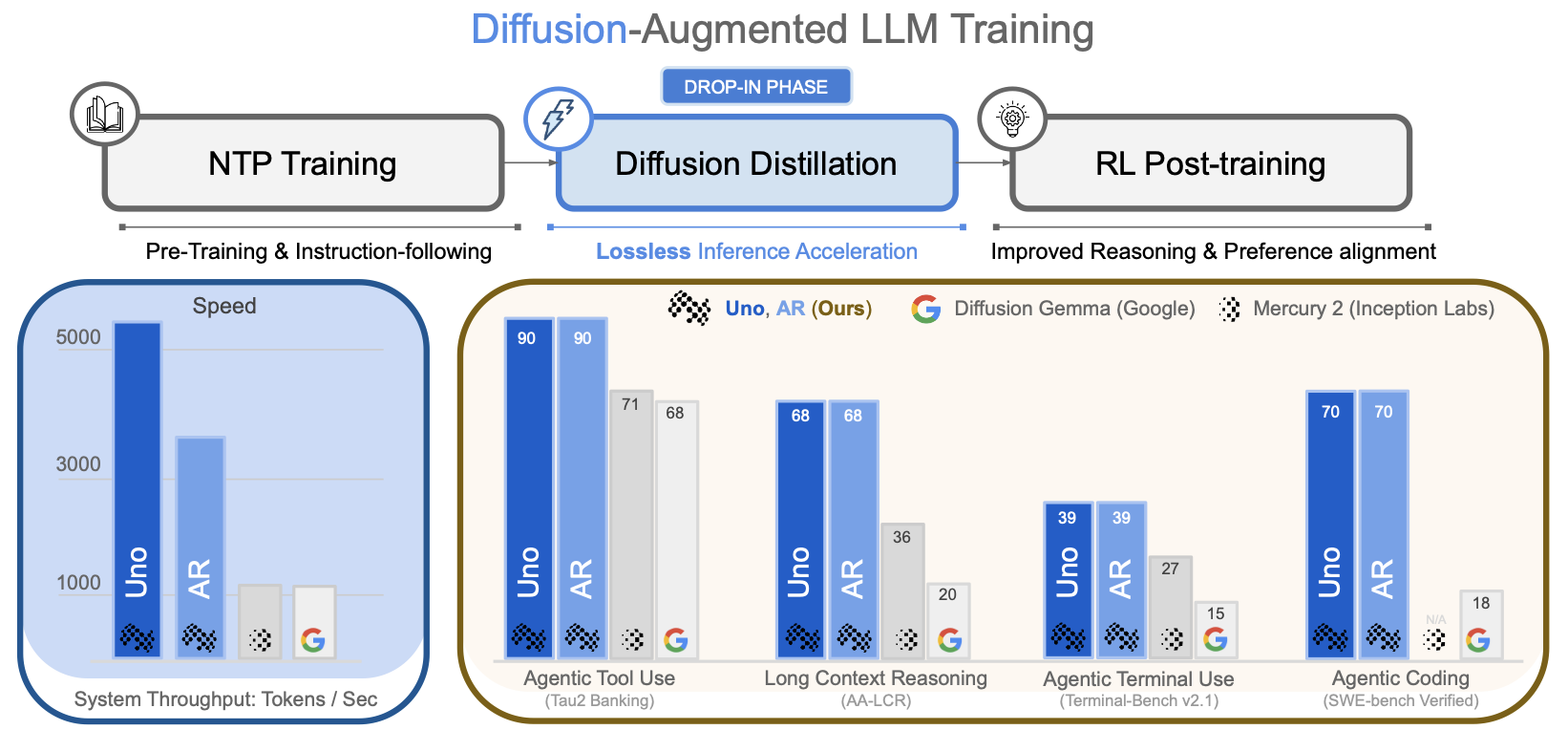

What happened
On September 3, 2026, a team from the Institute of Foundation Models (IFM) and Cerebras Systems, with co-authors from UIUC, Cornell Tech, and Harvard, published the paper Unlocking Lossless Speedups in LLMs via Discrete Diffusion (arXiv:2609.04010). It describes the Uno model — a diffusion-augmented LLM with two sets of weights: AR weights trained on standard next-token prediction and responsible for quality, and lightweight diffusion weights that predict multiple tokens in parallel. A family of samplers called Psi-Spec was developed for sampling, which, according to the authors, produces the same distribution as the base AR model but faster. Simultaneously, the code under the Apache-2.0 license (github.com/ifm-ai/uno) and weights were released: Uno 8B based on IFM/K2-Horizon-7B, Uno 1B based on IFM/K2-Horizon-0.9B, and Uno Qwen3 8B, available on Hugging Face without a token.
Context
Classic speculative decoding, which includes methods like DFlash and Eagle3, accelerates LLM inference using a separate small draft model: it proposes tokens, and a larger model verifies them. The main drawback of this approach is the need to keep a second model in memory and in the operational loop. Uno offers a different path: instead of an external draft model, speed is built into the architecture itself, and the lightweight diffusion part predicts blocks of tokens in parallel. An additional training stage, Diffusion Distillation, is added to the existing pipeline with negligible overhead. The involvement of Cerebras Systems suggests a possible connection of the method to hardware-oriented acceleration.
Why this matters for the industry
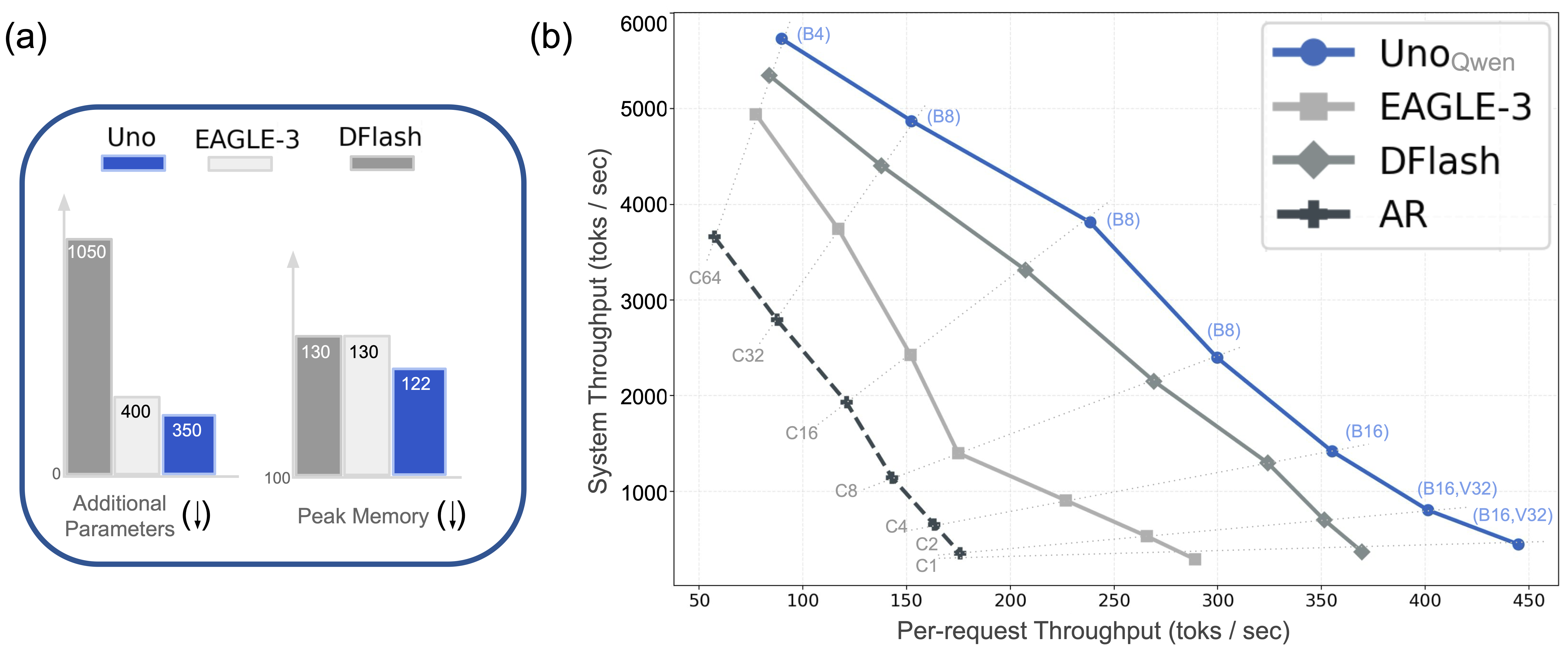
Uno establishes a new class of diffusion-augmented LLMs, where quality (AR weights) and speed (diffusion weights) are separated within a single model, and the structural drawback of speculative decoding in the form of a separate draft model with its memory and operational complexity disappears. The authors claim that the method outperforms DFlash and Eagle3 in throughput across all tested batch sizes with the fewest additional parameters and minimal memory consumption during inference. If independent reproduction confirms the claimed figures, Psi-Spec will become a real alternative to draft-model speculative decoding in open inference stacks: some teams will be able to replace DFlash and Eagle3 with it for less memory and simplicity, and integration into serving loops will reduce the cost per request.
Why this matters for users
For readers, this is a specific open implementation that can be reproduced right now: Uno 8B, Uno 1B, and Uno Qwen3 8B weights are on Hugging Face without a token, and inference code is open under Apache-2.0. An engineer can deploy inference.py with linear or tree sampling, measure TPF and TPS on their own hardware, and compare with DFlash and Eagle3 in the same stack. Today, this is a benchmarking tool: based on it, one can evaluate acceleration on their own workload and decide whether to switch from classic speculative decoding.
What is still unknown / limitations
All quantitative claims — up to 3x, throughput superiority over DFlash and Eagle3, as well as Uno 8B's win over 26B DiffusionGemma and proprietary Mercury 2 on benchmarks for agentic tool use, coding, and long-context reasoning — are data from the authors themselves. Available sources show no signs of independent verification of distribution equality and real speedups, no absolute latency figures (TPOT), hosted API, or support in major inference platforms. Until independent reproduction, this is a solid research artifact, not a production-ready solution.
Sources
- Unlocking Lossless Speedups in LLMs via Discrete Diffusion — project page (IFM + Cerebras)
- arXiv:2609.04010 — Unlocking Lossless Speedups in LLMs via Discrete Diffusion
- GitHub: ifm-ai/uno — inference, training, and evaluation code (Apache-2.0)
Author
Look at AI, editorial team