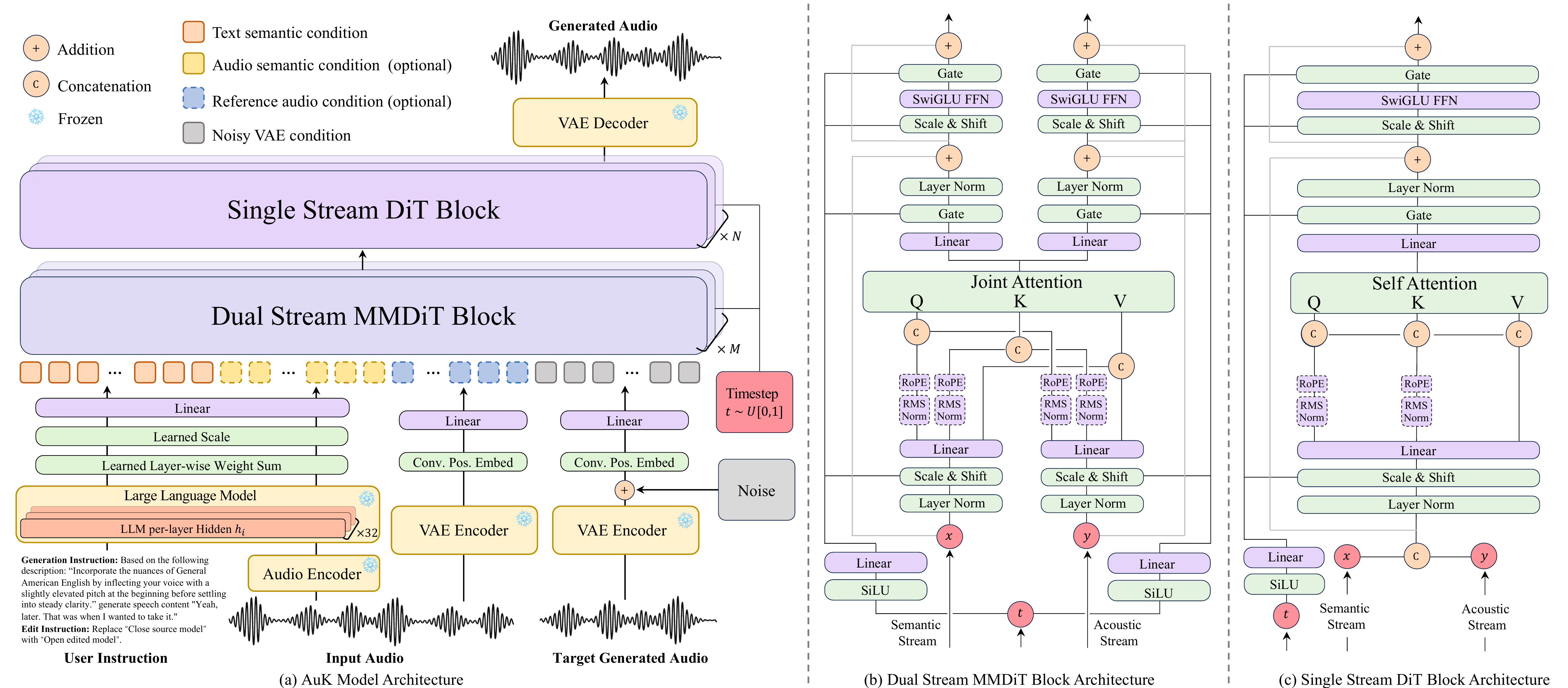
On September 9, 2026, Tencent (Hunyuan) open-sourced AuK, a 1.5B-parameter speech foundation model, under the MIT license. It combines speech synthesis, editing, cleaning, and separation into a single model controlled by natural language commands.


What Happened
The release includes the weights for tencent/AuK and tencent/AuK-Flash, the code, the technical report (arXiv:2609.08936), a Python API, ComfyUI nodes, and a fine-tuning pipeline, with support in SGLang-Omni appearing on the day of publication. Through a unified instruction interface, AuK performs zero-shot TTS and voice cloning from a reference, TTS based on descriptions without a reference (Instruct TTS), replaces, inserts, and deletes words in a finished recording, rewrites song lyrics while preserving the melody, adjusts pitch, speed, and volume, changes emotion and timbre, removes accents and unintelligible sounds, converts speech to a whisper, and also performs denoising, speaker separation, vocal extraction from a mix, and extracting a target speaker based on what they said. AuK-Flash was also released separately — a distilled version with 4-step inference without classifier-free guidance, accelerating output by 4.5x in wall-clock time. According to the technical report, instruction tuning was performed on approximately 3.03 billion instruction examples and 1.95 million hours of supervision.
Context
Speech synthesis and processing systems have typically been built as a set of separate task-specific models and closed APIs, with sound generation itself relying on autoregressive decoding of sequences. AuK uses a different scheme: a multimodal LLM encoder, Qwen2.5-Omni-3B, works in conjunction with an audio VAE trained on speech, general audio, and music, and a hybrid rectified-flow transformer, where two-stream MMDiT blocks come first, followed by single-stream DiT. Generation and editing are built on flow matching rather than autoregressive decoding, allowing a single model to work with both new sound and already recorded material.
Why This Matters for the Industry
AuK is one of the first fully open (MIT) speech foundation models, so it sets an open baseline against which larger closed systems can now be measured. Teams now have access not only to an API but to the core of voice functionality itself: the weights can be fine-tuned on their own corpora and voices, integrated into products via SGLang-Omni and ComfyUI, and differentiation shifts from speech synthesis to the level of workflows and voice agents. For the market, this is direct pressure on the prices of closed TTS providers: basic voice features become cheaper, turning into a commodity component, and the cost of prototyping drops to almost zero.
Why This Matters for Users
It can be tried immediately: demos are running on HuggingFace and ModelScope, the weights for tencent/AuK and tencent/AuK-Flash can be downloaded, and the model can be run locally via the Python API and ComfyUI nodes. Realistic first scenarios include voice cloning from a short reference, correcting individual words in a finished recording, denoising, and vocal extraction from a mix. Russian is not officially announced, but the multilingual Qwen2.5-Omni-3B encoder leaves a chance that it is also supported, and this is worth checking on your own data.
What Is Still Unknown / Limitations
The stated figures — the 4.5x wall-clock acceleration of AuK-Flash and the results on generation, editing, cleaning, and separation benchmarks — are taken from Tencent's technical report and require independent verification. How much the quality of AuK-Flash falls short of full inference after distillation is not disclosed in the open materials. They also lack real latency, throughput, and GPU requirement metrics, so for production the model remains at the PoC level, and the quality in Russian is not announced or confirmed.
Sources
Author
Look at AI, editorial team