DeepSeek released DeepSeek-V4.1-Flash on September 10, 2026 — the smallest model in the new architecture lineup with native image understanding. It is a 552B-parameter MoE with a Causal Encoder–Decoder architecture (8B active parameters on input and 16B on output) and up to 1M token context; the model is already available in the DeepSeek API as deepseek-flash, and starting September 14, requests for the previous flagship deepseek-v4-pro will also be routed to it.
What Happened
The model is already running in production: in the DeepSeek API it is available as the deepseek-flash endpoint with native multimodality and is rolling out to web and mobile clients. Previous separate modes — fast, expert with a reasoning budget, and image recognition — have been merged into a single model that determines request complexity on its own and enables vision when an image is received as input. Open weights have been published on Hugging Face as deepseek-ai/DeepSeek-V4.1-Flash along with a technical report. A new pricing structure has been in effect since September 10, 2026: the off-peak price is 2x lower than the peak price. The old endpoints deepseek-v4-flash and deepseek-v4-flash-vision-exp continue to work, temporarily routing to the new model, and starting at 04:00 UTC on September 14, 2026, all deepseek-v4-pro requests will also be routed to V4.1-Flash.
Context
The key technical novelty is the Causal Encoder–Decoder architecture with asymmetric active parameters: 8B on input versus 16B on output, meaning separate compute budgets for the input and output parts within the MoE, where the share of active parameters is only about 1.5–3% of the 552B total. Combined with a KV cache that takes 4x less HBM and 8x less SSD than the previous generation, this is a concrete engineering mechanism for reducing the cost of calls on long context. Native multimodality means that vision is not a separate mode: the model enables it on its own when it receives an image, and the openness of the weights and technical report allows third-party teams to independently verify the architectural claims.
Why This Matters for the Industry
DeepSeek is effectively pushing out its own flagship V4-Pro with the cheaper and faster V4.1-Flash, and the savings mechanism here is concrete: the extreme sparsity of the 552B MoE with 8B/16B active parameters plus the compressed KV cache directly reduce the cost of agentic calls on long context, and the off-peak rate 2x lower than peak reduces costs for agent workloads. The segment of "fast, cheap, multimodal" requests is being compressed into a single open model with 1M context: the cost of agentic calls with vision is falling, and the niche of teams selling "cheap inference" and manual routing between modes is being commoditized. For developers, the model is a ready-made cheap multimodal alternative to the GPT/Claude class in the niche of fast, cheap requests: support is already available in WorkBuddy/CodeBuddy and OpenCode, and the Causal Encoder–Decoder with a compressed KV cache is becoming a benchmark that other labs will test and likely copy.
Why This Matters for Users
You can switch to deepseek-flash in the DeepSeek API or web chat right now: a single model handles dialogue, analyzes images, and solves complex tasks without manual mode selection, and existing integrations with the old flash endpoints continue to work through automatic routing, so nothing should break. For self-hosting, there is a vLLM recipe: vllm 0.30.0 or newer is required, with an estimated minimum of about 614 GB VRAM according to vLLM, and a ready-made Docker image vllm/vllm-openai:deepseekv41-flash; combined with 1M context, this is an option for a local multimodal agent. The new pricing is already in effect: if workloads can be shifted to off-peak, their price is half of the peak price.
What Is Still Unknown / Limitations
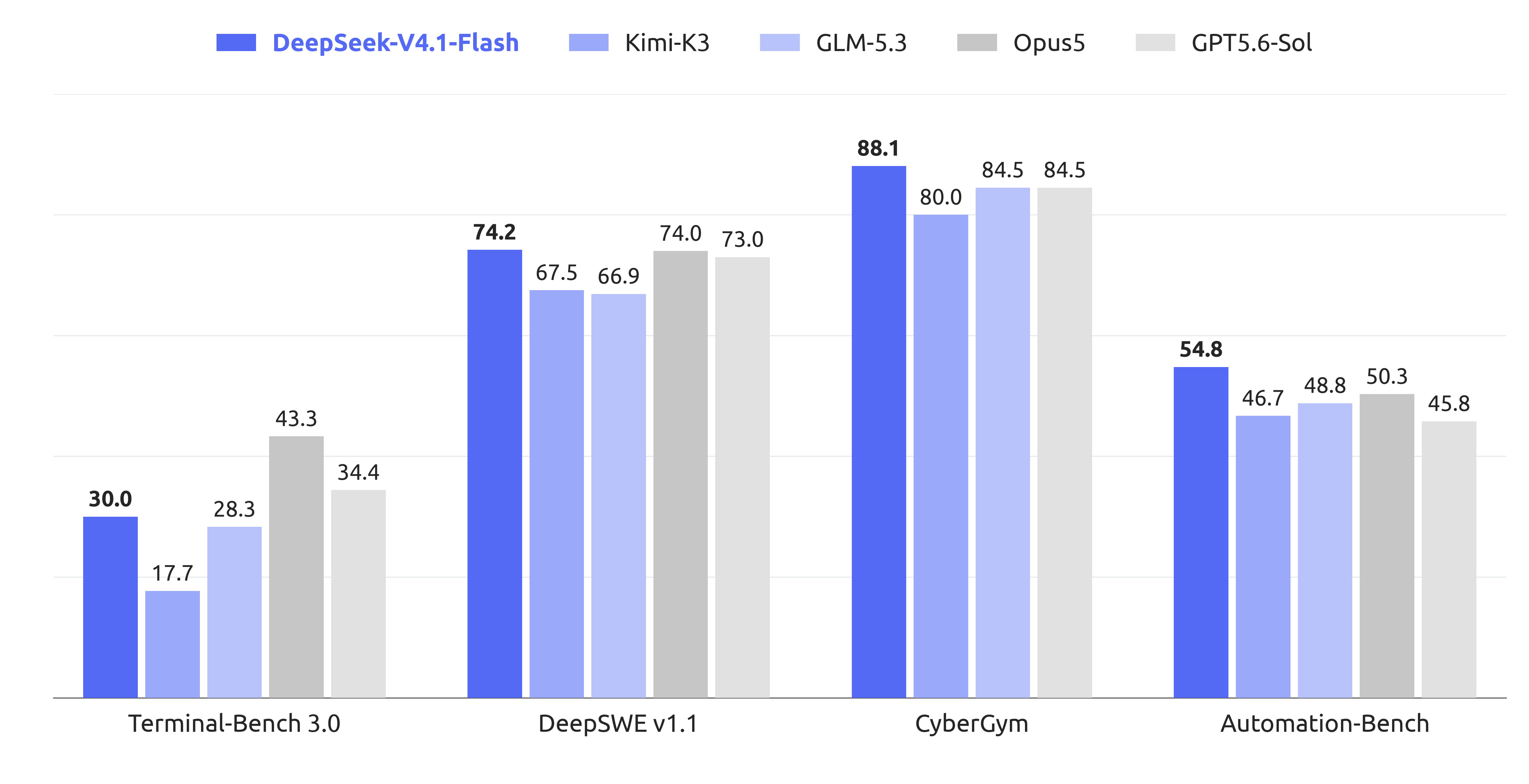
DeepSeek's claim that V4.1-Flash outperforms V4-Pro in quality, cost, speed, and total execution time has so far only been confirmed by the company's own materials, including the "DeepSeek-V4.1-Flash agentic benchmark comparison" chart from the news page: independent benchmarks are not yet available. The mechanism by which the model determines request complexity and switches between fast and expert modes is not described in detail in the published materials. The actual KV cache compression and cost reduction at real inference scales remain to be verified by third-party teams, relying on the open technical report.
Sources
- Official DeepSeek news page: Introducing DeepSeek-V4.1-Flash: smarter, faster, more efficient
- Model and technical report deepseek-ai/DeepSeek-V4.1-Flash on Hugging Face
- Deployment instructions for DeepSeek-V4.1-Flash on vLLM Recipes
Author
Look at AI, editorial team