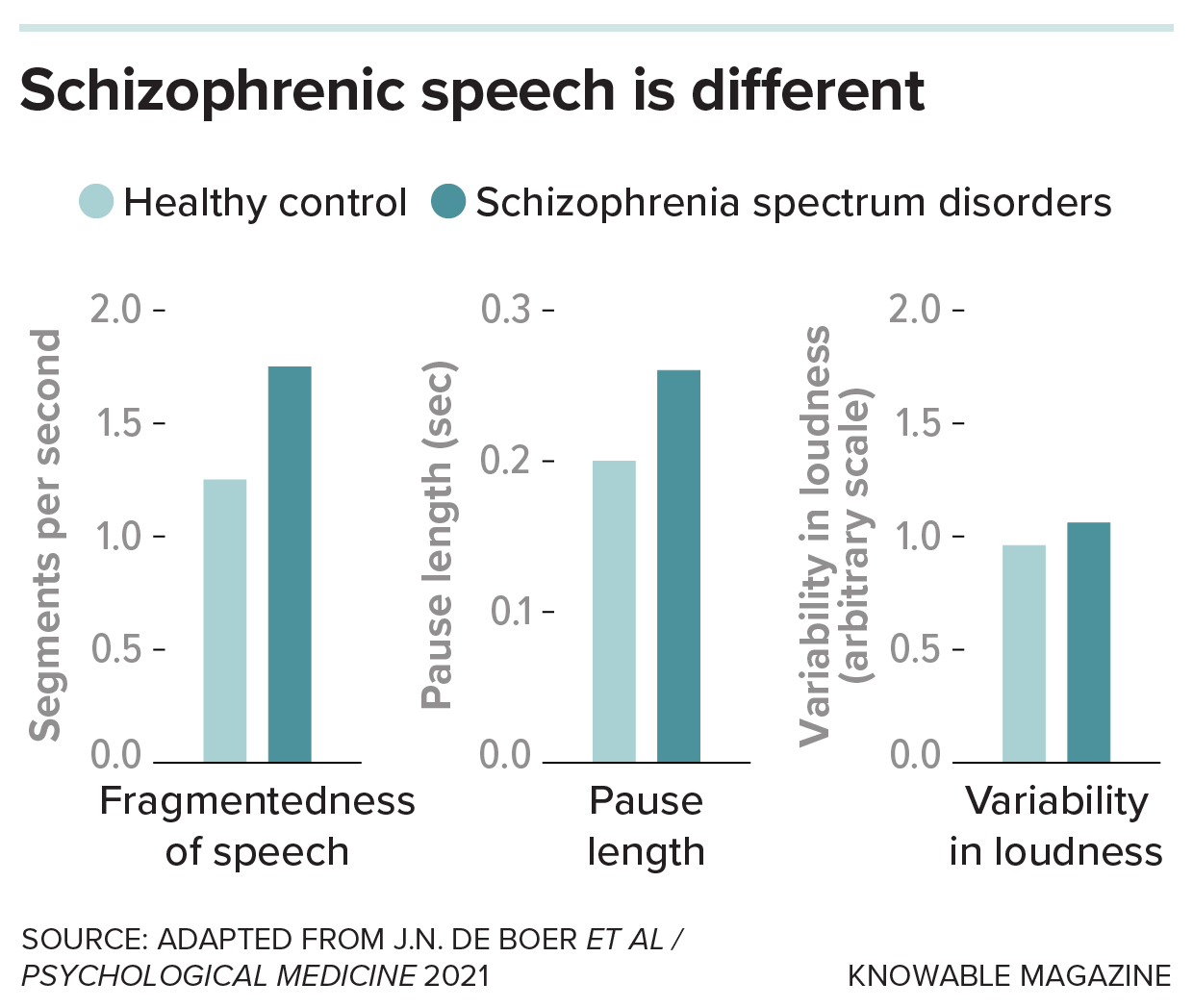
On September 9, 2026, Knowable Magazine, a publication of Annual Reviews, published a review article by Astrid Landon on how machine learning helps diagnose schizophrenia from speech. Two independent approaches — acoustic analysis and tracking semantic drift in transcripts — distinguished people with schizophrenia-spectrum disorders from healthy controls with an accuracy of about 86–87 percent, and speech is becoming a measurable signal for early diagnosis, although several years remain before clinical trials.

What happened
The Knowable Magazine article (DOI 10.1146/knowable-090926-1) examines two studies. A Dutch group (de Boer, Voppel and colleagues, Utrecht and Groningen) measured 88 acoustic speech features — loudness, pause length, vowel pronunciation, and intonation — in recordings of 142 patients with schizophrenia-spectrum disorders and 142 healthy controls, and a random forest classifier distinguished the groups with 86.2 percent accuracy and an AUC of 0.92. A separate approach by Sunny Tang at the Feinstein Institutes builds vector “addresses” for words in transcripts and tracks the drift of meaning; it showed 87 percent accuracy compared with 68 percent for clinicians working without AI.
Context
The problem these results address is described in the article itself: in the US, a schizophrenia diagnosis is on average made 1.5 years after the first symptoms, and assessments by different psychiatrists for the same patients differ by 30–50 percent. The Knowable Magazine publication is not a new study but a synthesis of already published work: the acoustic model was published in 2021 in the journal Psychological Medicine (volume 53, issue 4, pages 1302–1312, DOI 10.1017/S0033291721002804), and Tang's text-based approach is described in a separate study. The authors also refer to a 2026 review in Annual Review of Clinical Psychology.
Why this matters for the industry
For the industry, the material is useful primarily as a reproducible benchmark pattern: 88 standard acoustic features from eGeMAPS/OpenSMILE and a classic random forest without an LLM deliver measurable accuracy in a medical task, and leave-ten-out cross-validation makes the result verifiable. Public benchmarks — 86.2 percent and AUC 0.92 in acoustics, 87 versus 68 percent in semantics — can be used as a baseline and checklist for evals of future speech models in medicine. No commercial product, public API, or open dataset has been announced, so the direct value today is a signal for R&D roadmaps: speech biomarkers for mental disorders have moved from the concept stage to the stage of measurable accuracy.
Why this matters for users
For patients and readers, the practical takeaway is twofold. On the one hand, the model is positioned as a tool to assist the doctor, not replace them, and speech is beginning to be perceived as an objective biomarker that may help reduce diagnostic delay. On the other hand, a practical effect is still far off: Tang plans to bring his tool to clinical trials only by 2030, so in the coming years speech will not change the order of diagnosis. The note clearly shows that in medicine it is not only LLMs that work: here classic machine learning on audio and text with an open list of limitations is used.
What is still unknown / limitations
The figures of 86.2 and 87 percent were obtained in different studies, on different cohorts, and in different modalities; the article does not provide the result of a combined model. The comparison of 87 percent for Tang's model and 68 percent for clinicians was not necessarily conducted head-to-head on the same recordings, so this is not direct evidence of superiority. The acoustic study relies on a small balanced sample (n=284) and a binary task of “patient versus healthy control,” not on differential diagnosis with other psychiatric conditions; external validation and calibration are not discussed in the summary, which, with an AUC of 0.92, creates a risk of overestimating generalizability. According to the 2026 review in Annual Review of Clinical Psychology, small non-representative samples and confounders — age, second language, stress, medication — hinder the transfer of models from the laboratory to the clinic.
Sources
- Knowable Magazine — article “Listening for schizophrenia: How AI could help with early diagnosis” (Astrid Landon, 09.09.2026)
- Psychological Medicine — article “Acoustic speech markers for schizophrenia-spectrum disorders: a diagnostic and symptom-recognition tool” (de Boer, Voppel et al., 2021)
Author
Look at AI, editorial team