The OpenBMB team (Tsinghua NLP / ModelBest) has released MiniCPM5-2B — a dense 2B-parameter transformer with open weights. According to the model card, the model outperforms 4B-class competitors on average across 34 benchmarks and ranks first among open models under 4B in the Artificial Analysis Intelligence Index.


What Happened
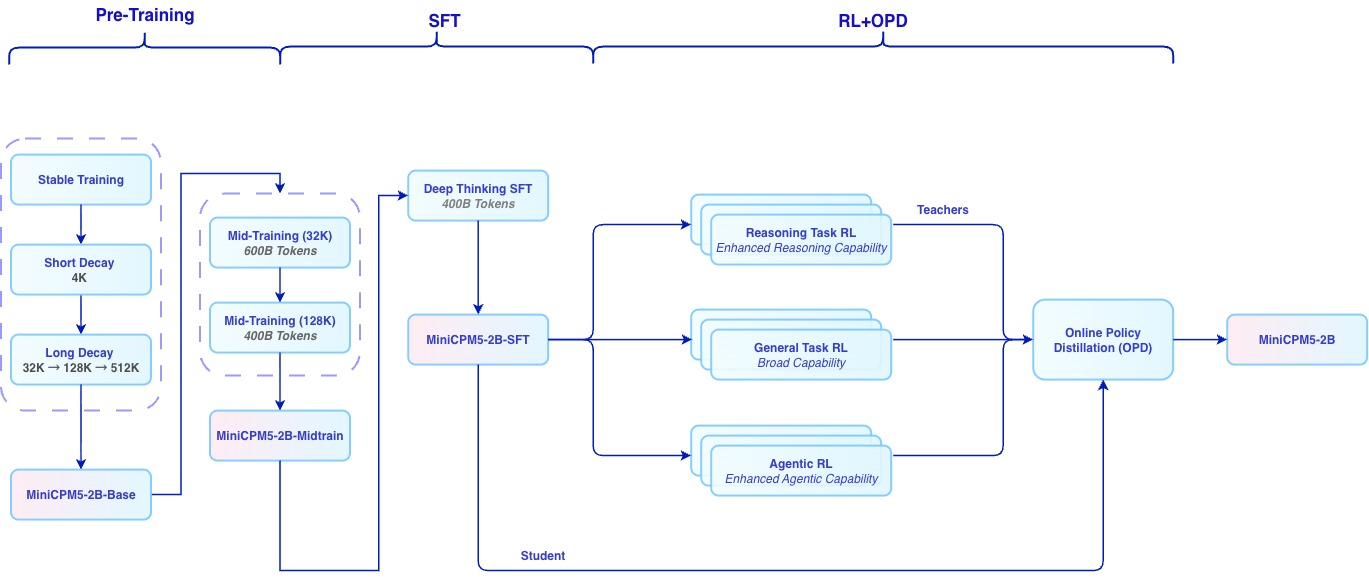
OpenBMB published MiniCPM5-2B — the second model in the MiniCPM5 series, following MiniCPM5-1B. The release is in BF16 with post-training built on RL and OPD (On-Policy Distillation, distilling RL teachers into the final model). The model uses the standard LlamaForCausalLM architecture, supports a native context of 131,072 tokens, and is distributed under the Apache-2.0 license. According to the model card, in a comparison across 34 benchmarks (code, math, long context, tool use, agentic tasks), MiniCPM5-2B outperforms all included participants, including 4B-class models, where the highest score among competitors is 51.1. It claims 86.5 on AIME 2025/2026, 69.1 on LiveCodeBench v6, 46.4 on SWE-bench Verified, 88.7 on GAIA Text-103, and 43.7 on LongBench v2. In the Artificial Analysis Intelligence Index, the model scored 23 on the Intelligence Index and 20 on the Agentic Index.
Context
The MiniCPM series from OpenBMB (a joint project of Tsinghua NLP and ModelBest) specializes in compact open models, and MiniCPM5-2B continues the line started by MiniCPM5-1B. The technical focus of the release is not on architecture — it is a standard dense transformer in the LlamaForCausalLM standard with no architectural novelty — but on the training recipe: SFT on 400B tokens, followed by RL and OPD, which transfers the effect of RL teachers to the compact final model. Unusually, the full set of UltraData training data, training recipes, and the RL stack were published alongside the weights: this level of openness is rare and distinguishes this release from typical weight-only releases. Against the backdrop of the market's general shift toward compact models for edge scenarios, the release intensifies competition in the 2B–4B class, where local and agentic products are gradually moving.
Why This Matters for the Industry
For the industry, the release sets a new benchmark for the quality-to-size ratio in the 2B class: a compact model with 4B-class agentic performance paves the way for on-device and edge deployment — local assistants, coding agents, and tool-use scenarios. The standard LlamaForCausalLM architecture means it can be loaded into mainstream inference engines without custom kernels, and the Apache-2.0 license removes licensing restrictions for commercial products. The open UltraData and training recipes lower the barrier to entry: teams get a reproducible baseline and a third path between fine-tuning someone else's model and a paid API — building their own edge model on an open base. If independent evaluations confirm the claimed figures, the published pipeline will become a reference point for reproducing edge models and trigger a wave of distillations and fine-tunings in the 1B–4B class.
Why This Matters for Users
Readers can already download the weights from Hugging Face (openbmb/MiniCPM5-2B) or ModelScope, try the model in the online demo openbmb/MiniCPM5-2B-Demo, and run it locally through any inference engine that supports the Llama architecture: BF16 weights are estimated to take up about 4 GB and fit on a single consumer graphics card. In practice, this is the opportunity to have a private assistant with a long context that works offline and does not send data to the cloud. The claimed level in code, math, and agentic tasks makes the model a candidate for piloting a local coding assistant, tool-use agent, or long-context RAG module — provided independent verification on their own tasks.
What Is Still Unknown / Limitations
All benchmark figures are taken from the vendor's model card: the evaluation protocol (pass@k, number of samples, prompts, seed) has not been disclosed, and there are no independent confirmations yet. The claim of first place in the Artificial Analysis Intelligence Index relies on a third-party provider's leaderboard, cited via the card without a link to a separate independent measurement. Details of the OPD method are presented only in a training recipe image — without formalization or ablations. There is no data on latency, throughput, or production serving costs, so capacity planning is not yet possible. Finally, 46.4 on SWE-bench Verified is a strong prototypical level, not a confirmed autonomous capability: the status of a full-fledged coding agent has not yet been proven, and no source calls the model the first open 2B model of its kind.
Sources
- openbmb/MiniCPM5-2B — official model card (Hugging Face)
- OpenBMB/MiniCPM — official GitHub repository
- MiniCPM5-2B — ModelScope (OpenBMB)
Author
Look at AI, editorial team