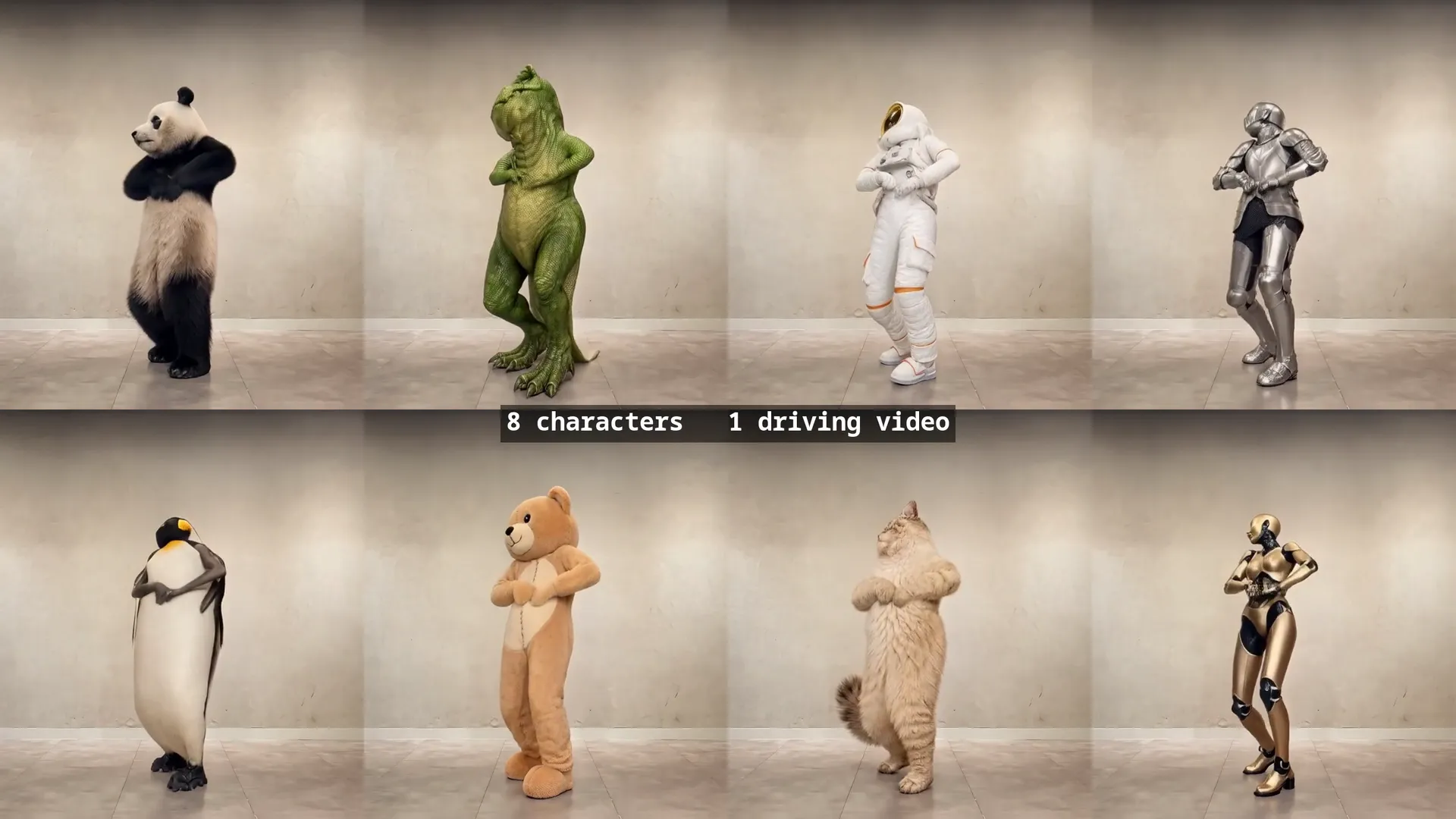
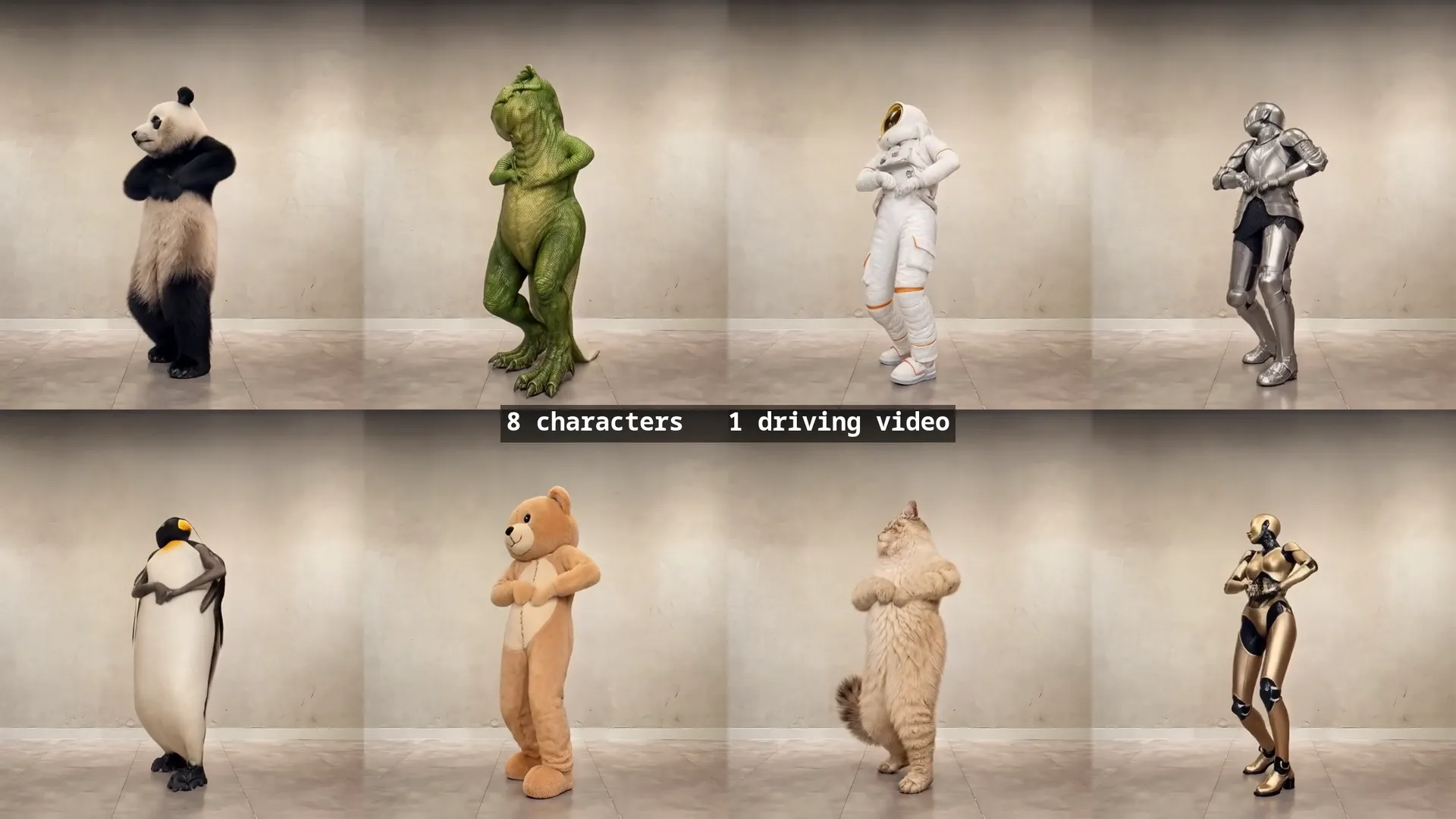
Viggle has released Viggle-Animate — an open model for replacing a character in a finished video: all you need is the original clip and one of its frames, repainted with a new character. The model is a full fine-tune of the 33.1-billion parameter MiniMax H3 video transformer, distilled via DMD down to three sampling passes, and in the company's test, 124 frames are rendered in 26 seconds on a single NVIDIA B200.
What Happened
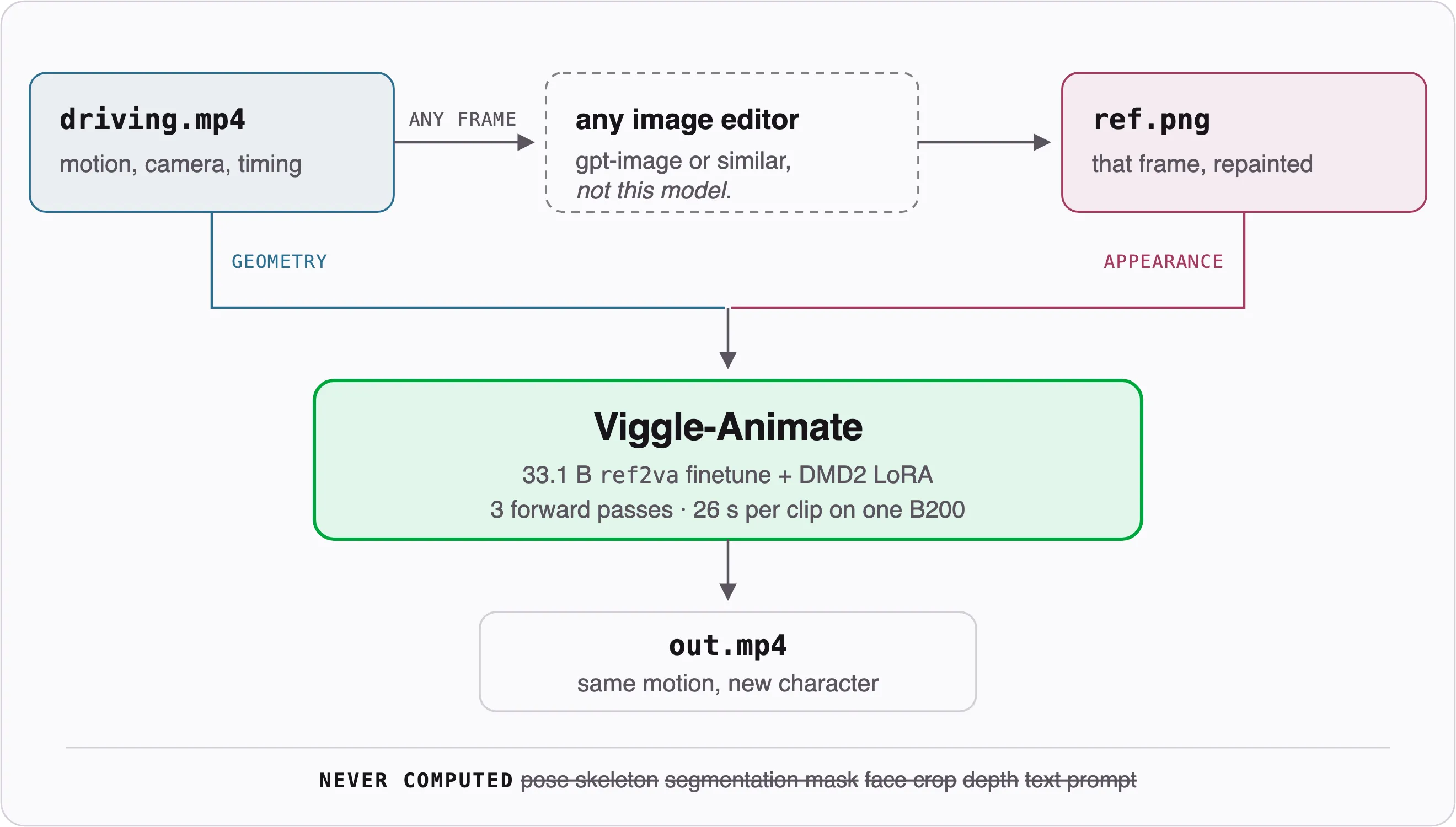
The weights are published on Hugging Face in the Viggle/Viggle-Animate repository, and a browser-based demo page has been launched in parallel. There are exactly two inputs: the original clip and one of its frames where the character has been replaced; masks, pose skeletons, face tracking, and text prompts are not needed. According to the company's own measurements, a 124-frame clip (24 fps, 480x832 resolution) is rendered in 26 seconds on a single NVIDIA B200, which is 6.1 times faster than Wan2.2-Animate-14B, which showed 160 seconds on the same hardware. The official description lists the weaknesses: lip-sync is lacking in close-ups, quality degrades in scenes with multiple characters and at editing cuts, and the original audio track is not preserved in the result.
Context
Character replacement in video has historically been built from a chain of separate models: a pose estimator, character segmentation, face tracking, and a text encoder, plus long sampling passes, usually around 30. Viggle-Animate reduces this pipeline to a single fine-tune of the base MiniMax H3 video transformer (reference ref2va) with 33.1 billion parameters: the model takes the motion geometry from the original clip, and the character's appearance from the single repainted frame. Distillation via DMD reduces sampling from a typical ~30 to three passes, which provides the claimed speed. Essentially, this is an engineering simplification of the pipeline, not a new class of architecture.
Why This Matters for the Industry
For video platforms, the model removes the entire chain of auxiliary models and orchestration from the pipeline: character replacement can be run with a single inference call on a single GPU, which significantly reduces the cost per frame. The publication of the weights for the 33.1B model trained on MiniMax H3 shows that large video diffusion models are being brought to narrow applied tasks through open fine-tuning, not just through closed APIs. Teams with B200/H200 and a niche scenario — one character, controlled scenes, short clips — can pilot Viggle-Animate right now, and researchers get an open base for further training for their own solutions.
Why This Matters for Users
Replacing an actor in a finished clip with a stylized character can now be done locally: through the browser demo or your own weights, you just need to provide two inputs — the video and one repainted frame — without masks or tracking. The price: full bf16 mode requires a GPU with approximately 96 GB of video memory, offloading to ~12 GB allows running the model on more accessible cards, but slower. Commercial use is subject to the MiniMax H3 Community License terms, and replacing a real person in a frame requires their consent.
What Is Still Unknown / Limitations
All speed figures are provided by the company on NVIDIA B200 and have not been independently reproduced. There is no scientific paper, quality metrics (FVD, FID, CLIP similarity, human eval), or comparison with Wan2.2-Animate-14B in terms of quality, not just speed; exact figures for offload mode are not disclosed, so the model's fit on 80-gigabyte cards like A100/H100 is not yet confirmed. Independent quality assessments on typical content beyond the demonstration scenarios are absent.
Sources
Author
Look at AI, editorial team