On September 4, 2026, Anthropic announced the first fully machine-checked proof of Fermat's Last Theorem. An internal Claude research model, comparable to Claude Fable 5.1, formalized the theorem in Lean nearly autonomously for 11 days, and an independent kernel exhaustively checked the result of 13 million lines of Lean 4 code. This is not new mathematics, but the first case where an LLM agent pipeline closed a multi-year community task of formalizing a famous theorem.
What happened
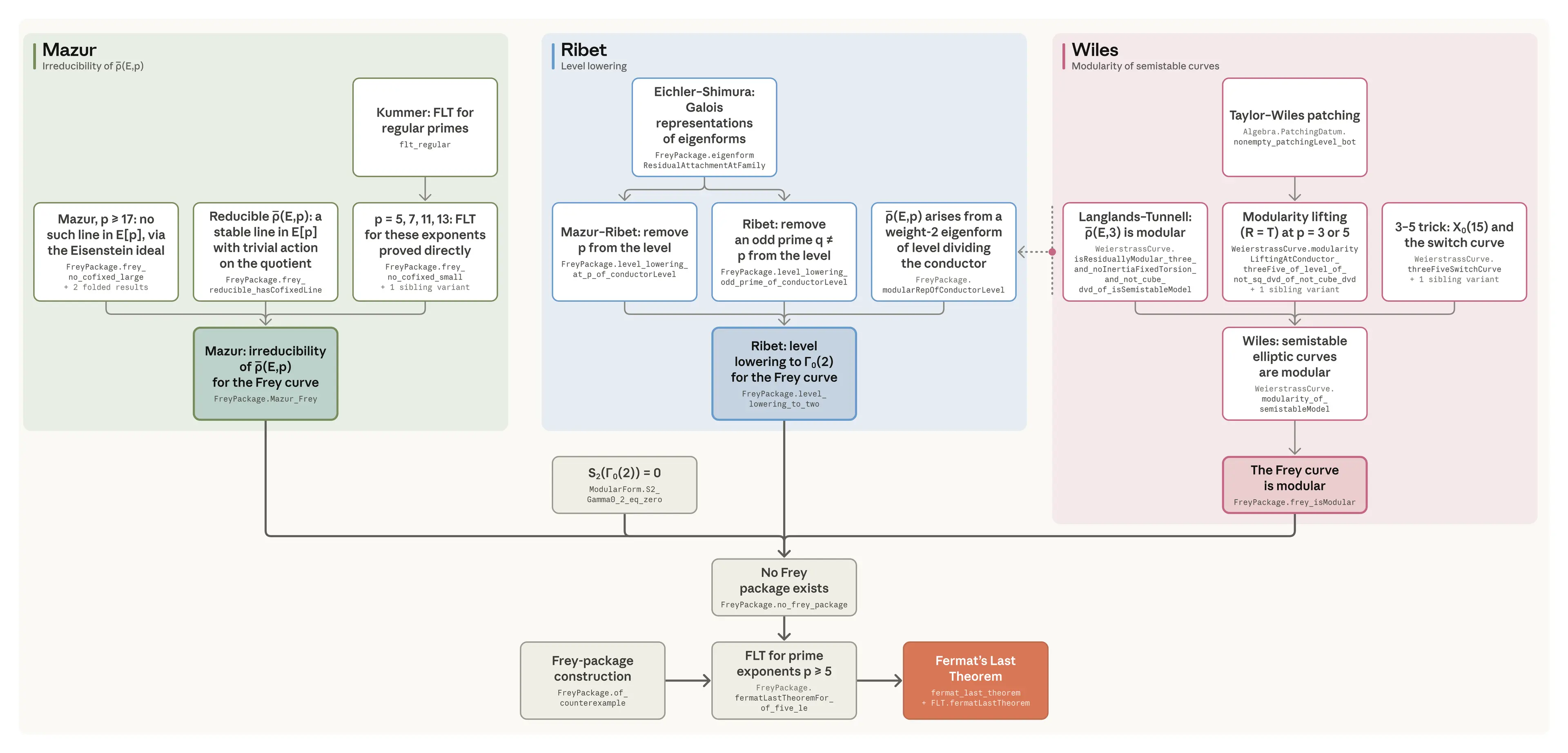
Anthropic presented the result on September 4, 2026. An internal Claude research model, comparable to Claude Fable 5.1, worked on formalization in the Lean assistant nearly autonomously for 11 days and consumed about 6 billion output tokens. The result is 13 million lines of Lean 4 code (Lean 4.33.1, Mathlib v4.33.0, built from source), which is more than 5 times the size of the Mathlib library; the final proof used 29,500 intermediate theorems out of 30,300 formalized. Verification is multi-level: building 60,475 modules from scratch, comparing the statement with Mathlib's own assertion via leanprover/comparator v4.33.0, and running it through an independent Lean kernel written in Rust (nanoda 0.4.13, 1,052,234 declarations). The proof relies only on three standard Lean axioms, including propext.
Context
The mathematical part of the proof is not new: the formalization follows a simplified version of the Frey-Serre-Ribet-Wiles-Taylor-Wiles argument and is transformed into a form that the Lean kernel checks exhaustively, meaning this is a machine check of a known argument, not a discovery. Lean is a proof assistant, and Mathlib is its standard mathematical library: a machine-checked proof in such a system means that every chain of steps is checked by a program, not a human. Formalizing Fermat's Last Theorem was a multi-year community task: it was launched in 2024 by Kevin Buzzard from Imperial College London as the ImperialCollegeLondon/FLT project, and it was perceived as purely human. After the publication of proofs, the community did not finish it within a year.
Why this matters for the industry
For the industry, the value is in the mechanism, not the theorem. The first complete machine-checked proof graph of FLT became a reference artifact: the checkpoint shifts from trust in the lab to trust in verification, and verifiability, not authorship, becomes the criterion for AI-generated proofs and code. An LLM agent pipeline closed in 11 days a task that the community did not finish in a year — this changes the economics of long agent tasks and dampens the moat of services selling manual formalization. The open repository is immediately available as a reference benchmark: for auditing and training pipelines, as an eval case for agents, and as an example of integrating machine checking of AI output into CI. In the coming months, repeated attempts by other labs on other major theorems, the first independent audits of the proof graph by the Mathlib community, and comparisons of the price-to-quality ratio of LLM formalization versus human teams are expected.
Why this matters for users
The proof can be studied and rechecked independently, without relying on the lab's word. The anthropics/fermats-last-theorem repository is open under the Apache 2.0 license (856 stars, 72 forks), contains the full Lean 4 code, a PROOF-PATH.md file, and an offline version in the html/ folder about 390 MB in size, where you can read all 29,511 theorems with a dependency graph. A full rebuild from scratch takes about 5 hours and 32 minutes on 96 threads, and the final check is done by an independent kernel. For the reader, this is a public example that LLMs can close in one long autonomous cycle — 11 days and about 6 billion tokens — a task that humans did not finish, and anyone can check the result.
What is still unknown / limitations
This is a research demonstration, not a product: API, pricing, and latency data have not been announced, the model is internal and not available, so the generative part cannot be independently reproduced. There is no peer-reviewed description and no public agent harness, and the statement of near-autonomy does not disclose the extent of human involvement, so the claim about the model's capabilities currently relies on a single demonstration. The sources also have a small internal discrepancy: the summary says 29,500 used theorems out of 30,300 formalized, and the offline HTML version says 29,511 theorems; this does not affect the correctness of the kernel check, but it is worth requesting clarification before citing the numbers.
Sources
- Formalizing Fermat's Last Theorem — Anthropic (official article, September 4, 2026)
- anthropics/fermats-last-theorem — machine-checked proof in Lean 4, Apache 2.0
- Hacker News: Claude formalized Fermat's Last Theorem in 11 days (discussion)
Author
Look at AI, editorial team