
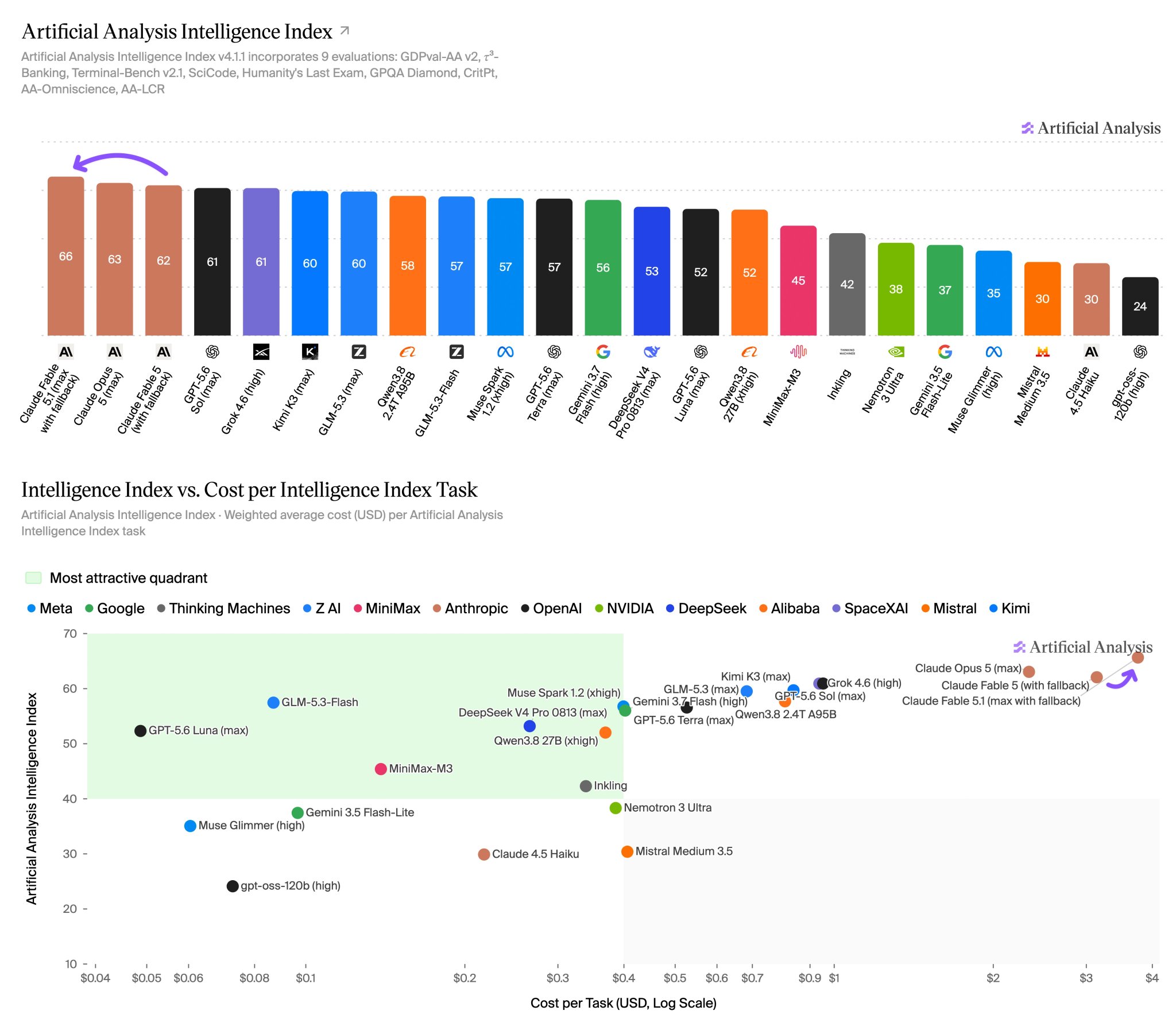
Anthropic released Claude Fable 5.1 on September 1, 2026, and on the same day, Artificial Analysis published the first independent evaluation of the model. At the maximum effort level (max effort), Fable 5.1 scored 66 points on the Intelligence Index — the highest result ever measured, 4 points higher than the previous Claude Fable 5 and higher than Claude Opus 5 (63) and GPT-5.6 Sol (61). The record did not come for free: the cost of a solved task increased by 20% because the model uses significantly more output tokens, and the final economics now depend decisively on the chosen effort level.

What happened
Fable 5.1 set new best measured values on three benchmarks: 59.1% on Humanity's Last Exam, 91.4% on Terminal-Bench v2.1, and 62.0% on SciCode. The price increase was the result of a specific mechanism: at the max effort level, the model uses approximately 1.7 times more output tokens at $50 per 1M, so the cost per task rose from $3.14 for Claude Fable 5 to $3.76. This was partially offset by a 75% reduction in cache read pricing, from $1.00 to $0.25 per 1M tokens, which saved about $1.40 per task; without this discount, the cost would have been approximately $5.16. The model can be connected now: claude-fable-5-1 is available in the Claude API, Amazon Bedrock, Google Cloud, and Microsoft Foundry.
Context
Understanding the new economics is helped by the spread between effort levels: low and max use 13.1M and 143.7M tokens, respectively, a difference of 11 times, with a score difference of only 58 to 66. The record was achieved at the most expensive point on the "quality per inference compute" curve, and it is at this level that all leading values were measured. The pricing structure, however, did not change: 1M token context, $10 input and $50 output per 1M, as with Fable 5; the shift occurred in the cache, and Anthropic effectively moved the economics in favor of caching long context. This is a structural signal for agentic systems that rely on repeated requests with a large immutable prefix.
Why this matters for the industry
Intelligence is now being bought in effort levels, and this is more important than the record itself. The xhigh mode provides 65 points for $2.72 per task, meaning almost flagship return at 28% less than max; for product builders, this means that the winner is not the one who chose the best model, but the one who found a working point on the "quality per inference compute" curve. Pipelines running on max effort automatically become more expensive, and unit economics will have to be explicitly recalculated. An aggregated index without cost normalization can distort the picture of leadership, so if the trend continues, independent rankings will have to publish results tied to the effort level and cost per task. The expected ecosystem response is effort levels as an explicit routing knob in orchestrators and cost-per-task as a primary comparison metric alongside scores; this is currently an interpretation, not an established fact.
Why this matters for users
If you are choosing a model for agents and long tasks, Fable 5.1 is currently the strongest default option, but check the effort level. The practically advantageous configuration is xhigh: 65 points for $2.72 per task versus 62 points for $3.14 for the previous flagship, meaning higher quality and lower costs. Repeated requests with a large cacheable context have become significantly cheaper: scenarios with a long immutable prefix, where cache reads dominate the bill, benefit the most. The model is available in four clouds, so the first check can be done immediately: reproduce the evaluation on your tasks and explicitly fix the effort level in the orchestrator config, not relying on the default.
What is still unknown / limitations
The difference between 65 and 66 points was obtained on an aggregated index without confidence intervals and domain breakdown, so on a specific task, the gap between effort levels could be zero or large. The evaluation methodology is not fully disclosed: the number of repetitions, prompt templates, and the rule for choosing the effort level are not described in the publication, and a correct comparison with other vendors requires fixing the effort level. The observation that intelligence gains are bought with thinking tokens was made on a single model, so extrapolations to future releases and competitors remain assumptions.
Sources
- Claude Fable 5.1 Tops Artificial Analysis Intelligence Index
- Claude Fable 5.1 - Claude Platform Docs
- Claude Fable 5.1 tops Artificial Analysis Index but costs 20% more | Hacker News
Author
Look at AI, editorial team