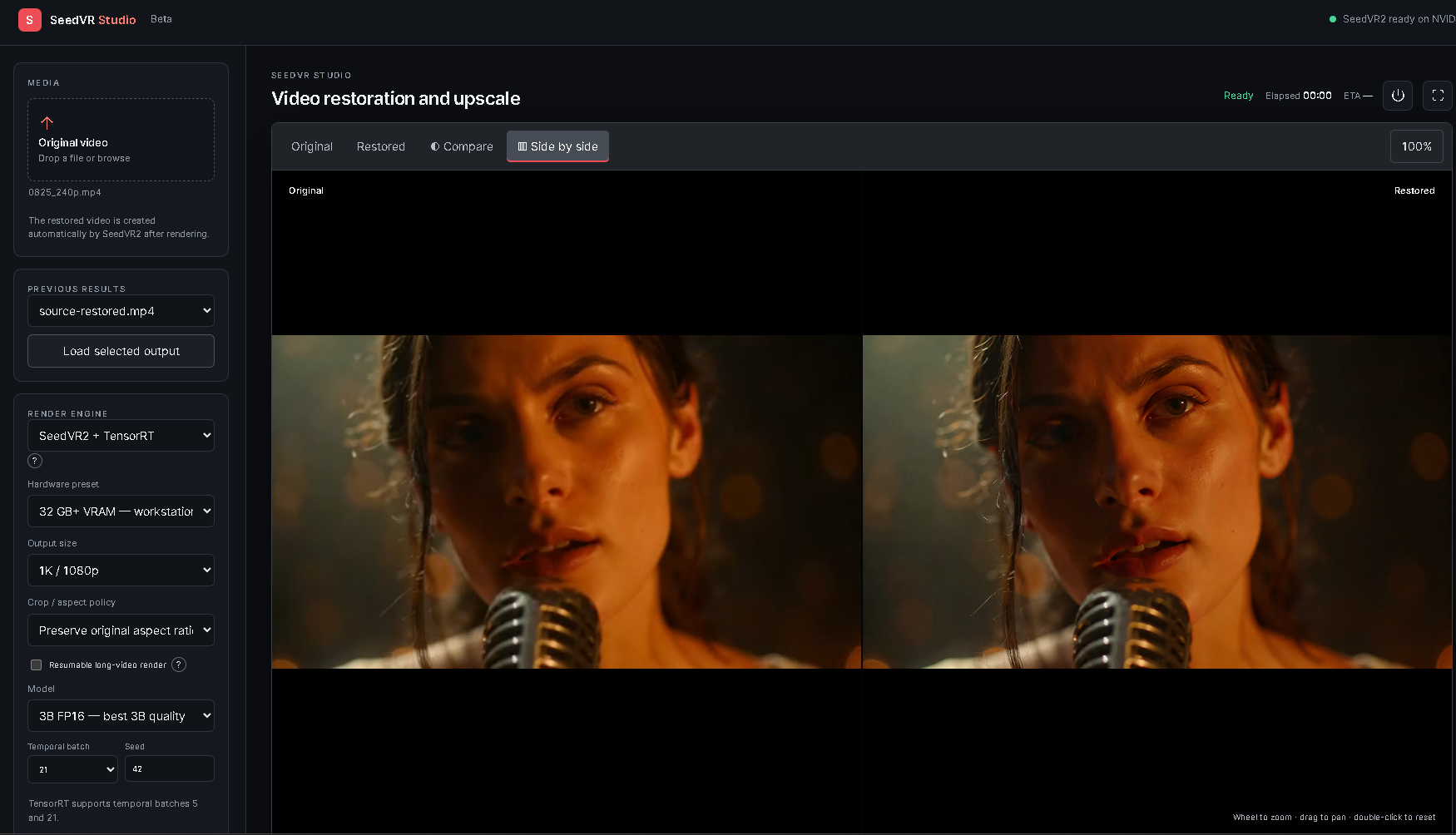
VRGDG SeedVR2 TensorRT Studio has been released — an open-source local tool that turns the research SeedVR2 pipeline into a video restoration and upscaling studio with a graphical interface for Windows 11 and TensorRT acceleration on NVIDIA RTX cards. The vrgamegirl19 repository appeared on GitHub on August 26, 2026, and has already collected 81 stars; installation is reduced to two .bat files, and the stated performance target is an 8-second 360p→2K clip in about 8 minutes on an RTX 5090 with the 7B Sharp FP16 model.
What happened
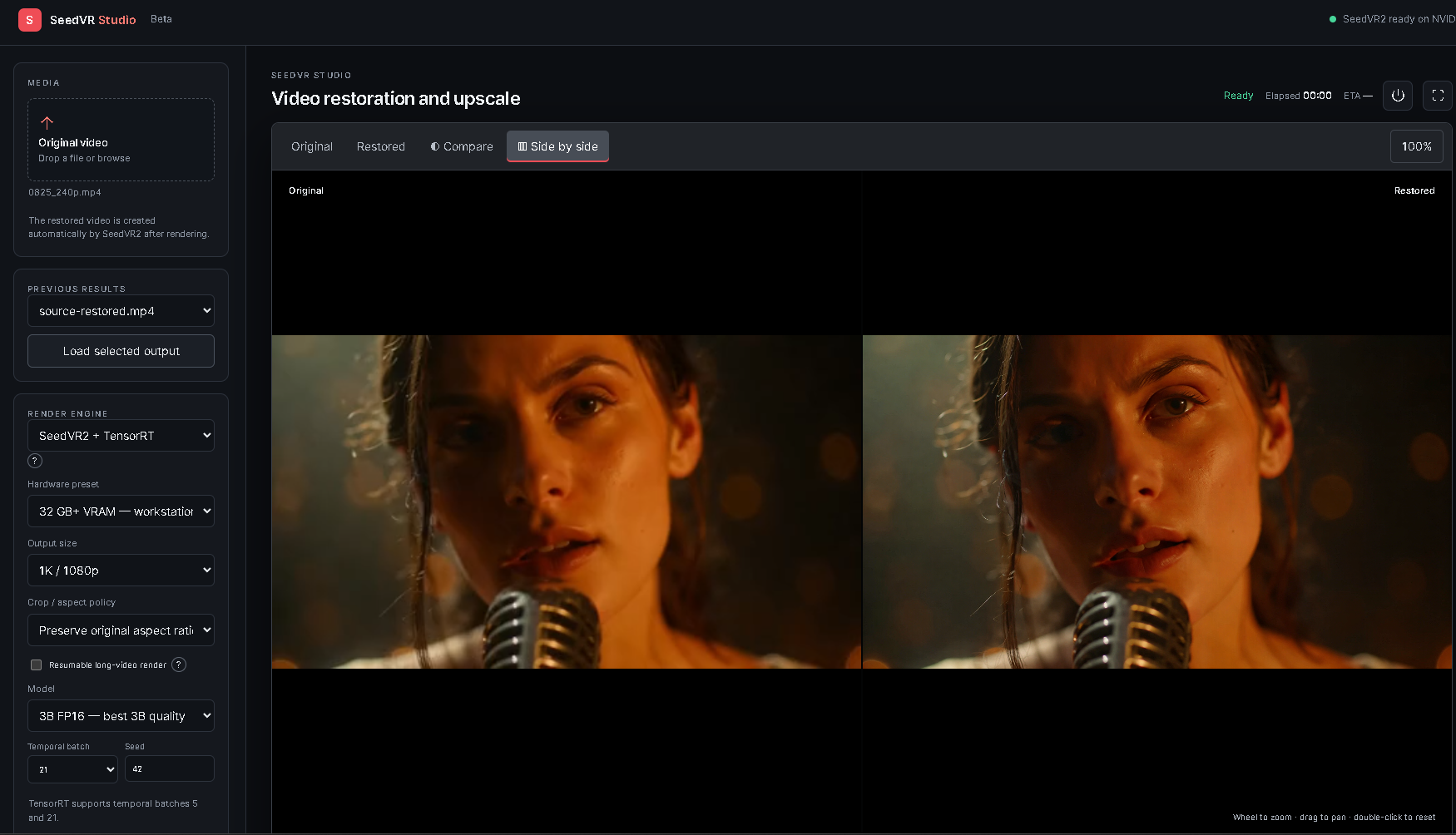
The author published the vrgamegirl19/VRGDG-SeedVR2-TensorRT-Studio repository on GitHub: this is a JavaScript interface with a FastAPI backend, designed for Windows 11. Before full rendering, you can render a short preview, and compare the result with the original in Original, Restored, Compare (slider), and Side by side modes. Long rendering is resumed after a break thanks to checkpoints, and post-processing — sharpening, grain, seam smoothing, and skin finishing — can be fine-tuned without re-running the neural network. TensorRT accelerates only VAE decoding, and in case of failure, the tool falls back to the standard decoder on saved latents. Installation via Install SeedVR Studio.bat pulls in Python 3.12+, FFmpeg, CUDA PyTorch, SageAttention 2, and model weights; the studio itself is distributed under the MIT license, and the SeedVR2 integration is under Apache-2.0.
Context
SeedVR2 previously existed as a research pipeline launched via the command line, and in this project the model architecture was not changed — there is no scientific novelty here, the contribution is purely engineering. This path is typical for utility models: to become a working video production tool, they need a wrapper with preview, checkpoints, and post-processing, not just a CLI script. The pipeline relies on a 7B model, which requires a significant amount of VRAM in FP16; FP8 variants save memory at the cost of some quality, while FP16 provides the maximum. The project is less than a week old, has one author and 81 stars, so it is in an early phase of stabilization.
Why this matters for the industry
The main asset for the industry is not SeedVR2 itself, but a ready-made wrapper template: FastAPI, TensorRT backend, rendering with resumable chunks and checkpoints, and post-processing without re-rendering. This framework can be reused for other video diffusion models, and similar studios based on this template will likely appear around new checkpoints. The MIT and Apache-2.0 licenses are commercially friendly, so for studios and services with a park of RTX cards, the restoration of short clips becomes free of license costs, which puts pressure on the prices of simple cloud upscalers in the low segment. However, a single-user open-source wrapper is not a business in itself: the protected value shifts to workflow quality and data, and the competition of local tools shifts from bare CLI to studio UX with preview, comparison, and checkpoints.
Why this matters for users
If you have Windows 11 and an NVIDIA RTX card, you can restore old or washed-out video for free and locally, without sending files to the cloud. The entry barrier is significant: about 35 GB of weights, Python 3.12+, CUDA PyTorch, and the 7B model's VRAM requirements, although the installation itself is done via two .bat files. A reasonable order of work is as follows: first render a 5-second preview and compare it with the original using a slider, then start the full rendering, and fine-tune sharpness and grain afterwards without re-running. On cards of the RTX 5090 level, the stated mode is really applicable; FP8 models help fit into a smaller amount of video memory, while FP16 provides maximum quality. Owners of lower-end cards will have to check operability on their own configuration.
What is still unknown / limitations
The stated performance target is the author's data from a single hardware configuration (RTX 5090, 7B Sharp FP16 checkpoint): this is a single measurement point, without a results table, without a comparison with the basic SeedVR2, and without detailed indications of fps and source resolution, so it should be treated as anecdotal evidence, not a benchmark. Since TensorRT accelerates only the VAE decoder, a correct speed comparison is possible by the decoder, not by the entire pipeline, and the overall gain must be more modest than it sounds in the description. It is unknown whether the acceleration will extend beyond VAE decoding and how the tool behaves on cards below the RTX 5090; the repository is less than a week old, so a phase of bug fixes on different card and driver configurations lies ahead, and the fate of the project depends on whether it will attract contributors.
Sources
- GitHub — vrgamegirl19/VRGDG-SeedVR2-TensorRT-Studio
- VRGDG SeedVR2 TensorRT Studio — installation and troubleshooting guide
Author
Look at AI, editorial team