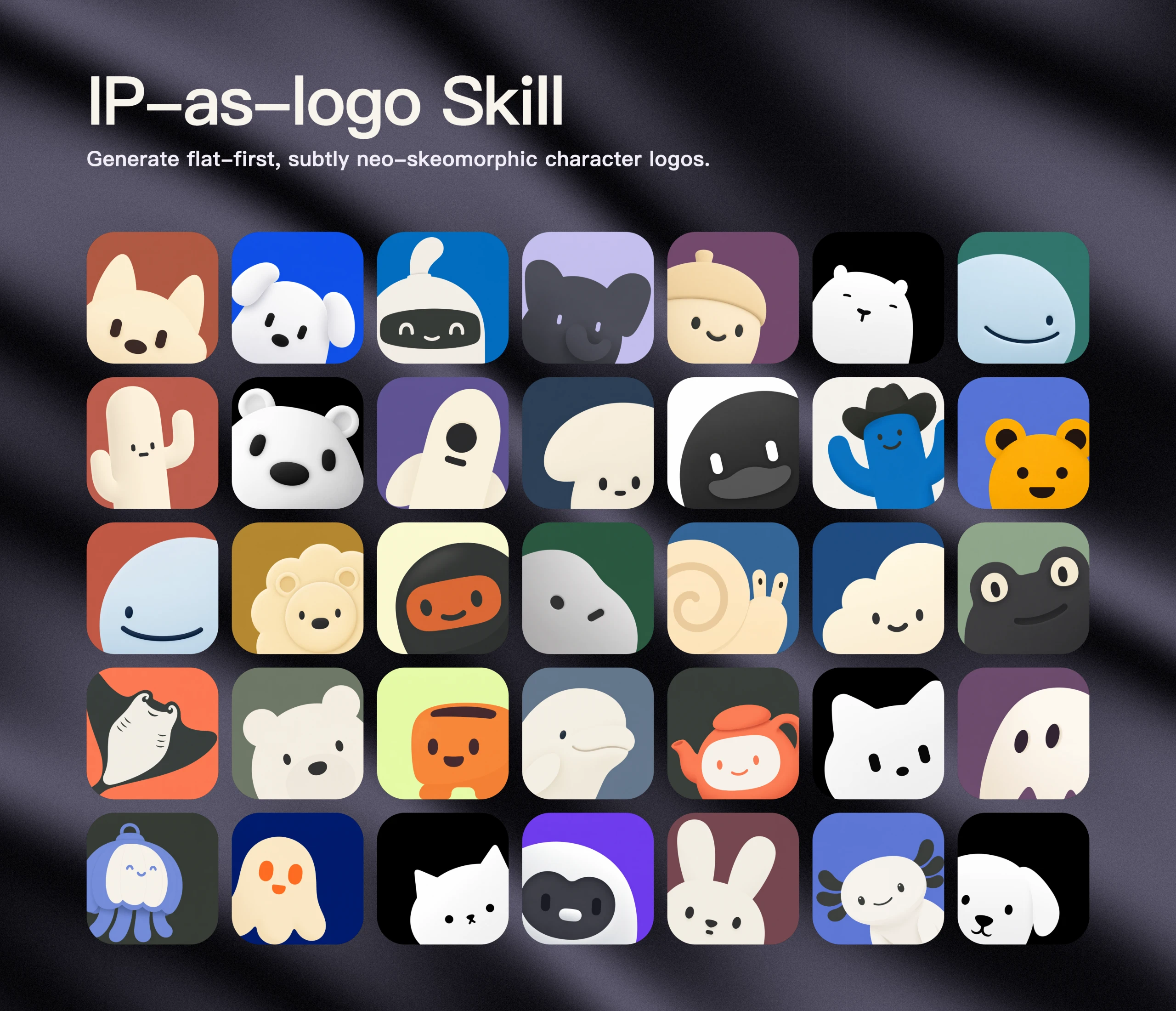
Author s1dashu published the open-source Agent Skill ip-as-logo-skill — a single SKILL.md instruction file that turns AI agents like Codex, Doubao, Coze, Manus, YouMind, Gemini Apps, and Replit Agent into corporate mascot generators. The skill installs with one npx command and works on top of the agent's native image model, and in two weeks the repository gathered 4.7k stars. If the agent lacks a suitable model, ready-made mascots can be obtained for free on the project site ipaslogo.com.

What happened
The author under the nickname s1dashu released Agent Skill ip-as-logo-skill to the public. The repository was created on August 18, 2026, the last commit is dated August 22, and the project's only artifact is the SKILL.md instruction file, without a separate model or training code. The file sets strict constraints for the agent: the mascot is built as a silhouette of 4–7 large shapes, with exactly three semantic colors in the palette — two for the character and one for the background, the character "emerges" from the bottom left or right corner of a square and occupies 85–95% of its area. First, the agent proposes three design directions, then generates six independent candidates labeled A1–C2 — three emerging from the left corner and three from the right — and returns them as is, without transparency checks or auto-retries. The project is distributed under the MIT license.
Context
ip-as-logo-skill is not a model or a service, but a "natural language program" in the Agent Skills format: an instruction file is added to a compatible agent and works on top of its native image models. From a scientific novelty standpoint, this is packaged instruction engineering — constraint-based prompting without methodology, metrics, or auto-checks, whose functionality is entirely inherited from the base model. The skill requires a top-tier image model: GPT Image 2, Seedance 5.0 Pro, Nano Banana Pro (Gemini Image Pro), or Nano Banana 2. There is no SVG fallback, so if the model fails to maintain the specified rules, there is no backup rendering method. De facto, such a file works as an informal instruction-following test: it is only viable where the base model itself can maintain structural constraints like the number of shapes, palette, and composition.
Why this matters for the industry
The main signal for the industry is not the mascots, but distribution. Agent Skills are becoming a format for distributing narrow design practices: instead of a separate service or a prompt collection, the skill is installed with one npx command into any compatible agent and sets strict output rules for its native image model. In two weeks, the project received 239 forks, indicating demand for ready-made "instruction-professions" and simplified brand mascots as a cheap alternative to hiring a designer. For startups, such a skill is a cheap distribution channel with almost zero customer acquisition cost, but the project itself remains a feature without a moat: one open SKILL.md and an MIT license allow anyone to copy the approach, so competition shifts from the question "can the model do it" to the quality and packaging of instructions.
Why this matters for users
You can try it in a couple of minutes: the skill installs with the command npx skills@latest add s1dashu/ip-as-logo-skill, and for global installation — with the --global flag. Then the agent leads the process itself: it proposes design options and offers several mascot candidates for a project or brand, but final selection and refinement remain with the human — the working scheme today is "human in the loop," where the result is generated, selected by eye, and refined manually. If the agent lacks a suitable image model, ready-made logos can be downloaded for free from the ipaslogo.com site, and they are permitted for commercial use. The author of the Telegram channel shared a personal experiment: he asked the neural network how it sees him, and received a beaver-editor in response.
What is still unknown / limitations
Quality assessment is absent in the project: there are no metrics for constraint compliance, no human evaluation, and no comparison with alternatives, so result predictability is low. Ease of installation alone says nothing about the share of candidates that actually satisfy the specified rules — this share is unknown. GitHub stars are a metric of attention, not quality, and the repository is less than two weeks old, so the sustainability of interest and the skill's behavior on different agents and models still need to be tested.
Sources
- s1dashu/ip-as-logo-skill GitHub repository
- IP as Logo Skill — official project site and library of ready-made mascots
Author
Look at AI, editorial team