Nassim Dehouche, a researcher at Mahidol University International College in Thailand, published a systematic review on the impact of artificial intelligence on the labor market in Frontiers in Human Dynamics on May 7, 2026. Its main finding: displacement is already observed in job posting, freelance, and firm survey data, rather than existing only in forecasts. In 2022–2024, entry- and mid-level job postings in software development and content creation in high-income countries fell by an average of 23%, while demand for infrastructure, security, and QA — that is, for validating model outputs — is growing. Confirmed AI skills are already being monetized: the wage premium for such specialists reaches 15–22%.


What happened
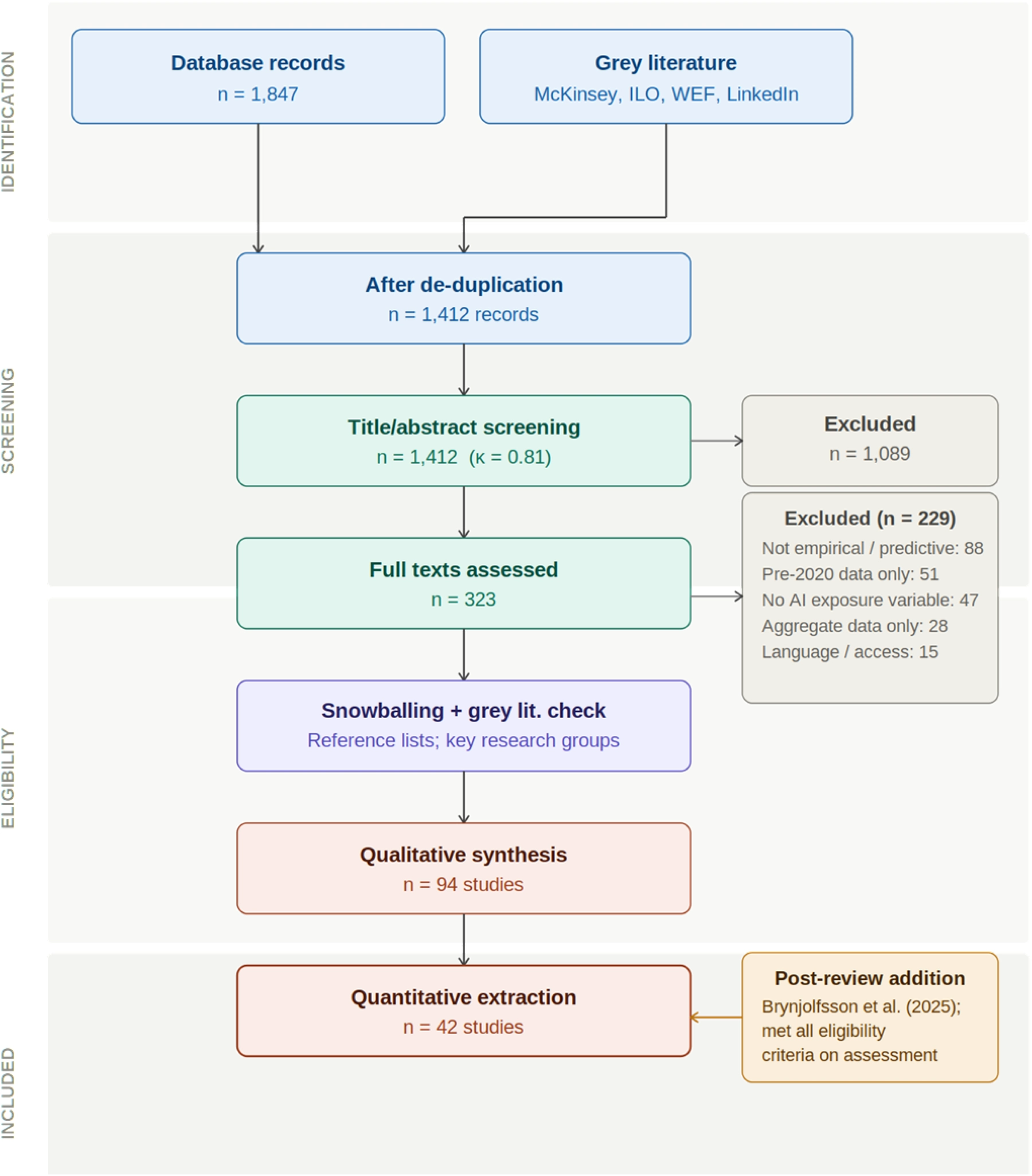
The key event is the publication of the peer-reviewed article Creation, validation, obsolescence: AI-driven labor market displacement (article 8:1815037, DOI 10.3389/fhumd.2026.1815037). This is a systematic review following the PRISMA 2020 protocol: from 1,847 records found, 94 studies from 2020–2025 remained after screening, of which 42 had quantitative data. The picture is provided by three independent data streams. Entry- and mid-level job postings in software development and content creation in high-income countries fell by 14–41% in 2022–2024 (median −23%). On Upwork, after the launch of ChatGPT, postings for writing fell by 21% and for programming by 14% (Hui, Reshef & Zhou, 2024). According to Acemoglu 2024, employment in firms intensively using AI fell by 3.5%. In parallel with the compression of developer roles, demand is growing for roles in infrastructure, security, and QA as channels for validating AI output, and workers with confirmed AI augmentation skills have a wage premium of 15–22%.
Context
These figures need to be understood against the backdrop of an inversion of the familiar picture. According to Eloundou et al. 2024, approximately 80% of US workers have at least 10% of their tasks affected by LLMs, with exposure concentrated in high-paying professions: past waves of automation hit low-paid routine work, while the current blow has landed on prestigious intellectual labor. The review describes a specific mechanism: companies are consolidating roles, seniors together with the model absorb junior functions, breaking the classic "junior → senior" ladder — it is precisely the environment in which experienced specialists are cultivated that is being compressed. The author's framework is reflected in the title: creation, validation, obsolescence. Routine creation of code and content is being commoditized, and value is shifting to checking model outputs for correctness, safety, and absence of hallucinations. What distinguishes this work from typical industry reports with selective citations is transparency: causal relevance criteria are stated, and the article is open access along with evidence tables.
Why this matters for the industry
For the industry, the review moves the debate about jobs from forecasts to the plane of observable quantities, and this changes product logic. Routine generation of code and text is being commoditized, so the value of packaging shifts from generation to validation: a product selling "yet another generator" loses to one that builds a layer of checking and decision-making within familiar tools — evals, observability, guardrails, and human checkpoints on critical outputs. Within teams, roles are already being consolidated: seniors plus the model take on junior functions, meaning the load on review and quality control is growing without an increase in headcount. A practical set of actions for today: measure the share of AI-generated code and content in production, raise regression evals and monitoring of output quality, introduce human checkpoints on critical operations, log edits and compare results before and after. In hiring, budgets are flowing from mass creation roles to QA, security, infrastructure, and validation tools, and buyers are already ready to pay for saved time of qualified specialists, as evidenced by the established wage premium for AI augmentation.
Why this matters for users
For the reader, this is already today's economy, not an abstraction. The AI skills premium in OECD countries rose from 2.1% in 2021 to 4.8% in 2024, meaning the market is revaluing the ability to work with models right now. A reasonable first step is to honestly analyze one's own tasks: some of them are already being taken over by the model, while the rest are transitioning to the category of checking its results, and it is precisely in validation skills — testing, review, quality and safety assessment of outputs — that one should invest. Freelancers are familiar with the scale of change from their own orders: on Upwork, after the launch of ChatGPT, routine writing and programming services fell at double-digit rates. Junior specialists should take into account that entry through simple tasks is narrowing, so it is better to compensate for this by early mastering of validation tools. The article is open access, so the selection methodology and evidence tables can be read independently and to distance oneself from hype in both directions.
What is still unknown / limitations
The readiness of the figures for direct product planning has limits. Of the 94 studies, quantitative data are available for only 42, and the 14–41% range is collected from heterogeneous studies with different designs: consistency of direction does not cancel the spread of estimates, and the median of −23% remains an aggregate figure, not a measurement of a single market. The corpus relies primarily on high-income countries and data up to 2025, so transferring the conclusions to other markets and periods requires caution. Observational data limit causal conclusions: the AI effect may be mixed with macroeconomic cycles and post-pandemic correction of tech hiring, and separating these factors will have to be done in future replications on 2025–2026 data. The question of the future of validation roles themselves also remains open: if agentic models learn to replace not only routine creation but also checking of results, today's favorable positions will also become obsolete.
Sources
- Dehouche N. Creation, validation, obsolescence: observed evidence of AI-driven labor market displacement, 2020–2025. Frontiers in Human Dynamics, article 8:1815037
- Hacker News: discussion of the article (item 49500453, submitted 2026-08-30)
Author
Look at AI, editorial team