
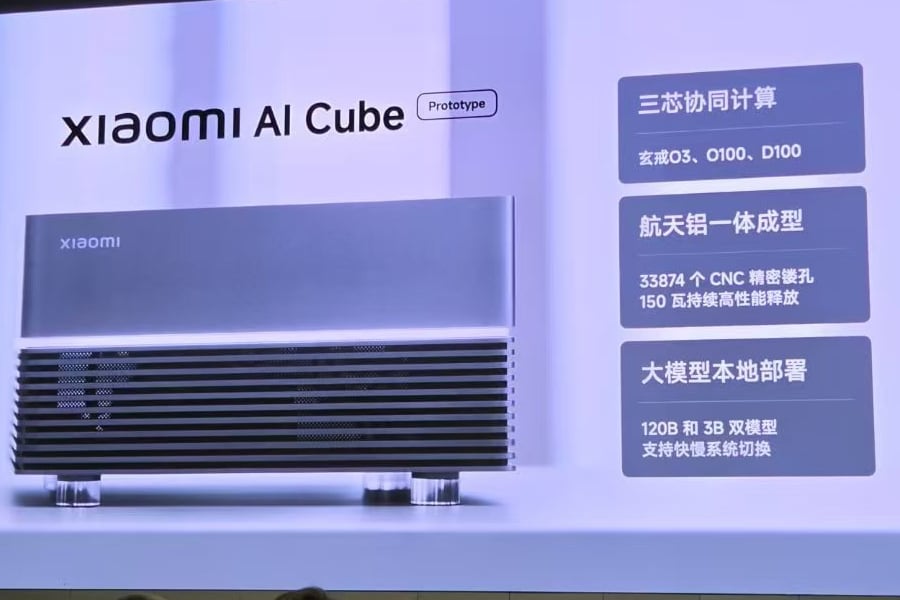
On August 24, 2026, at the XRING Chip Technology Communication Conference, Xiaomi presented the AI Cube — a prototype of a compact AI computer in mini-PC format, designed for local deployment of large language models. The device is built on proprietary XRING chips, is announced to work with models from 3B to 120B parameters, and operates at a continuous power consumption of up to 150 W. The release date and price have not been announced.

What happened
At the presentation, Xiaomi revealed what the AI Cube consists of. The O3 serves as the main AI SoC: a 10-core CPU, a 16-core GPU G2-Ultra NX, and an NPU with a performance of 200 TOPS on the TSMC 3 nm process. The O100 accelerator is made on a 6 nm process and uses wafer-on-wafer NPU-DRAM bonding, which provides a near-memory computing bandwidth of up to 1.22 TB/s. The third chip, the D100, is also on a 3 nm process: a 20-core CPU, a 16-core NPU, and support for up to 160 GB of memory; it was originally created for "smart driving" tasks. The prototype runs a combination of 120B + 3B models with switching between "fast" and "slow" modes depending on the task.
Context
The segment of personal AI computers was previously largely defined by NVIDIA: the DGX Spark launched at a price of $3,999 and defined the format of a "home AI supercomputer," against which the AI Cube is now positioned. The second part of the background is the technical limitation that Xiaomi's architecture hits. When decoding language models, execution speed is governed not by the number of operations, but by memory bandwidth, so accelerating memory exchange is arithmetically more beneficial than simply increasing the number of cores. This is why the near-memory O100 combination is the most significant detail of the announcement.
Why this matters for the industry
For the industry, the AI Cube is significant as Xiaomi's entry into the segment of local AI machines on its own silicon, rather than on NVIDIA or AMD chips. If the prototype is brought to a product, it will become the first serious competitor to the DGX Spark, made outside the US, on the TSMC 3 nm process, and probably significantly cheaper than $3,999. This intensifies competition for the personal AI supercomputer format and accelerates the formation of an independent Chinese stack. For engineers, the system pattern itself is valuable — a combination of a fast 3B model and a slow 120B model with task routing, which can be transferred to current hardware.
Why this matters for users
For the reader, the AI Cube sets a specific benchmark: a 150 W mini-computer that, according to the announcement, locally runs a 120B model in parallel with a fast 3B "router" model. If the device reaches the market, it will be a ready-made format for a home AI server for agents without the cloud and subscriptions. It is worth watching for the announcement of the price and release date — it is precisely from them that it depends whether this will become a working format for local models.
What is still unknown / limitations
The announcement was made as a prototype: there is no release date, price, spec sheet, or independent measurements. The claim of "support for models from 3B to 120B" speaks to capacity, not performance — tokens per second, latency, quality, and performance per watt are not disclosed. The D100 is a repackaged automotive chip, and its suitability for LLM workloads has not been proven. The routing policy between the 3B and 120B models and the overhead of switching are also not disclosed. All announced figures, including the 1.22 TB/s for the O100, have not yet been confirmed by reproducible benchmarks.
Sources
Author
Look at AI, editorial team