On August 18, 2026, the Ornith team released Ornith-1.5 — an open family of three models for coding, logic, and agents. According to the developer, the flagship 397B version is comparable to the closed Claude Opus 4.8 on agent benchmarks, and all checkpoints are already available for download on Hugging Face.
What happened
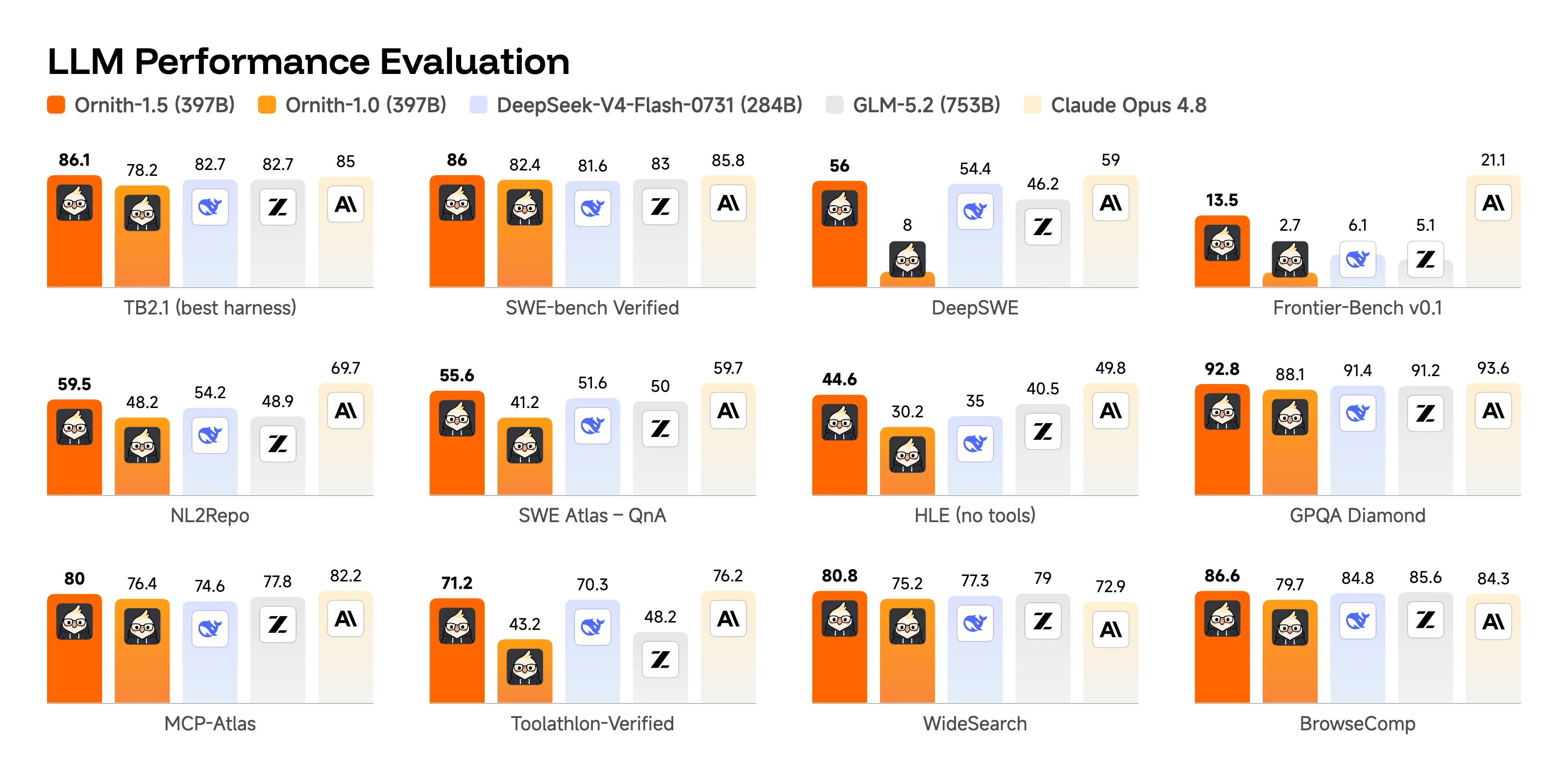
The Ornith-1.5 family includes three versions: a dense 9B, a 35B-A3B MoE model that activates 3B parameters per token, and a 397B MoE flagship. The key mechanic is a self-improvement loop: the model itself generates tasks, writes scaffolds (instructions, tools, strategy) for them, and trains on its own attempts via GRPO, while selected tasks are validated for solvability, boundary difficulty p* = 0.2, and novelty. According to the developer, Ornith-1.5-397B scores 86.1 on Terminal-Bench 2.1 and 56.0 on DeepSWE, outperforming GLM-5.2 (82.7/46.2) and DeepSeek-V4-Flash-0731 (82.7/54.4) with Claude Opus 4.8 results at 85.0/59.0. On SWE-Bench Verified, the 35B-A3B version scores 79.0 compared to 52.0 for Gemma 4-31B and 76.0 for Muse Glimmer-30B.
Context
Ornith-1.5 builds on Ornith-1.0, which was built on Qwen3.5 and Gemma 4 with CPT, mid-training, and post-training stages, so a significant part of the agent capability is inherited from the base models, not just from the self-improvement stage. The 35B-A3B designation means that out of 35B total parameters, only 3B are active per token, which determines inference efficiency. Self-improvement through training on its own generations had previously been encountered mainly as an experiment of individual labs, while Ornith presents it as a documented, reproducible pipeline with formal task selection criteria.
Why this matters for the industry
Ornith-1.5 raises open weights to a level comparable to the closed Claude Opus 4.8 on agent benchmarks Terminal-Bench 2.1 and DeepSWE with fully public checkpoints, which becomes the first notable open pressure on closed APIs. The loop of "the model generates tasks, writes scaffolds, runs a rollout, and trains via GRPO" turns self-improvement from a marketing narrative into a reproducible engineering technique that other labs can copy in their own fine-tuning pipelines. If independent evals confirm the 35B-A3B results, the "30-40B total parameters with 3B active" format will become a real self-hosted alternative to closed APIs for routine SWE and terminal tasks: lower cost per token, and data does not leave the perimeter. Also, accelerated saturation of SWE-Bench Verified and Terminal-Bench and the emergence of new agent benchmarks should be expected.
Why this matters for users
All three checkpoints can be downloaded right now on Hugging Face in FP8, GGUF, MLX, and NVFP4 formats with a 128K-256K context, meaning for different types of hardware. Quantized 9B versions (MLX/GGUF) run on iPhone and Android, the 35B-A3B with a small number of active parameters is suitable for self-hosted deployment, and the 397B is designed for local servers. This week, you can run your own agent and coding tasks through Ornith-1.5 and compare them with Gemma 4-31B, Qwen 3.6-35B, and your current API provider in your own conditions.
What is still unknown / limitations
All benchmark figures are self-reported data from the developer: there is no independent verification, no API, and no prices or latency data have been published. The claim of parity with Claude Opus 4.8 is partial: leadership exists only on Terminal-Bench 2.1 (86.1 vs 85.0), while on DeepSWE Ornith-1.5-397B lags (56.0 vs 59.0). There are no ablations by training stages, so the contribution of the base models Qwen3.5 and Gemma 4 cannot be separated from the contribution of the self-improvement stage based on available data.
Sources
- Ornith Blog: Ornith-1.5: From Self-Scaffolding to Self-Improvement
- Ornith-1.5 Collection on Hugging Face
- Ornith-1.5-397B Model Card on Hugging Face
Author
Look at AI, editorial team