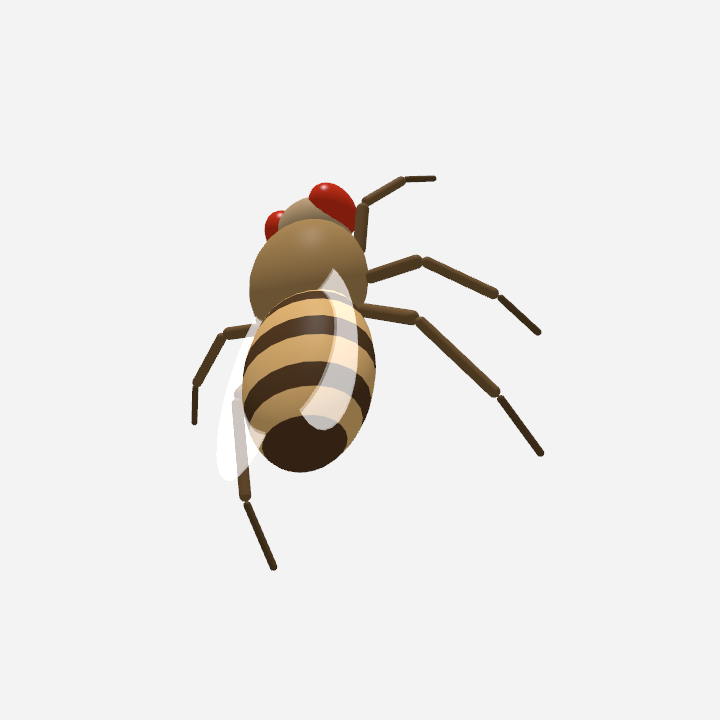
Developer DenisSergeevitch has released the open-source project DesktopFly — a 3D Drosophila living on the macOS desktop. The fly's "brain" is a 1 kHz leaky integrate-and-fire simulation of a circuit of 668 real neurons with ~19,000 synapses, extracted from the public FlyWire connectome, and the behavior — takeoff, escape, scratching — emerges from this network, not from a scripted scenario.


What happened
The project was released as an open repository desktop-fly on GitHub (MIT + CC BY-NC 4.0 licenses). Requirements: macOS 13+, Swift 5.9+, build — git clone and ./build.sh; the simulation runs on CPU, without GPU or external services. Cursor approach is fed to visual neurons LC4 and LPLC2 as a looming stimulus, and takeoff occurs only when the command neuron DNp01 (Giant Fiber) spikes through its own synapses: the reaction to a fast cursor jerk takes ~4 ms, while slow approaches suppress ~1200 inhibitory synapses. A separate brain window renders 23,210 real soma positions and allows clicking to stimulate ~60 nearest neurons: clicking on Giant Fiber makes the fly flee, on DNg11 it scratches, on DNa01 and DNa02 it turns. In normal mode, the fly walks along window edges, sleeps during a daytime siesta and at night, and runs faster on a heated Mac — the system's thermal state is fed into the simulation.
Context
FlyWire is a public Drosophila melanogaster connectome: in version FAFB v783, 139,255 neurons of an adult fly are annotated, and the data is described in the paper Dorkenwald et al., 2024, "Neuronal wiring diagram of an adult brain" (Nature). FlyWire Codex is an interactive browser of this connectome, through which the raw dump is accessible. Before DesktopFly, public connectomes remained, essentially, static datasets: they were viewed and analyzed, but executable behavior was not extracted from them. The novelty of the project is not in architecture or learning method, but in the reproducible pipeline itself: "public connectome → executable behavior."
Why this matters for the industry
For the industry, DesktopFly is a reference for how a public connectome becomes executable software: the cost of a "brain-in-a-box" demonstration has dropped to one developer, a laptop, and a ~60 MB raw dump. There is no direct impact on ML infrastructure: no service, API, or cost/latency savings, but the reproducible pattern "connectome → spiking simulation → behavior" is likely to be replicated on other public connectomes. The Hacker News discussion (198 points, 54 comments) shows a shift in value: the window for pure "demos" is closing, connectomics visualization is becoming a commodity component, and the potential is moving to tooling — automatic extraction of subgraphs from FAFB and generation of spiking simulations.
Why this matters for users
Mac owners just need a couple of commands from the README to set up a fly in a minute, open the brain window, and observe live spikes at real soma positions. This is a rare opportunity to touch connectomics with your hands: in front of you is not a picture of a neuron, but a working graph where specific neurons produce specific behavior — escape, scratching, turning. The repository is open and can be forked: swap out a subset of neurons, stimuli, port to other systems, or refine the neurodynamics.
What is still unknown / limitations
The connectome provides only the topology of connections, not physiology: LIF constants, neurotransmitter signs (ACh+, GABA−, Glu−), synaptic weights, and sensory transduction are calibration assumptions, not measured parameters. The 668 simulated neurons are ~0.5% of all FAFB v783 neurons, and the brain window is a visualization, not a simulation, so the phrase "real brain" should be read as "real connectivity of the extracted subset." The coincidence of the ~4 ms reaction with the delay of the real Giant Fiber pathway is a consequence of the simulated loop mirroring this fast biological pathway, not the result of a quantitative comparison with a live fly: the project has no benchmarks, ablations, or statistical comparisons with the Drosophila behavior literature.
Sources
- DenisSergeevitch/desktop-fly — GitHub: official DesktopFly repository (README, licenses, build)
- Hacker News — thread "A 3D fruit fly on macOS desktop powered by the real FlyWire connectome" (198 points, 54 comments)
- FlyWire Codex — interactive browser of the Drosophila melanogaster connectome, FAFB v783 data
Author
Look at AI, editorial team