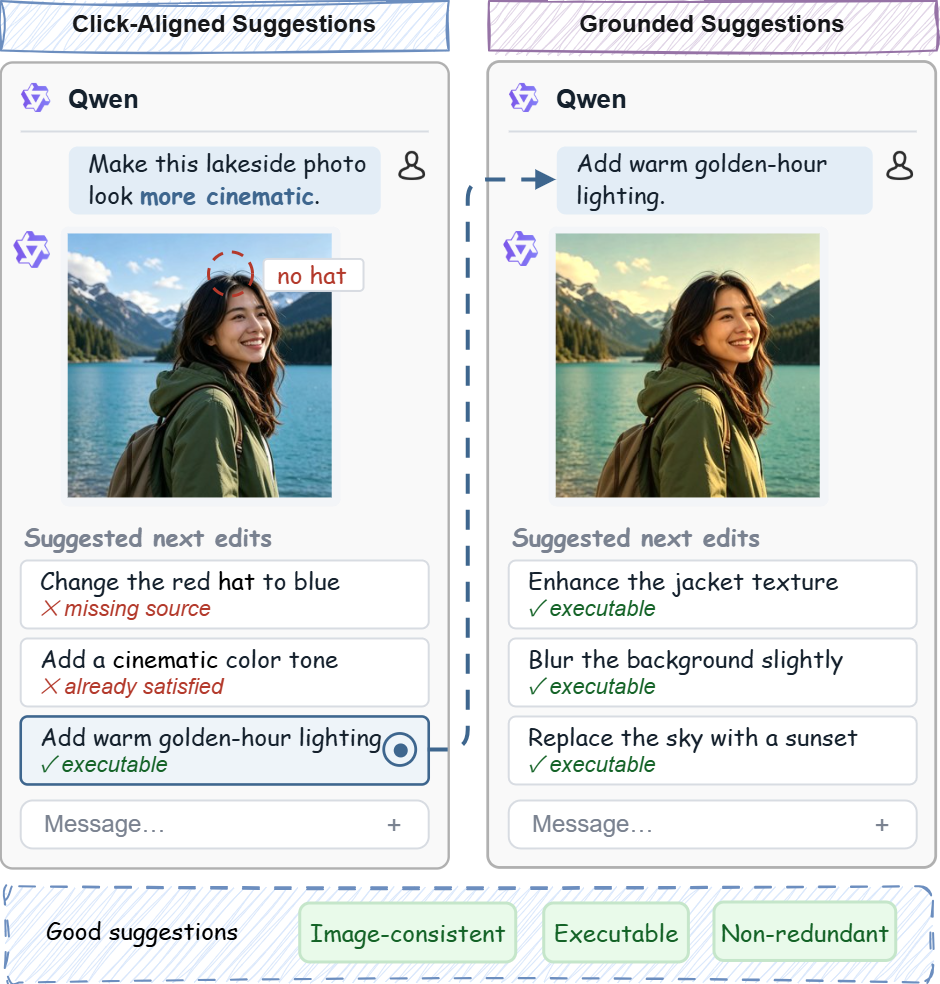
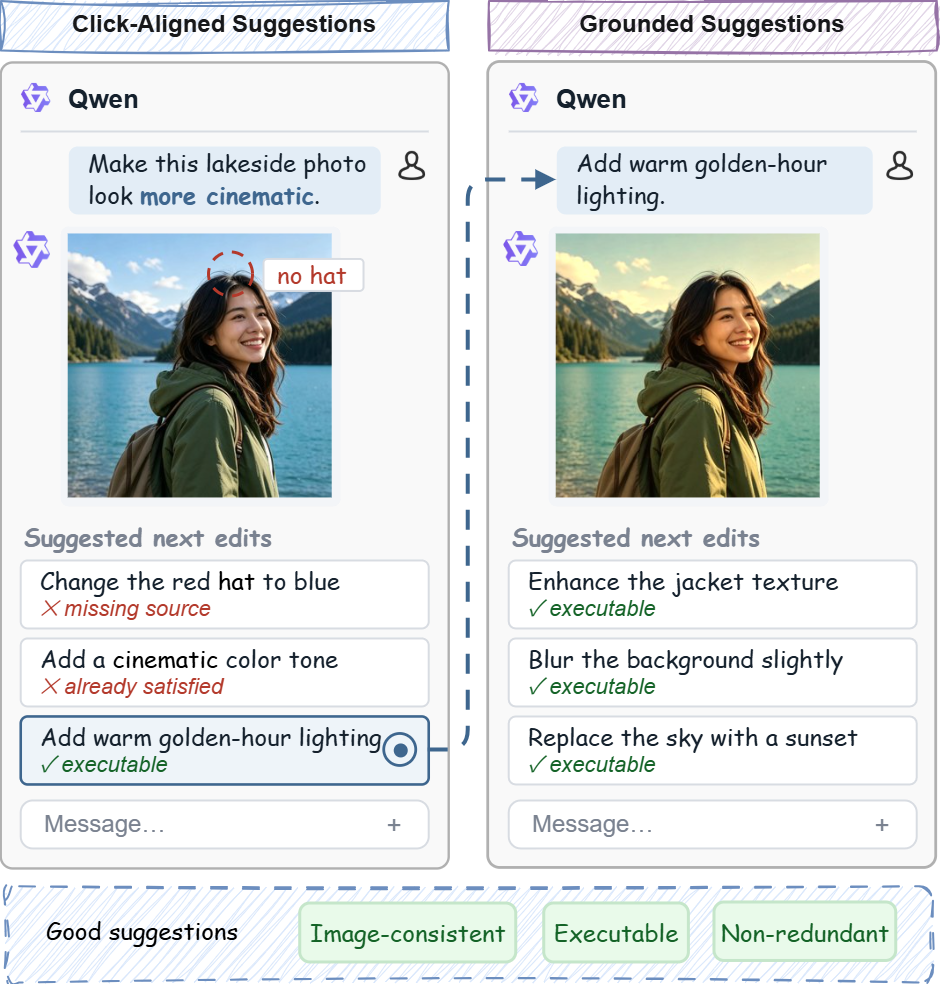
Qwen Business Unit of Alibaba, in collaboration with Southeast University and ShanghaiTech University, published the paper 'What to Edit Next' (arXiv:2608.07565) on how to make follow-up prompts in image generation chats visually consistent with the current image, so that each suggested edit is actually executable on it. The authors combine supervised learning, reinforcement learning based on user clicks, and a separate visual feasibility verifier, and test the recipe in a live 14-day A/B test with millions of users.
What happened
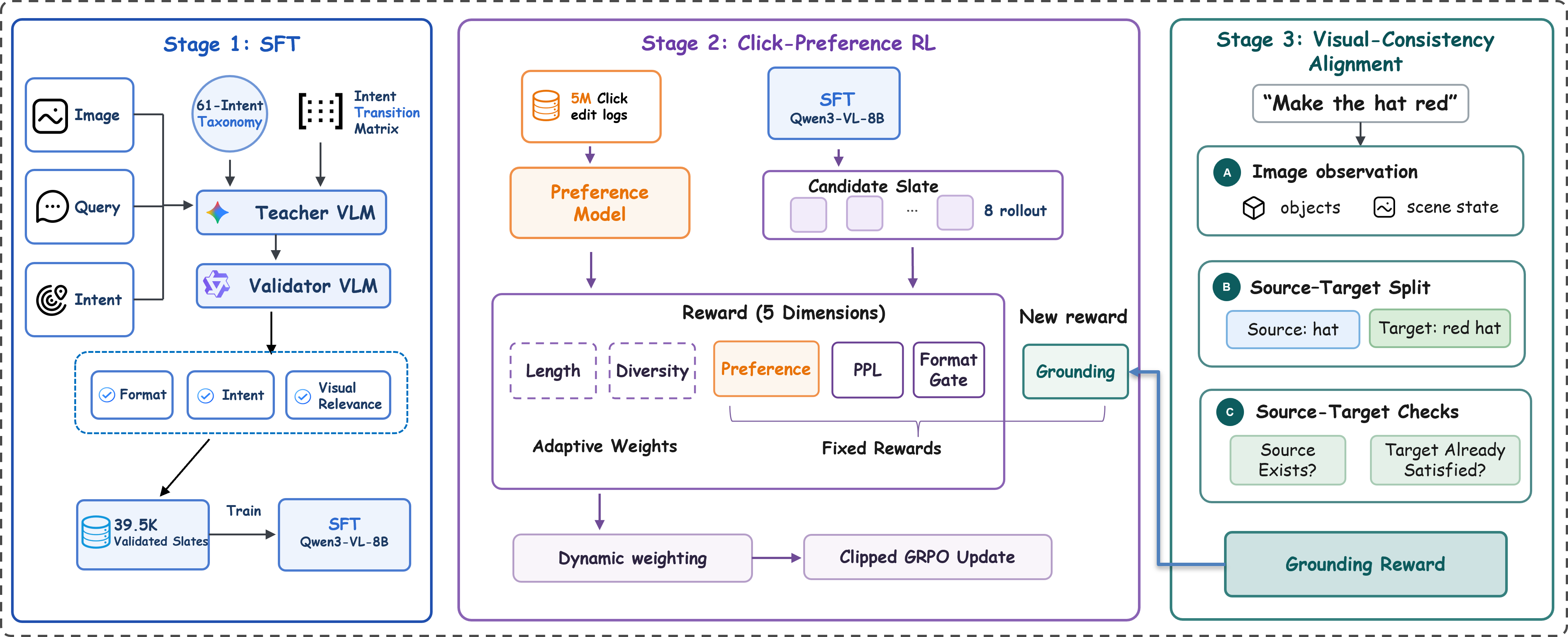
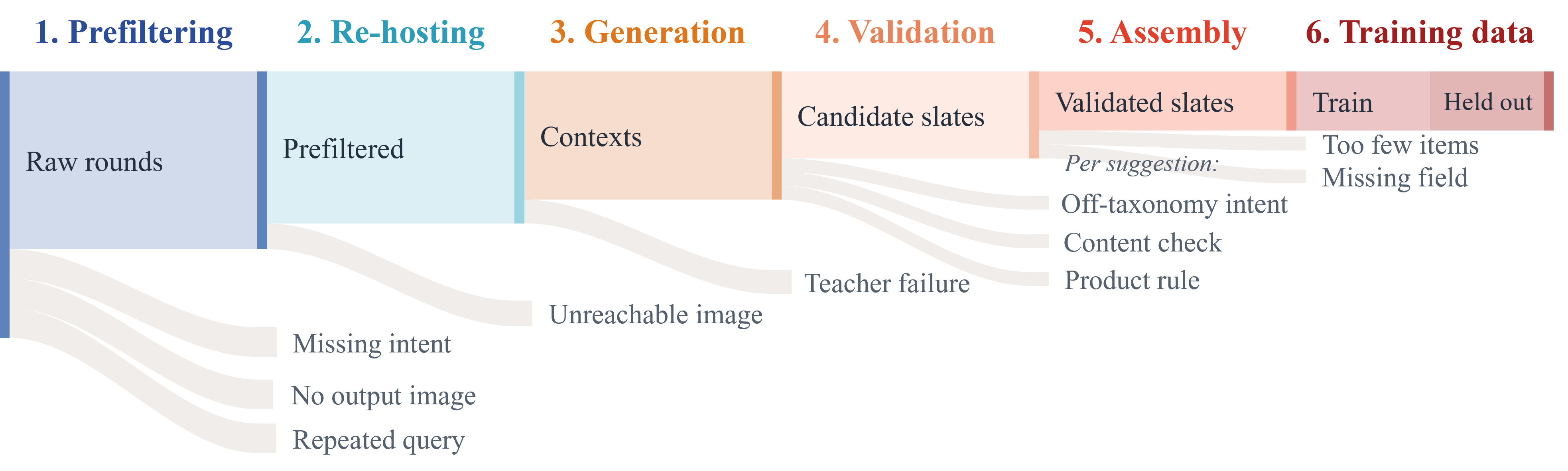
The framework is built on an analysis of 100,000 multi-turn Qwen App dialogues, in which 80.1% of follow-up requests depend on the current image. The pipeline consists of three stages: first, SFT on 39.5k prompt slices, then GRPO training on 173,071 click pairs with an 8B VLM model acting as a reward (the channel names the base model Qwen3-VL-8B), and finally a visual verifier that checks that the 'source' of the edit is actually visible in the image and the target state has not yet been achieved. Data was prepared in a chain: from 120k requests, 44.3k contexts were obtained, from which 243k validated prompts and 39.5k slices. The online experiment ran for 14 days on millions of users with 5% traffic per variant, all deltas are statistically significant at p<0.05: visual inconsistency of prompts dropped from 3.7% to 0.9%, recommendation CTR increased by 32.70%, image saves — by 16.32%, and average turns per user — by 39.90%.
Context
In conversational image generation, after each user turn, the system suggests continuing to work with the image, and the usefulness of a prompt is determined by whether it can actually be applied to the current state. The key scientific conclusion of the work is that the engagement signal and visual feasibility are orthogonal: the authors showed via ablation that RL on clicks (GRPO) improved prompt quality and CTR, but did not eliminate visually impossible edits, so a separate visual signal was needed. The verification mechanisms themselves are also an engineering contribution: a single-pass VLM check gave 22.2% false rejections, while an ordered source-target procedure with image-first observation — 0.6% with 78.7% recall.
Why this matters for the industry
The work is not a new model, but a reproducible recipe for the 'what to fix next' pattern, which can be transferred to any assistant suggesting actions on top of images: canvases, design assistants, image chats. The order of stages sets a design principle for multimodal recommenders: first a task on human-reviewed intents, then clicks, then feasibility checking by pixels. The combination of 'RL on clicks + structured visual verifier' can be immediately adopted by teams that already have click logs and their own VLM, and the A/B numbers of the paper serve as a benchmark for the category. At the same time, the paper is a methodological reference, not a library: the architecture can be studied and reinterpreted, but there is no drop-in component.
Why this matters for users
For everyone building generative products with a 'what to fix next' feature, the paper is an open methodological reference, readable without deep mathematics: it contains a complete data pipeline, ablation of the verifier architecture, and honest A/B numbers. The practical step today is to study the pipeline and source-target verifier, assess whether the 'prompt must be executable on the current image' pattern is applicable to your own product, and plan implementation on your own VLM. There is no ready-made library or API for integration, so the value of the work lies in the methodology and order of stages, not in installing a ready-made component.
What is still unknown / limitations
Code and model weights are not published, and the paper has no data on compute, latency, or inference cost, so the claim that the stack 'in principle fits on a consumer GPU' is not supported by sources. SFT and GRPO training of an 8B VLM with a separate 8B VLM reward model on 173,071 click pairs is a serious training load, the resource cost of which is not disclosed in the work. The base model Qwen3-VL-8B is named by the channel, not confirmed in the paper itself, and the conclusion about the reproducibility of the pipeline on open 8B VLMs remains a hypothesis, not a fact.
Sources
- What to Edit Next — official project page (Qwen Business Unit of Alibaba)
- Paper 'What to Edit Next: Visually Aligned Image-Editing Follow-Up Suggestions in Conversational Systems' (arXiv:2608.07565)
Author
Look at AI, editorial team