On August 12, 2026, Liquid AI released LFM2.5-VL-3B — an open multimodal vision-language model with 3.1B parameters designed for on-device deployment. According to the company, on a set of 28 vision benchmarks, the model reaches the level of larger 4B models, with the biggest jumps shown in screen understanding and function calling.

What Happened
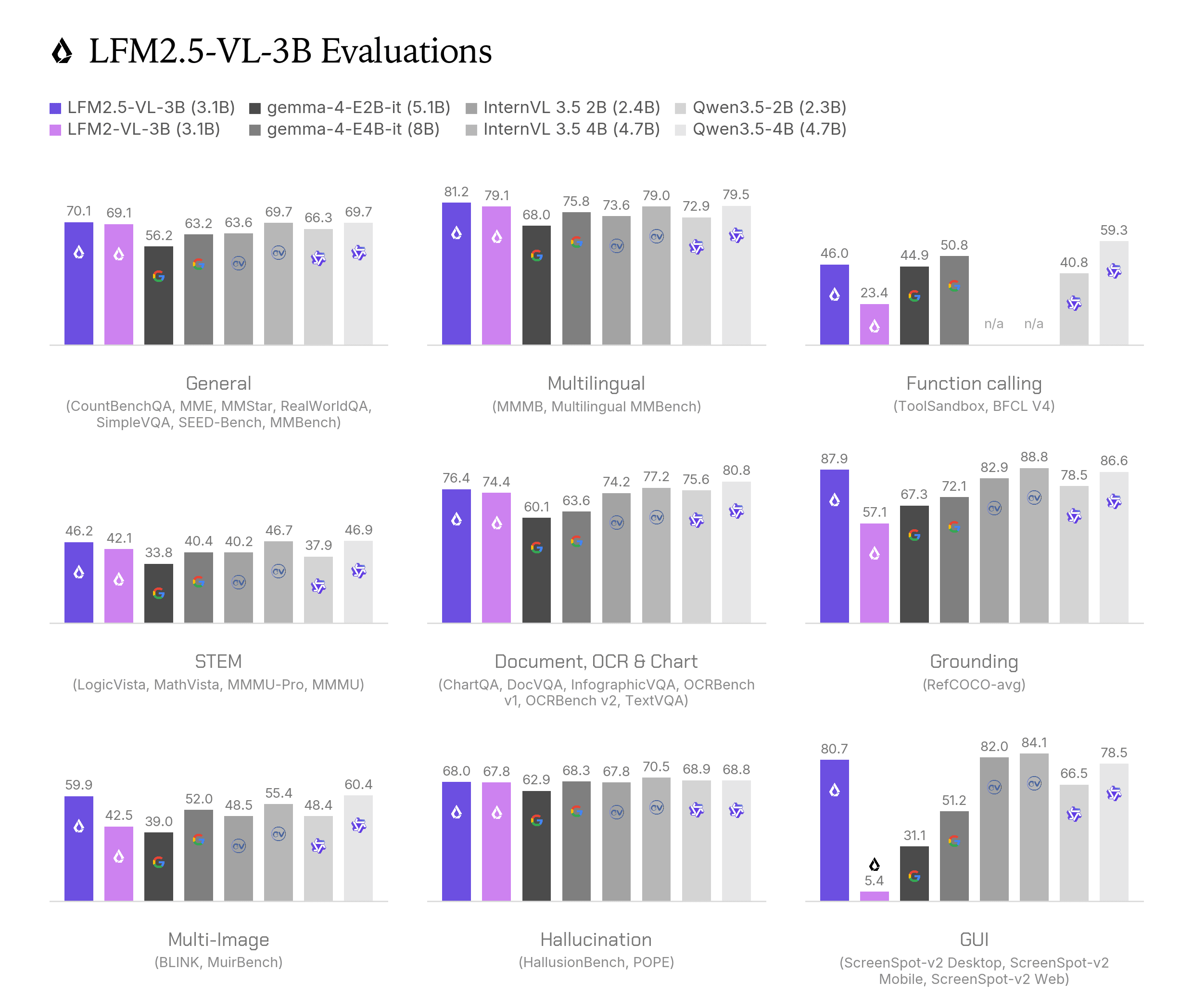
Along with the release, the company published a detailed blog post and model card, where the numbers match. The model is built on the LFM2.5-2.6B text base and the SigLIP2 400M NaFlex visual encoder, totaling 3.1B parameters; the context is 32,768 tokens, and it supports 16 languages, including Russian. LFM2.5-VL-3B is a non-reasoning model: it responds immediately, without a chain of thought. According to the vendor, the average across 28 vision benchmarks is 69.4 compared to 57.2 for the previous LFM2-VL-3B, meaning it is on par with the larger InternVL 3.5 4B (69.4) and 0.7 points below Qwen3.5-4B (70.1). The biggest jump is in screen understanding: ScreenSpot-v2 80.7 (desktop 78.7, mobile 81.2, web 82.2) compared to 2.5–7.6 for the predecessor. Other key metrics: grounding RefCOCO precision@1 increased from 57.1 to 87.9, function calling ToolSandbox — from 26.4 to 59.5, according to the vendor on par with Gemma-4-E2B, BLINK — from 50.2 to 61.5, MUIRBench — from 34.9 to 58.3. Generation speed is 228 tokens per second on Apple M5 Max and 116 tokens per second on AMD Ryzen AI Max+ 395. The weights are published on Hugging Face.
Context
LFM2 is Liquid AI's own series of compact models for on-device deployment, and LFM2.5-VL-3B is the updated generation of the company's vision-language model. The combination of a compact LLM base with a modern SigLIP2-class visual encoder is not a new scheme for the market, but the claimed efficiency per parameter, where a 3B-class model reaches the level of 4B models, is a new indicator for the class. For reading the numbers, it is important to know what the benchmarks measure: ScreenSpot-v2 — the ability to understand and localize elements in interface screenshots, ToolSandbox — function calling accuracy, RefCOCO — grounding, object localization in an image. The non-reasoning format is a conscious trade-off: the model sacrifices the chain of thought for speed, and the ceiling on complex visual reasoning tasks is visible from the fact that the jumps between generations on reasoning benchmarks are noticeably weaker than on screen-related ones.
Why This Matters for the Industry
For the industry, LFM2.5-VL-3B sets a new reference for on-device VLMs: for the first time, the 3B class shows the level of 4B in screen understanding and function calling, making local UI agents — working with mobile, web, and desktop interfaces without the cloud — a practically realizable product feature. The "read the screen and perform an action" layer is being commoditized: a startup that previously needed the cloud for a GUI agent can now prototype on a laptop or directly in the browser via WebGPU. The model is immediately available in GGUF, ONNX, and MLX formats and enters the llama.cpp, LM Studio, Ollama, and Jan ecosystems, meaning distribution goes through standard open runtimes without being tied to the vendor's API. For the research community, this is an opportunity to quickly reproduce the claimed benchmark grid on their own setups — the first real test of the company's claims. If independent reproductions confirm the numbers, on-prem UI automation and document understanding pipelines will begin to migrate from cloud APIs to local models, and 4–5B models will have to prove their advantage beyond size.
Why This Matters for Users
You can try the model right now without your own hardware: the WebGPU demo works in the browser, and there is a Liquid AI Playground. On your own hardware, the barrier to entry is practically zero: the model takes up about 3 GB of memory, and on a Galaxy S26 Ultra smartphone it maintains about 20 tokens per second. Based on it, a working pilot is already being built today — a local UI agent that finds interface elements from a screenshot, performs clicks, and calls tools, or an on-device OCR copilot.
What Is Still Unknown / Limitations
All benchmark numbers are provided by Liquid AI itself — in the official blog and model card, where they match, but there is no scientific paper or independent reproduction yet. The magnitude of the jump between generations on ScreenSpot-v2 is an anomaly that should be checked by an independent eval on external setups. The documented comparisons are only with 4B models — InternVL 3.5 4B and Qwen3.5-4B — no 5B model participates in the claimed benchmarks, so the extrapolation "3B catches up to 4–5B" remains an assumption for now. There are no API, pricing, or production deployment data, so for use in a product, an internal eval on your own screenshots and tasks will be required.
Sources
- Liquid AI blog: LFM2.5-VL-3B: A Better and Faster Vision-Language Model for the Edge
- LiquidAI/LFM2.5-VL-3B — Hugging Face model card
- LiquidAI/LFM2.5-VL-3B-WebGPU — Hugging Face Space demo
Author
Look at AI, editorial team