
On August 14, 2026, the Qwen team (Alibaba) released Qwen3.8-27B — an open dense model with 27.8 billion parameters under the Apache-2.0 license, which understands text, images, and video and runs on a single server. According to the vendor's official figures, the model catches up to, and in some agentic metrics surpasses, the closed frontier model Opus4.6 Max, which for the first time gives self-hosted stacks a verifiable alternative to frontier APIs for agentic coding and computer use.


What happened
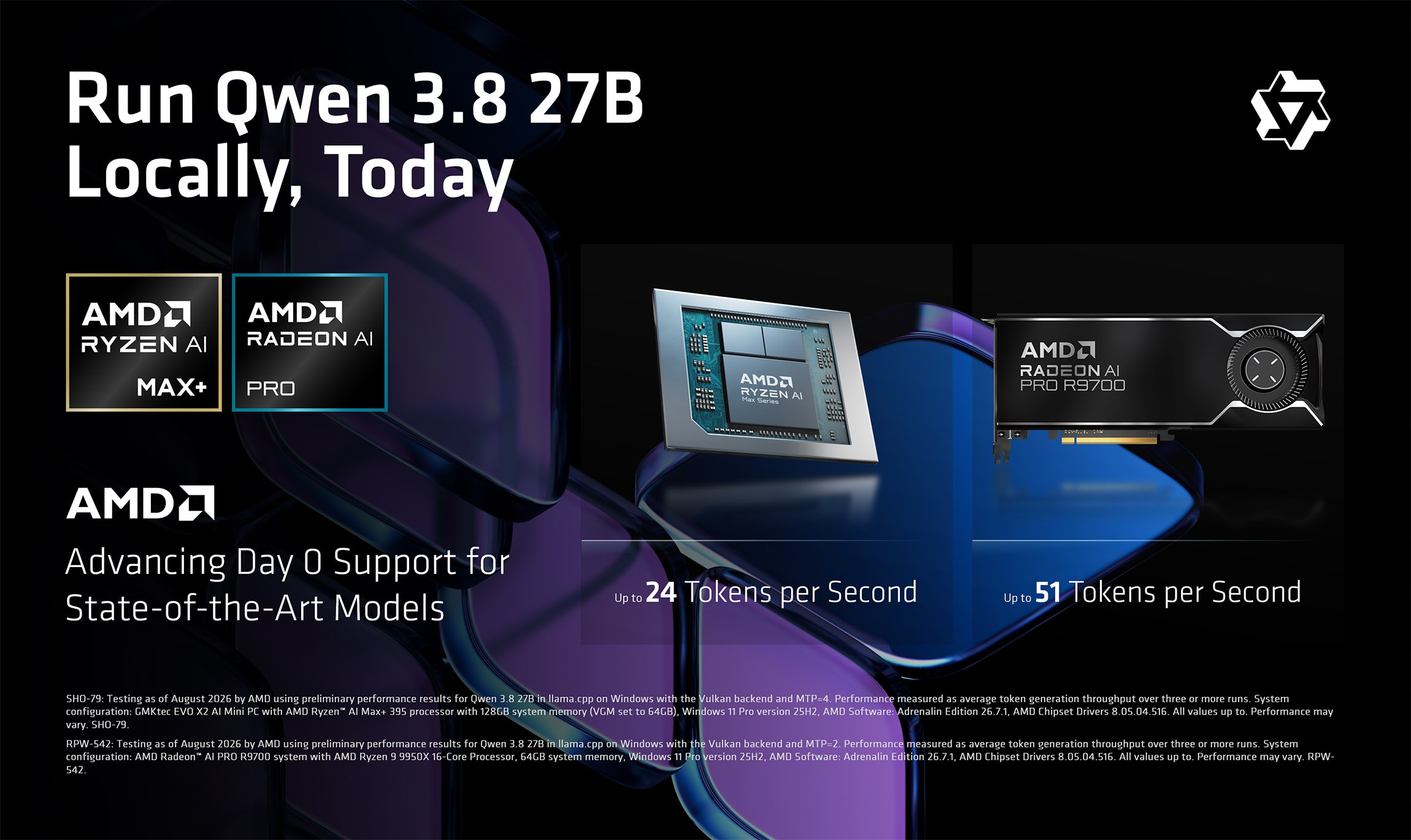
The model is built on a hybrid architecture of Gated DeltaNet (linear attention) and Gated Attention, has a native context of 262,144 tokens, and includes a default reasoning mode that can be adjusted via reasoning_effort (xhigh, medium, low) and preserve_thinking. In the vendor's official figures, Qwen3.8-27B is ahead of Opus4.6 Max on SWE-bench Pro (61.7 vs. 53.4), LiveCodeBench v6 (90.3 vs. 88.8), OSWorld-Verified (84.3 vs. 72.7), and AndroidWorld (81.9 vs. 62.0), but lags behind on GPQA Diamond (89.2 vs. 91.3), HLE (30.8 vs. 40.0), and Terminal Bench 2.1 (73.0 vs. 78.2). The same Qwen 3.8 generation includes the open MoE flagship Qwen3.8-2.4T-A95B with 2.4 trillion parameters, approximately 95 billion active, and a 1 million token context. The weights are hosted on Hugging Face under Apache-2.0, occupy about 55.6 GB in BF16, and run on vLLM and SGLang, while on release day AMD announced day-0 support on Ryzen AI Max and Radeon.
Context
Four years ago, Chinese labs were perceived as catchers, and open models as a cheaper option that lagged behind the closed frontier in quality. Today the picture is different: Alibaba is releasing open dense models that catch up to closed frontier systems on specific tasks, and it is doing so with an entire lineup, not a single release. The key field has become agentic workflows — coding, where the model writes and edits code itself, and computer use, where the model controls the interface. It is on these tasks that the cost per attention in long sessions becomes the main limiting factor, and open weights allow the model to be run in your own perimeter without paying for tokens.
Why this matters for the industry
The appearance of a dense model with 27.8 billion parameters under Apache-2.0, which fits on a single server and, according to official numbers, catches up to the closed frontier in agentic coding (SWE-bench Pro, QwenSWEBench) and computer use (OSWorld, AndroidWorld), shifts the argument that "frontier APIs are needed for agentic workflows" toward local and self-hosted solutions and increases price pressure on paid APIs. Anyone building a prototype on a frontier API can now recalculate the unit economics for a self-hosted 27B. Alibaba's bet on cheap long agentic sessions is visible in the architecture: hybrid DeltaNet attention and a context of up to 1 million tokens in the hosted version are aimed at this segment, and the release of an open MoE flagship with 2.4 trillion parameters in the same week shows that this is about an entire lineup, not a single model.
Why this matters for users
Practically, right now a reader can download the weights on Hugging Face, deploy the model on vLLM or SGLang on a single server, and get an agent with multimodal input — native understanding of images and hours-long videos, 262K context, and adjustable "thoughtfulness" via reasoning_effort. For on-prem and privacy products, this is an immediate opportunity without paying for tokens and without perimeter restrictions. Local operability is also claimed: on release day, AMD prepared day-0 support on Ryzen AI Max and Radeon, so the model can be tested outside the data center. For production without a pilot and its own latency measurements, it is still too early.
What is still unknown / limitations
The numbers are taken from the vendor's official benchmarks, and independent verification is not yet available, so the correct statement is "comparable to Opus4.6 Max according to official figures," not "frontier level in an open box." The biggest gap is on HLE (30.8 vs. 40.0, about 23% relative loss): on the most difficult scientific and reasoning benchmarks, the open 27B model lags significantly more than on agentic ones, so the claim "comparable to the frontier" is correct only for the domains of agentic coding and computer use.
Sources
- Qwen/Qwen3.8-27B — official model card (Hugging Face)
- Run Qwen 3.8 27B on AMD Ryzen AI Max Agentic PCs and Radeon GPUs (AMD day-0 blog)
- Model releases — QwenCloud changelog (Qwen3.8-2.4T-A95B, entry from August 13, 2026)
Author
Look at AI, editorial team