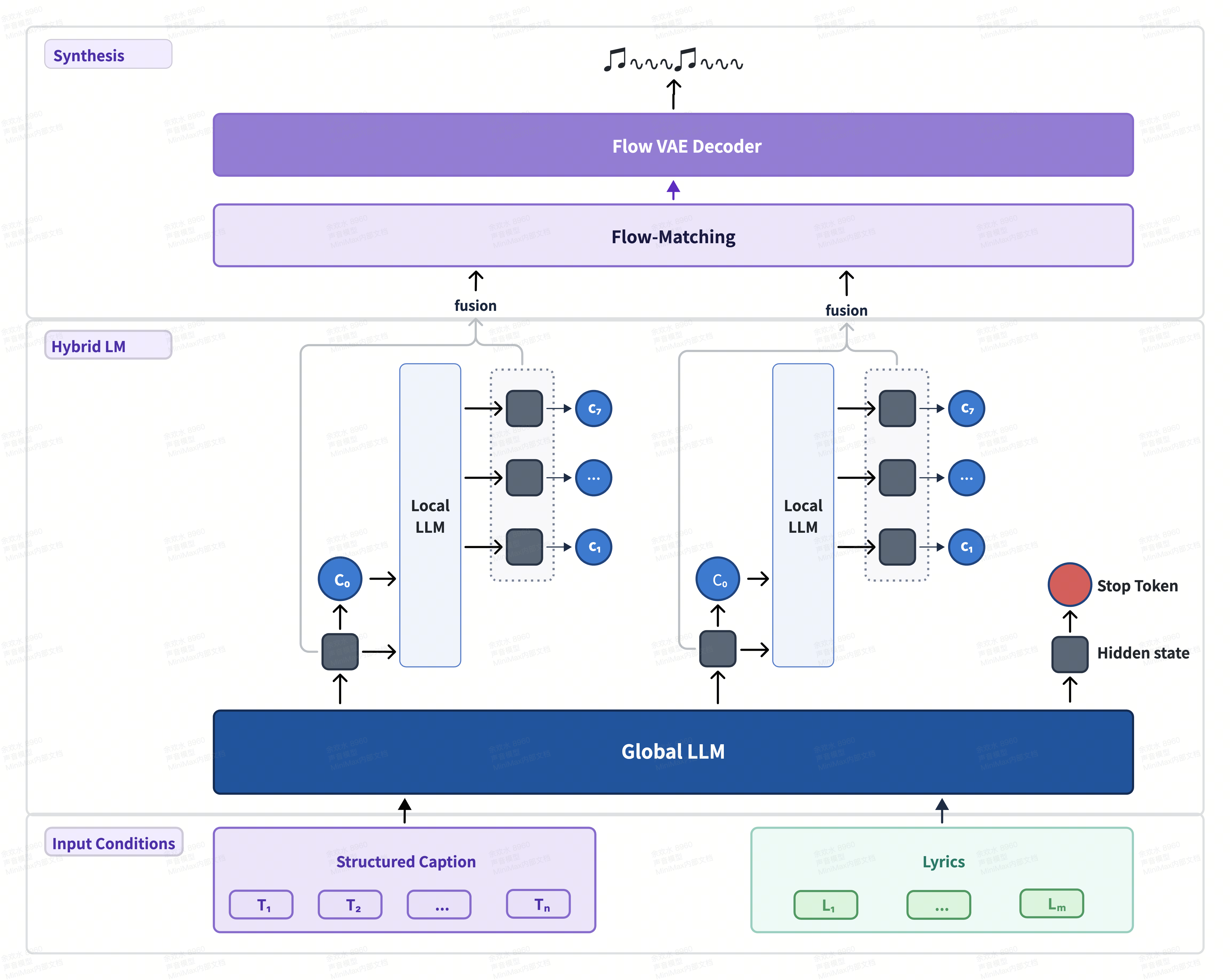
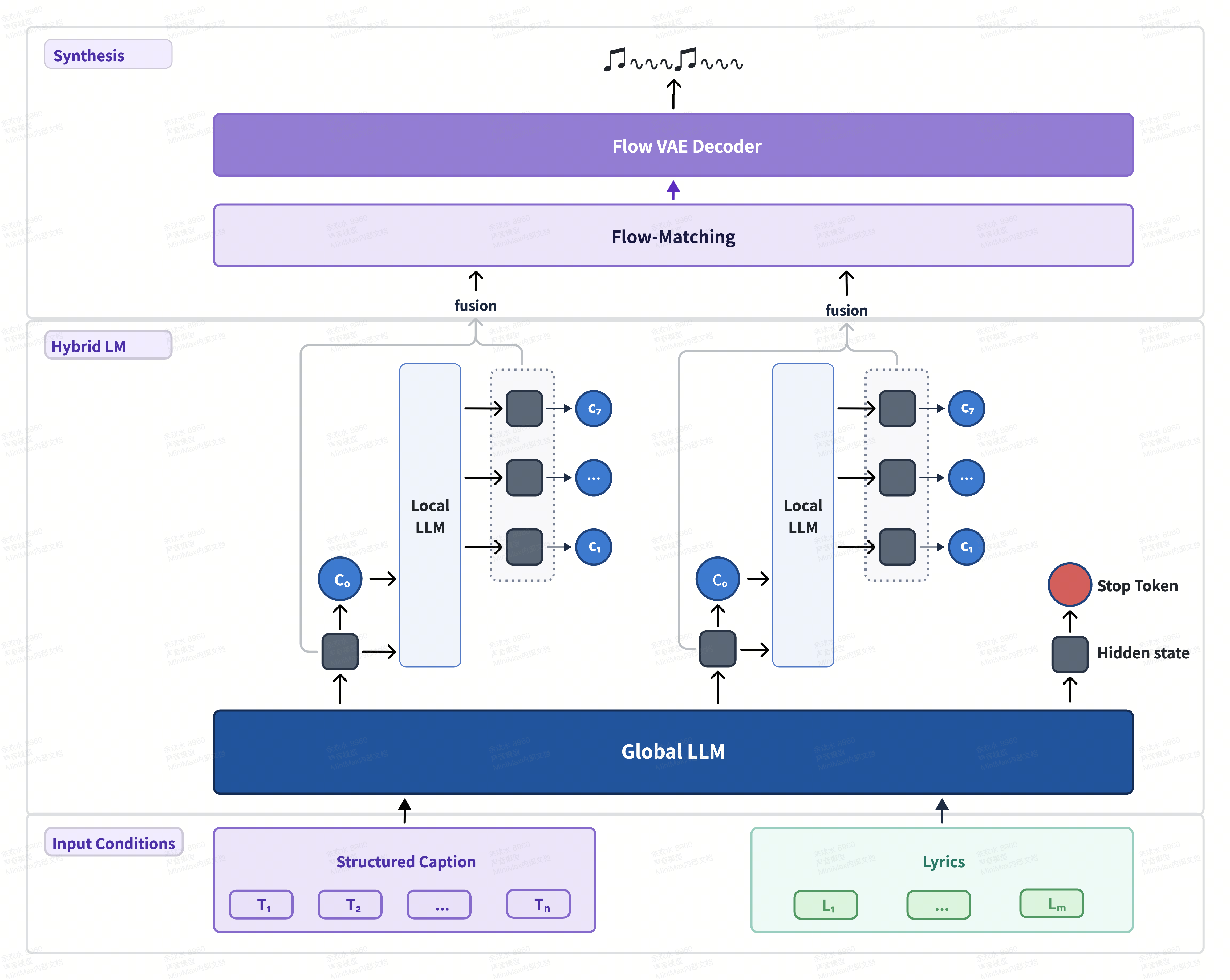
Chinese company MiniMax has released the weights of the MiniMax Music 3 model — a generator of full musical tracks up to 5 minutes long with lyrics, vocals, and arrangement. The architecture is hybrid: an 8B Global LLM based on Qwen3-8B for structure and a 0.6B Local LLM for acoustic details. Synthesis is done via Flow Matching (2.4B) + Flow-VAE (123M). Inference on two GPUs: 24 GB VRAM standard, 8 GB with streaming. Tokenization — 8-layer RVQ. Distributed under Apache 2.0.

What happened
On August 13, 2026, MiniMax published MiniMax Music 3 with open weights. The model generates full tracks up to 5 minutes long with controllable structure, vocals, and arrangement. Input — song text with section tags ([Verse], [Chorus], etc.) and a detailed music description via Structured Caption. Integrations are available in diffusers, ComfyUI, and SGLang-Omni. Official API on platform.minimax.io.
Context
MiniMax continues its open-weights strategy (after H3) in the music generation segment, where closed solutions like Suno and Udio previously dominated. The Global + Local LLM architecture pattern with Flow Matching is a modern approach to audio generation. Tokenization via 8-layer RVQ with a semantic codebook of 16384 + 7 acoustic layers of 1024 each provides a hierarchical representation of audio.
Why this matters for the industry
The model raises the bar for open-source music generation to the level of closed Suno and Udio with minimal hardware requirements (8 GB VRAM) and an Apache 2.0 license. This makes music-as-a-feature practically free for startups. Integrations with ComfyUI and diffusers mean developers will start experimenting in the first week. SGLang-Omni will add batch-inference optimizations.
Why this matters for users
You can run it locally on a GPU with 8+ GB VRAM or use it via ComfyUI for integration into workflows. The API on platform.minimax.io allows generating music via API. The music-caption-rewriter tool automatically converts simple descriptions into professional prompts. Structured control (section tags, BPM, genre) provides a UX foundation for applications.
What is still unknown / limitations
No peer has indicated objective quality metrics (MOS, FAD, PESQ, Clarity Score) or a head-to-head benchmark comparison with Suno and Udio. The production-ready claim requires empirical confirmation. The main question for production is the actual latency of generating a 5-minute track and stability in long-term generations.
Sources
- MiniMax Music 3.0: Next-Generation Open-Weights, Production-Ready & Versatile Music Model
- MiniMax-AI/MiniMax-Music3 — GitHub
- MiniMaxAI/MiniMax-Music3 — Hugging Face
Author
Look at AI, editorial team