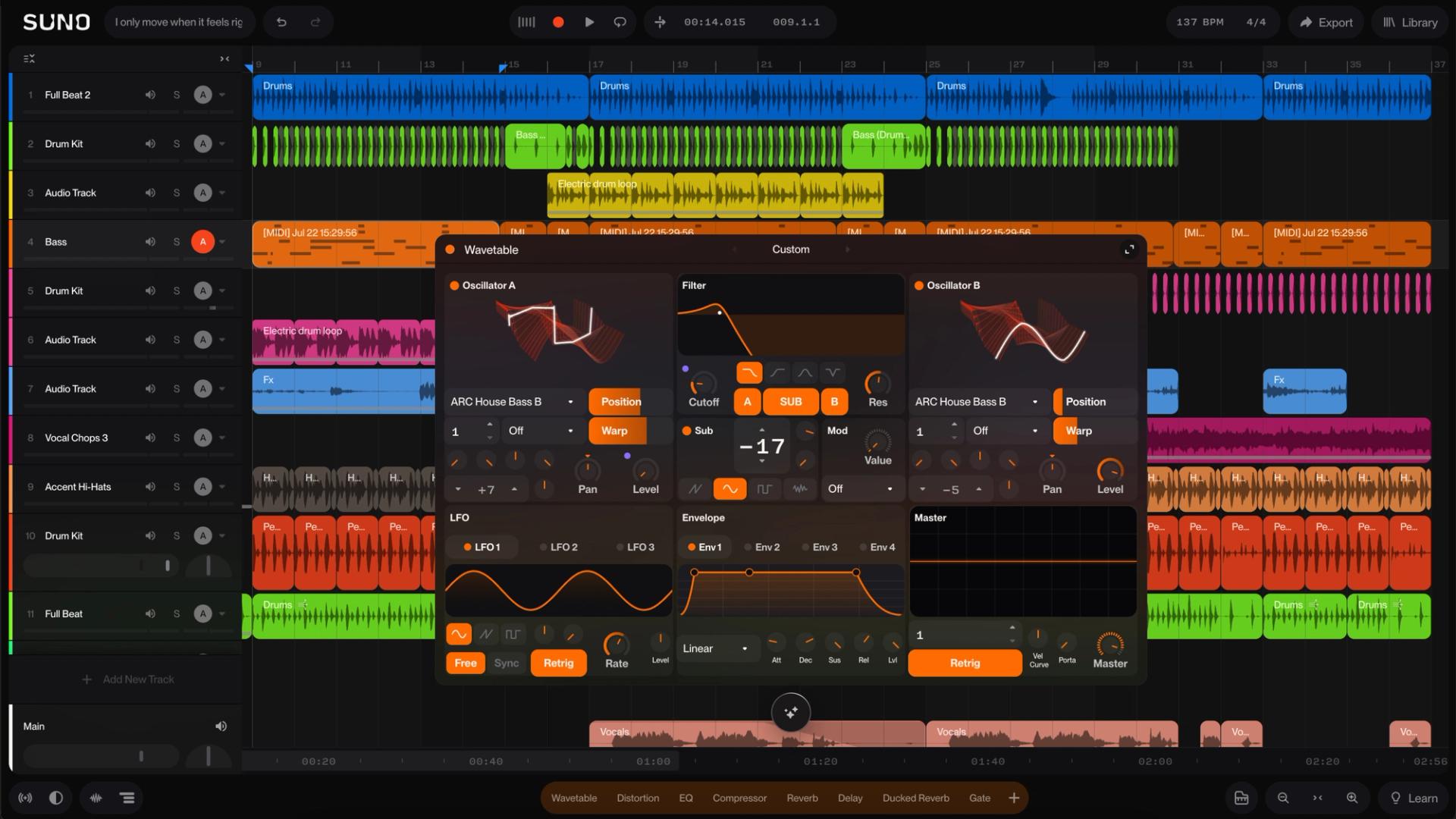
Suno has released Studio 2.0, a major update to its browser-based DAW for Premier subscribers that transforms the AI music generator into a full professional workspace with a MIDI workflow, natural language generation of custom plugins, and studio-quality export.
What Happened
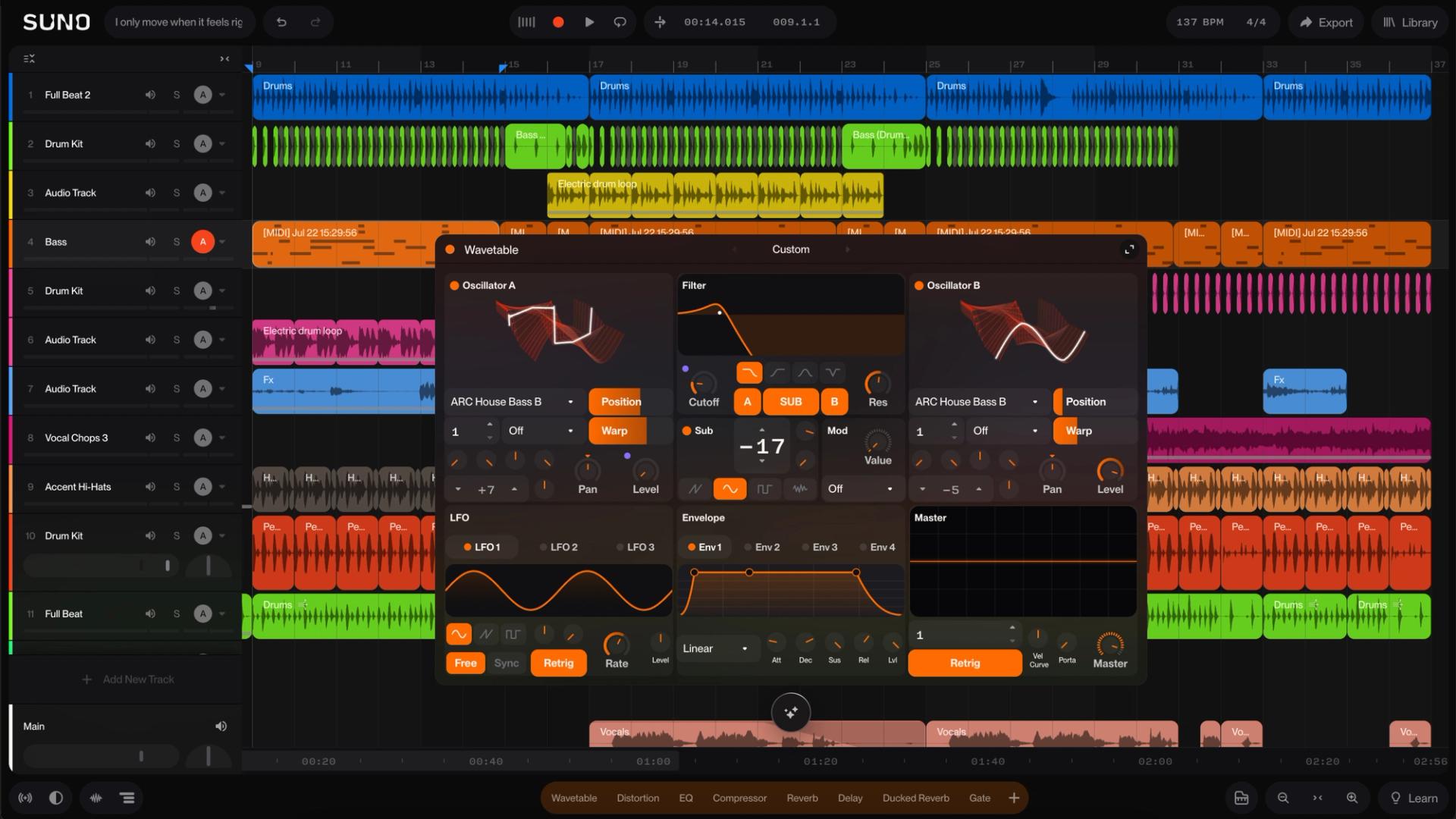
Suno released Studio 2.0 with a full set of tools for professional production: importing, recording, and editing MIDI clips on the timeline, connecting MIDI keyboards and controllers, a built-in wavetable synthesizer, a suite of effects (EQ, compression, delay, distortion, reverb, convolution reverb, sidechain compression), and parameter automation. The Chat Bar is now in beta, a system that generates instruments, vocals, custom effect plugins, and presets from text prompts, saving them to the user's library. Stem separation has been updated to six tracks: vocals, drums, bass, guitar, keyboards, and effects. Musical typing with an arpeggiator and chord mode, as well as MIDI Learn for mapping parameters to hardware controllers, have been added. Unlimited export in multitrack/stems format at 32-bit / 48 kHz. Third-party VST/AU plugins are not supported. Studio 1.x will be discontinued in September 2026. The release coincided with the announcement of Suno's joining the BMG Global AI Music Alliance.
Context
Suno was previously known primarily as an AI music generator from text prompts — a model that produced finished tracks but did not allow detailed control over the process. Competing solutions like Udio and AIVA operate in a similar "prompt → track" paradigm. Studio 2.0 changes this model: MIDI clips are used as a prompt for audio generation, which represents a novel conditioning modality — MIDI-conditioned audio generation, technically distinct from text-to-audio and requiring a separate model or cross-modal encoder. Joining the BMG Global AI Music Alliance is the first step toward the institutionalization of AI music at the level of major labels and rights holders. The discontinuation of Studio 1.x in September means a full migration of the user base to the new architecture.
Why This Matters for the Industry
The launch of Studio 2.0 signals that AI audio generation is moving beyond prototypes and being integrated into professional workflows. For startups selling "AI music generators," this is pressure: Suno already offers MIDI, stem separation, and NLP-controlled effect generation in the browser via subscription. The competitive advantage is shifting toward niche models or B2B integrations. Competitors (Udio, AIVA) are expected to be forced to release similar MIDI features and AI chats. Traditional DAWs (Ableton, FL Studio, Waveform) will also likely respond, probably by adding AI assistants. The BMG Alliance could lead to the emergence of industry standards for evaluating AI music systems. For ML engineers, Studio 2.0 sets a benchmark: if Suno can handle real-time generation latency in the browser, it is achievable for self-hosted solutions as well. The pattern of "generating instruments and effects from natural language" via the Chat Bar implies a chain-of-thought or planning mechanism within the system — a technically non-trivial task for the audio domain.
Why This Matters for Users
For producers and musicians working with AI, Studio 2.0 is the first browser-based product that combines MIDI editing, stem separation, and natural language effect generation in a single workflow. Creating professional music is reduced to the level of a "text prompt + browser," and a new layer of value shifts to control and customization. Premier subscribers can already test the new workflow: connect a MIDI keyboard, write a part on the timeline, ask the Chat Bar to generate a custom effect, and get a ready-made plugin. Unlimited 32-bit / 48 kHz export allows the results to be used in professional production. The lack of support for third-party VST/AU plugins and API documentation limits integration with existing studio pipelines.
What Is Still Unknown / Limitations
Technical details of the models, architectures, and training methods are completely closed — Suno has not published a paper or benchmark results. The quality of the Chat Bar is unknown without independent testing: the architecture of the multi-modal generative system (text-to-audio + text-to-plugin), baseline quality, and real-time latency have not been disclosed. Stem separation has been improved to six tracks, but without benchmarks (MUSDB, SIGSEp), it is impossible to assess progress relative to SOTA. The claim that Studio 2.0 is a proof-of-concept for a professional AI-first DAW overestimates the ML novelty: technically, Suno is likely combining known architectures — diffusion/autoregressive audio models and an LLM for the Chat Bar. There is no real scientific novelty in the publication; it is an engineering integration. There are no open-source analogs yet, no API, and the ecosystem remains closed.
Sources
- Suno — official release notes Studio 2.0
- Suno Help Center — Introducing Suno Studio 2.0
- Music Week — Suno launches Studio 2.0 with MIDI support and AI chat bar
Author
Look at AI, editorial team