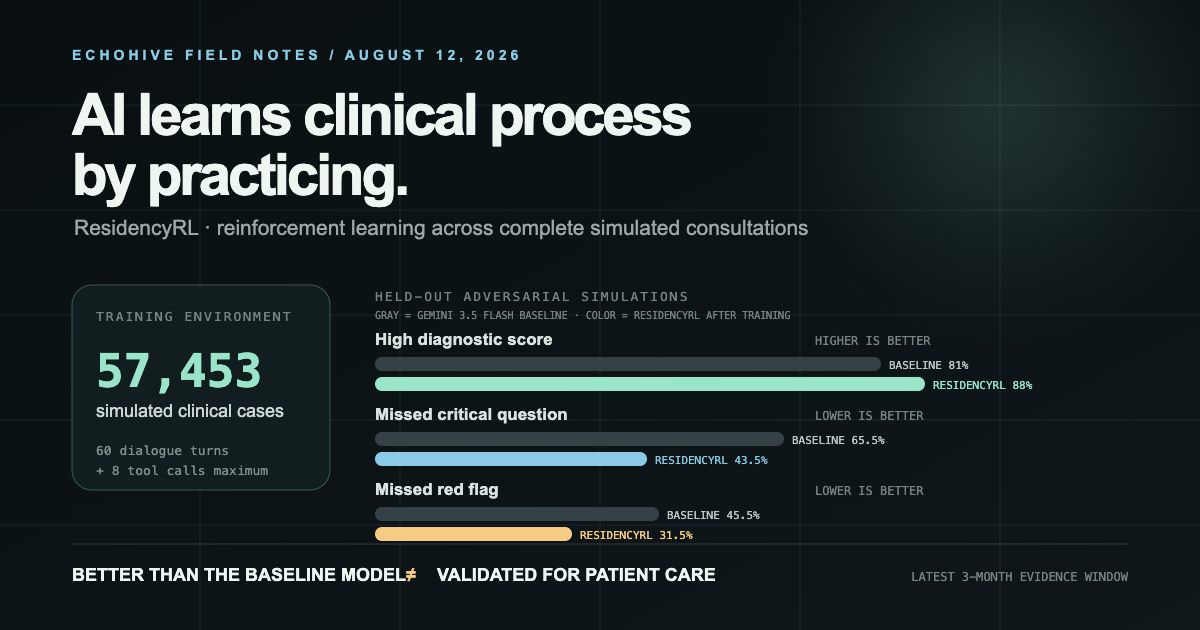
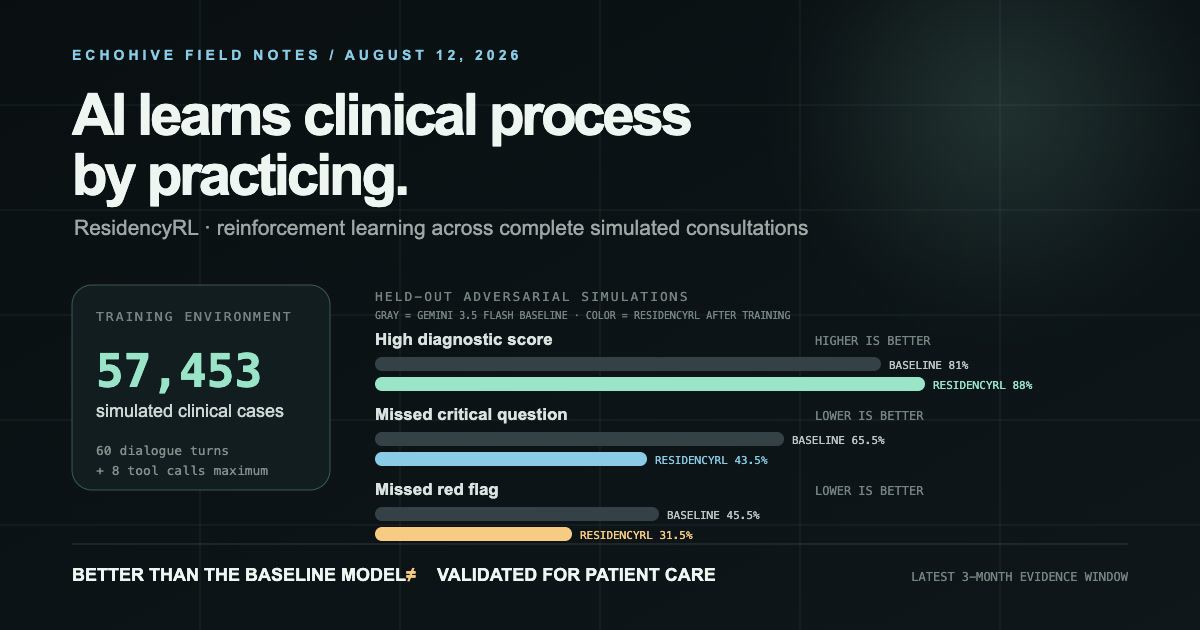
A team of 35 researchers led by Valentin Liévin introduced ResidencyRL, a reinforcement learning method for clinical AI agents that teaches the model sequential medical reasoning through simulated patient consultations. The work was published on arXiv (2608.07418) on August 7, 2026. The Gemini 3.5 Flash-based agent shows a 7 percentage point improvement in diagnostic accuracy on complex tests and a 31% reduction in missed critical signals, although the remaining rate of missed 'red flags' is still 31.5%.

What happened
Researchers introduced the ResidencyRL method, in which an AI agent undergoes a residency through simulated multi-turn patient consultations: up to 60 dialogue turns and 8 tool calls per trajectory. The training set includes 49,870 telemedicine cases covering 81 diagnoses, 5,000 history-taking scenarios, and 2,583 adversarial safety cases. On complex diagnostic tests, accuracy reached 88% compared to 81% for the base Gemini 3.5 Flash model. Missed critical questions decreased from 65.5% to 43.5%, and missed red flags from 45.5% to 31.5%. Blind clinician experts preferred the responses of the trained agent over those of the base model.
Context
Reinforcement learning in a simulated environment is a relatively new approach for clinical AI agents. Early systems were trained on text corpora or through supervised fine-tuning, which provided point improvements in answering specific questions but did not affect the multi-step reasoning process. ResidencyRL uses RL training on long horizons of up to 60 turns, which requires stable reward modeling—a task rarely solved in clinical domains. The method's analogy to real medical residency: just as a young doctor completes an internship under a mentor, the AI agent learns through repeated simulations with feedback. The approach showed skill transfer to external benchmarks AMIE Multi-Visit, AgentClinic, and CRAFT-MD.
Why this matters for the industry
ResidencyRL establishes a new baseline for multi-turn clinical reasoning agents: the method proves that RL in simulation can teach the process of clinical reasoning itself, not just point answers. For the research community, this opens the way to replications on open-weight models like Llama and Qwen—if similar results are achieved on locally deployed models, this will eliminate dependence on proprietary APIs. For the industry, a technological foundation emerges for a new class of AI assistants for primary diagnosis: structured history taking, checking against clinical protocols, documentation. The simulation plus RL architecture is reproducible for already narrower domains with lower risk, such as corporate medicine or primary screening. For investors—a new narrative in healthtech: RL-trained clinical agents instead of LLM chatbots. There are no direct products, APIs, or open-source code at the moment.
Why this matters for users
The work shows one of the realistic paths for training AI in medical judgment through practice on simulations, similar to real medical residency. In the near term, the technology may appear as an auxiliary tool for doctors: structured history taking on telemedicine platforms, checking prescriptions against clinical guidelines, automatic documentation of consultations. For patients, this may mean a higher-quality primary consultation with an AI assistant that asks more correct questions and less often misses dangerous symptoms. However, it is far from independent diagnosis or treatment by an AI agent—prospective studies with real patients, which have not yet been conducted, are necessary.
What is still unknown / limitations
The remaining rate of missed red flags is 31.5%, which is unacceptable for autonomous clinical use. The training set covers only 81 diagnoses—a narrow subset of real practice, and the model has not been tested on out-of-domain specialties like surgery or pediatrics. All three external benchmarks (AMIE Multi-Visit, AgentClinic, CRAFT-MD) operate in the same telemedicine domain, so transfer to them confirms validation but does not guarantee generalization. There is no data on latency, inference cost, or stability under production load. There is no open API, open-source code, or SDK. Prospective studies with real patients have not been conducted. It is unclear whether the results will be reproduced on open-weight models.
Sources
- ResidencyRL: Reinforcement Learning in Simulated Clinical Environments — arXiv
- ResidencyRL: Can AI Learn Clinical Judgment in Simulation? — EchoHive
- Hacker News discussion
Author
Look at AI, editorial team