Google has released the Gemini 3.7 Flash model, the third workhorse model in the Gemini 3 lineup, just three weeks after the 3.6 Flash release. The new model is focused on coding and agentic tasks, and its introductory price through the end of 2026 is half the base rate.

What happened
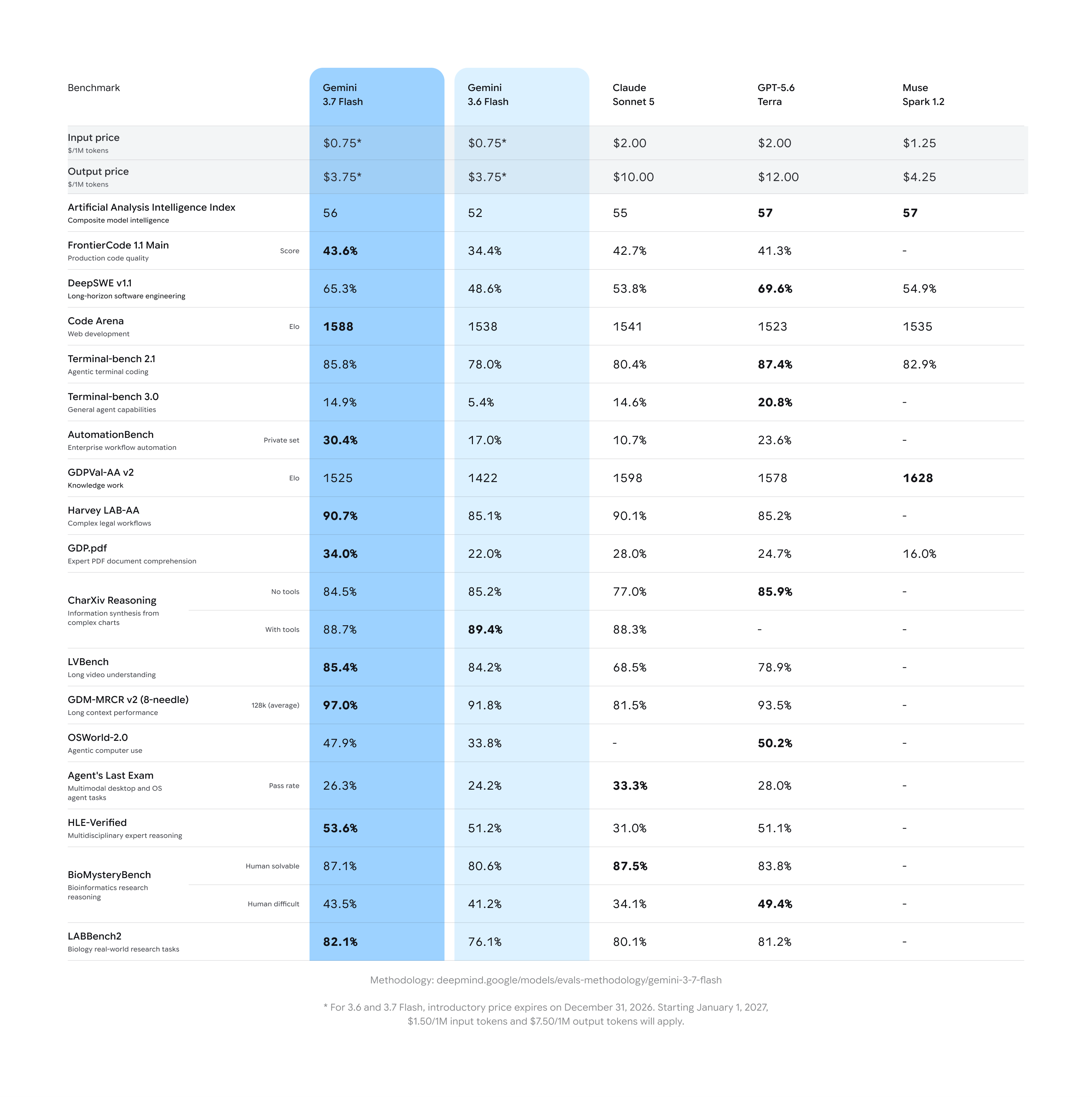
Gemini 3.7 Flash is available at a discounted price through the end of 2026: $0.75 per 1 million input tokens and $3.75 per 1 million output tokens. On January 1, 2027, the price will rise to $1.50 and $7.50 respectively. According to Google, the model showed significant growth on key benchmarks: FrontierCode 1.1 Main — 43.6% versus 34.4% for the previous version, DeepSWE v1.1 — 65.3% versus 49.0%, WebDev Arena — 1588 versus 1538 Elo, AutomationBench — 30.4% versus 17.0%. The model is already integrated into Google AI Studio, Android Studio, Google Antigravity, and Gemini Enterprise, and AI Pro and Ultra subscribers get access through the Gemini Spark agent. Google has also updated its safety mechanisms in the CBRN — chemical, biological, radiological, and nuclear weapons — domains.
Context
The three-week cycle between Flash model releases significantly exceeds the pace of competitors — OpenAI, Anthropic, and Mistral. Meanwhile, the flagship Gemini 3.5 Pro model, which was promised as early as June, has still not been released, indicating a shift in Google’s priorities toward the workhorse lineup. The base price of Gemini 3.7 Flash ($1.50/$7.50) after the promotional period remains higher than competitors’ offerings — for comparison, GPT 5.6 Luna is priced at $0.20/$1.20.
Why this matters for the industry
Google’s accelerated update cycle puts pressure on the entire industry in terms of iteration speed: companies unable to release updates every few weeks risk losing developers. The dual-pricing strategy — a 50% discount through the end of the year followed by a doubling — is designed to drive rapid migration of teams to the new model. If the pace is maintained, the Flash lineup could release 8–10 iterations per year by 2028, fundamentally changing the economics of LLM development.
Why this matters for users
The model is available for free testing in Google AI Studio right now — developers can evaluate improvements in code generation and agentic behavior. Google AI Pro and Ultra subscribers are already getting the model through Gemini Spark, which provides noticeable improvements in performing multi-step tasks and working with professional documents in finance, law, and biology. For regular users of the main Gemini chat, the model has not changed — it continues to run on 3.6 Flash. Through January 2027, teams have a window for load testing and integration before prices double.
What is still unknown / limitations
All benchmarks in this release are self-reported by Google. Without independent verification of results on FrontierCode 1.1 Main, DeepSWE v1.1, AutomationBench, and WebDev Arena, it is impossible to judge the real significance of the improvements. There are also no published data on API latency and context window size, which makes a full assessment for production workloads difficult.
Sources
- Gemini 3.7 Flash: our most intelligent workhorse model — Google Blog
- Gemini 3.7 Flash — Model Card
- Google announces Gemini 3.7 Flash just three weeks after previous release — Ars Technica
Author
Look at AI, editorial team