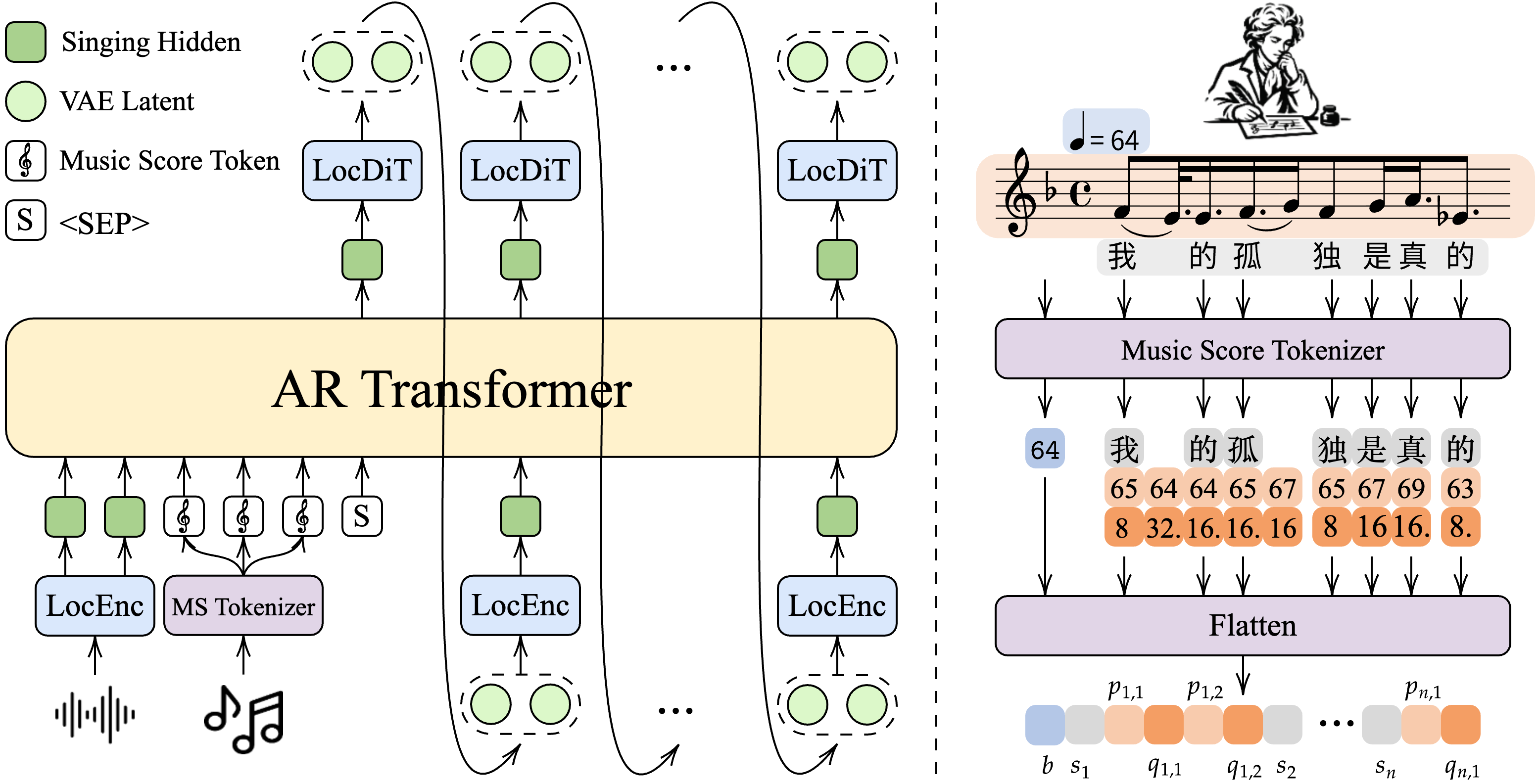
A team of researchers Chen, Wang, Mu, Yang, Chng has presented VocalRender — a vocal synthesis system that generates vocal performance directly from a score: MIDI part, text syllables, and tempo. The model eliminates the main bottleneck of modern SVS systems — the need for explicit prediction of phoneme durations and F0 curves — and makes the composer's workflow compatible with vocal generation. Weights and code are open under the Apache-2.0 license.


What happened
VocalRender takes three parameters as input: MIDI-pitch (notes), text syllables, and BPM — and independently determines articulation and timing. The architecture is based on VoxCPM2 from OpenBMB and includes three key components: interleaved lyric-note tokenization, AudioVAE for continuous acoustic latents, and an autoregressive diffusion model (ARDM) for generation. Two checkpoints have been released — VocalRender (trained on CrawlSinger-OS, over 2300 hours of vocals) and VocalRender-Pro (over 5600 hours, 160 thousand training steps). Each weighs about 9.5 GB and outputs 48 kHz WAV audio. To set the timbre, a prompt audio is required — a clean vocal segment 2–8 seconds long. The article was published on arXiv on July 30, 2026 (2607.27768).
Context
Before the emergence of score-native approaches, SVS systems — SoulX-Singer, TCSinger, TechSinger, Vevo2 — required explicit prediction of phoneme durations and time-aligned acoustic references. This created an intermediate stage between the score and generation that did not match the actual workflow of composers working in a MIDI environment. VocalRender's interleaved lyric-note tokenization solves the non-trivial problem of musical tokenization: it supports melismas, where one syllable is distributed over several notes. The hybrid combination of an autoregressive model with diffusion (ARDM) combines the efficiency of autoregressive generation with the quality of diffusion models. Using VoxCPM2 as a foundation allows the model to inherit pre-trained TTS representations, reducing the amount of data needed for SVS specialization.
Why this matters for the industry
VocalRender outperforms the best baselines by 0.42 points on the CMOS metric (sound naturalness) and achieves a WER of 3.88% on the Opencpop benchmark. The score-native architecture eliminates the need for intermediate pipelines, making the system compatible with the composer's workflow and opening the way to integration into DAW environments. Current SVS products built on proprietary pipelines with duration prediction lose part of their technical advantage. Open weights and the Apache-2.0 license allow startups and researchers to use the model as a base layer. The VoxCPM2 architecture is inherently multilingual, leaving the way open for expanding language support through community fine-tuning.
Why this matters for users
The model is available for testing right now: the HuggingFace demo allows you to upload a short vocal segment and a MIDI part with text to get a result. Code and weights are open on GitHub, the model can be run locally on a GPU. For the Russian-speaking community, only Mandarin Chinese is currently available, but the prompt-audio approach and the VoxCPM2 architecture leave the possibility of fine-tuning on other languages. Developers can start integrating VocalRender into DAW plugin prototypes, voice-cloning services, and musical AI tools.
What is still unknown / limitations
Only Mandarin Chinese — multilingual support is not yet implemented. There is no public data on inference latency: ARDM generation of 48 kHz audio requires significant computational resources. There are no fine-tuning instructions. There are no serving optimizations for production deployment — TensorRT acceleration, quantization, and similar optimizations are not claimed. Quality on Russian vocals has not been tested.
Sources
- arXiv — VocalRender: Score-Native Singing Voice Synthesis for Real-World Composition
- GitHub — pymaster17/VocalRender
- VocalRender — Audio Demo
Author
Look at AI, editorial team