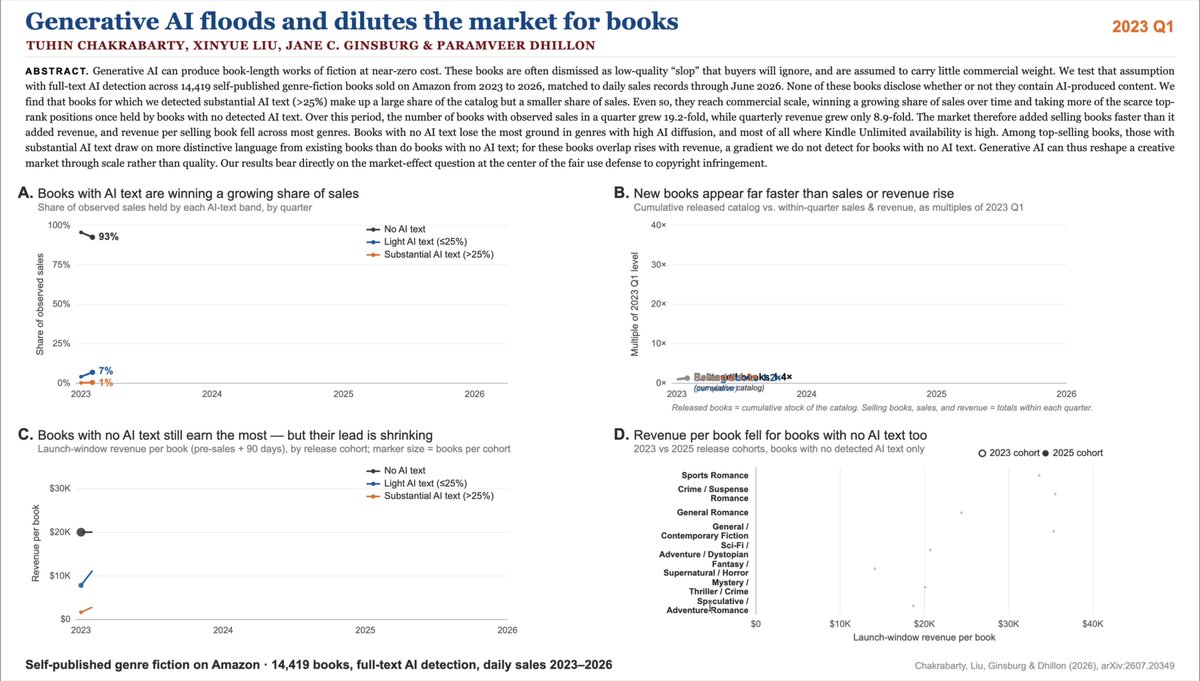
A new study, arXiv:2607.20349, has revealed a radical transformation of the self-publishing market on Amazon: between 2023 and 2026, the volume of the book catalog grew 38-fold, while total revenue increased by only 9-fold. This indicates a massive saturation of the platform with cheap AI content, which dilutes the economic value of each individual publication.

What Happened
Researchers from UMich, Stony Brook, and Columbia Law recorded that approximately 20% of genre literature on Amazon now contains more than 25% AI-generated text. Such a sharp increase in supply, coupled with significantly slower revenue growth, points to a "market dilution" effect, where low costs of content generation lead to the devaluation of individual units of production.
Context
The current situation confirms concerns raised in major lawsuits, such as *Kadrey v. Meta*, regarding copyright infringement. The use of generative AI allows for scaling content production to incredible volumes, creating conditions where traditional authors are forced to compete not only with colleagues but also with an endless stream of synthetic material.
Why It Matters for the Industry
For the industry, this means the destruction of the classic economic model of creative professions through oversupply. This creates new niches for the development of quality verification tools, AI content detection systems, and specialized copyright protection mechanisms, as existing platforms face critical catalog noise.
Why It Matters for Users
It is becoming increasingly difficult for readers to find high-quality new releases due to stores being overwhelmed with low-quality content. For authors, it is becoming harder to monetize their work, as the massive volume of cheap AI text reduces the profitability of each book and complicates the competition for audience attention.
What Is Not Yet Known / Limitations
Opinions regarding the consequences are divided: while this poses direct risks to traditional publishers and authors, for AI tool developers, it may serve as a tool for the large-scale expansion of content creation capabilities.
Sources
Author
Look at AI, Editorial Staff