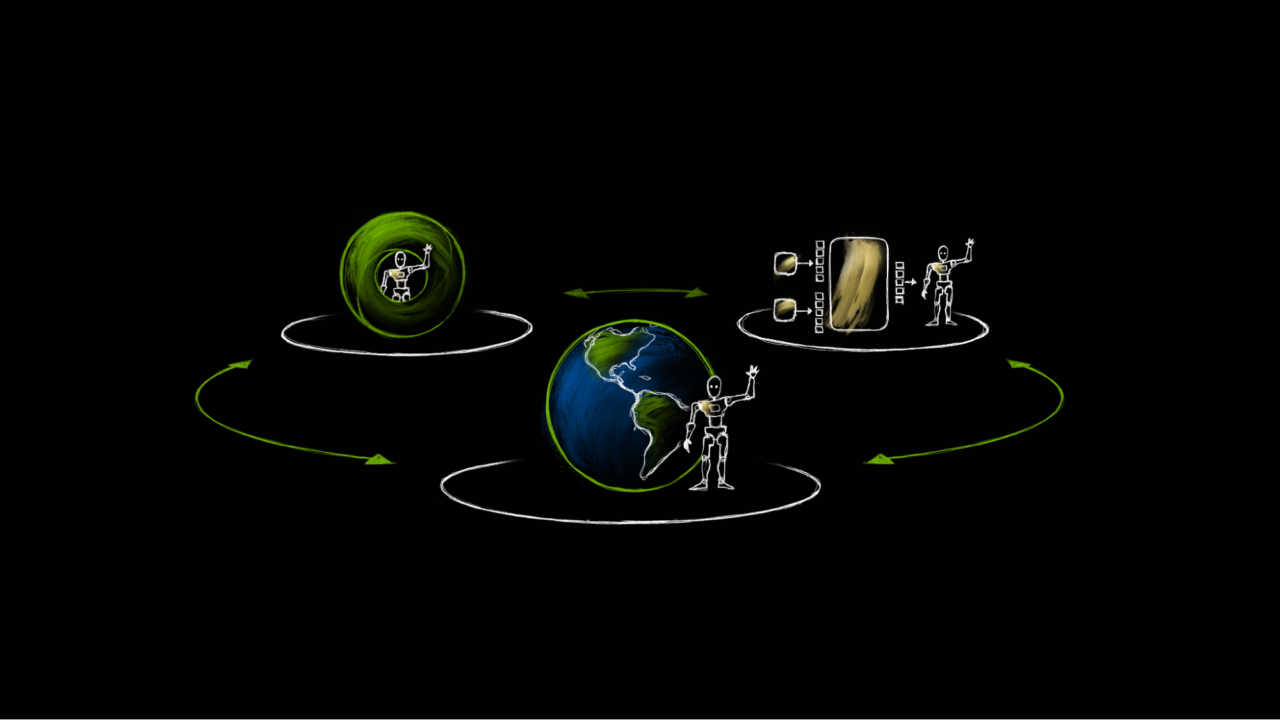
NVIDIA, in collaboration with Google DeepMind and Disney Research, has introduced Newton — a new GPU-accelerated differentiable physics engine built on NVIDIA Warp and OpenUSD. This tool marks the transition of Physical AI from simple visualization to the creation of full training loops within simulation.

What Happened
A new differentiable engine, Newton, has been presented, utilizing NVIDIA Warp and OpenUSD to provide GPU acceleration. This technology allows physics to be integrated directly into the gradient descent process. The overview also highlights key components of the ecosystem: training clusters, simulation workstations, and edge devices such as the NVIDIA Jetson AGX Thor. A comparative analysis of existing engines was conducted: MuJoCo for biomechanics, Isaac Sim for digital twin creation, and Drake for mathematically precise trajectory optimization.
Context
The development of Physical AI requires solving the data scarcity problem for training robots in the real world. The modern industry is shifting from using simulation as a visualization tool to using it as part of a closed-loop learning process. To achieve this, a specialized stack is being created that links high-fidelity simulators with powerful Edge hardware.
Why It Matters for the Industry
Simulation is becoming a critical layer in the Embodied AI stack. The emergence of differentiable engines allows physical laws to be used directly in gradient optimization, which radically accelerates the training of robots for complex manipulations. This is forming a standard technological stack where simulation and real hardware are linked through an end-to-end training process.
Why It Matters for Users
Engineers and developers gain access to powerful tools for creating synthetic data, reducing dependence on expensive real-world data. The use of high-fidelity simulators and ready-to-use SDKs, such as NVIDIA Warp and OpenUSD, shortens the path from a digital model to a real robot, making the prototyping of physical agents cheaper and faster.
Sources
Author
Look at AI, Editorial Team