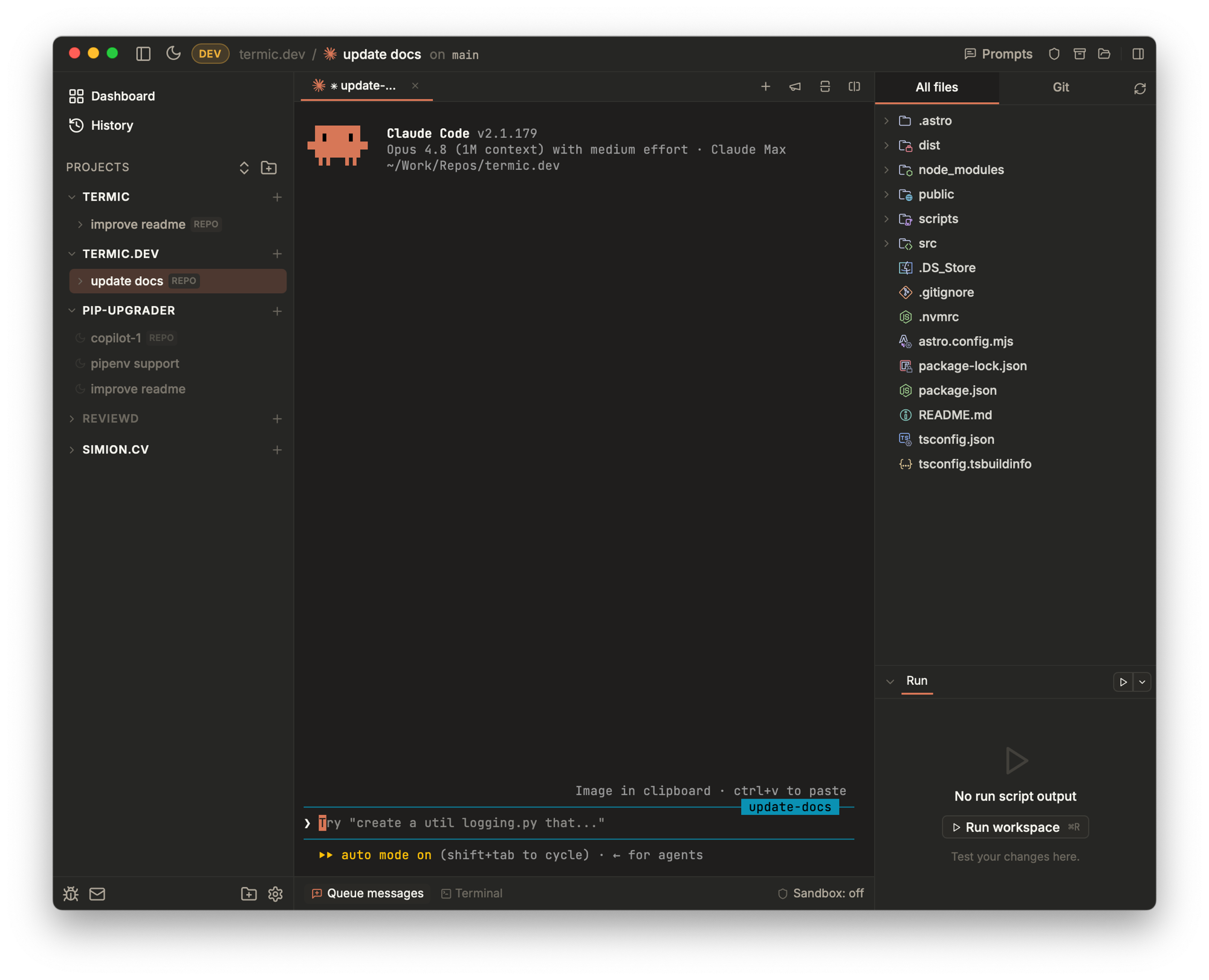
The open-source application Termic (AGPL-3.0) has been released, allowing you to manage CLI agents such as Claude Code, Codex, and Gemini directly through a desktop interface. Instead of using expensive proprietary SDKs, the tool runs actual agent binaries in PTY terminals, enabling the use of existing Pro/Max subscriptions without additional API token costs.


What Happened
Developers have introduced Termic—a desktop application based on Rust/Tauri2 designed for AI agent orchestration. The application uses PTY terminals to run native CLI tools, supports session isolation using Git worktrees, enables parallel operation of multiple agents, and includes security mechanisms such as a macOS sandbox to control file system and network access.
Context
Traditionally, working with AI agents requires integration via vendor SDKs, which often entails additional API usage costs and lock-in to specific provider pricing models. Termic offers a different architectural approach, shifting the focus from APIs to managing native command-line interfaces.
Why It Matters for the Industry
The emergence of such tools reduces developer dependency on proprietary SDKs and vendor monetization models. This stimulates the growth of the open AI agent ecosystem and may contribute to the formation of a 'Bring-Your-Own-Agent' (BYOA) standard, where local orchestrators manage cloud agents through unified CLI interfaces.
Why It Matters for Users
Users gain the ability to save on API token budgets by using their current Pro/Max subscriptions. The tool also provides a more secure environment for running powerful coding agents thanks to process isolation and control over network activity.
What Is Not Yet Known / Limitations
There are potential legal risks (ToS risks) regarding the legitimacy of bypassing provider monetization mechanisms by using CLI instead of official SDKs.
Sources
Author
Look at AI, Editorial Team