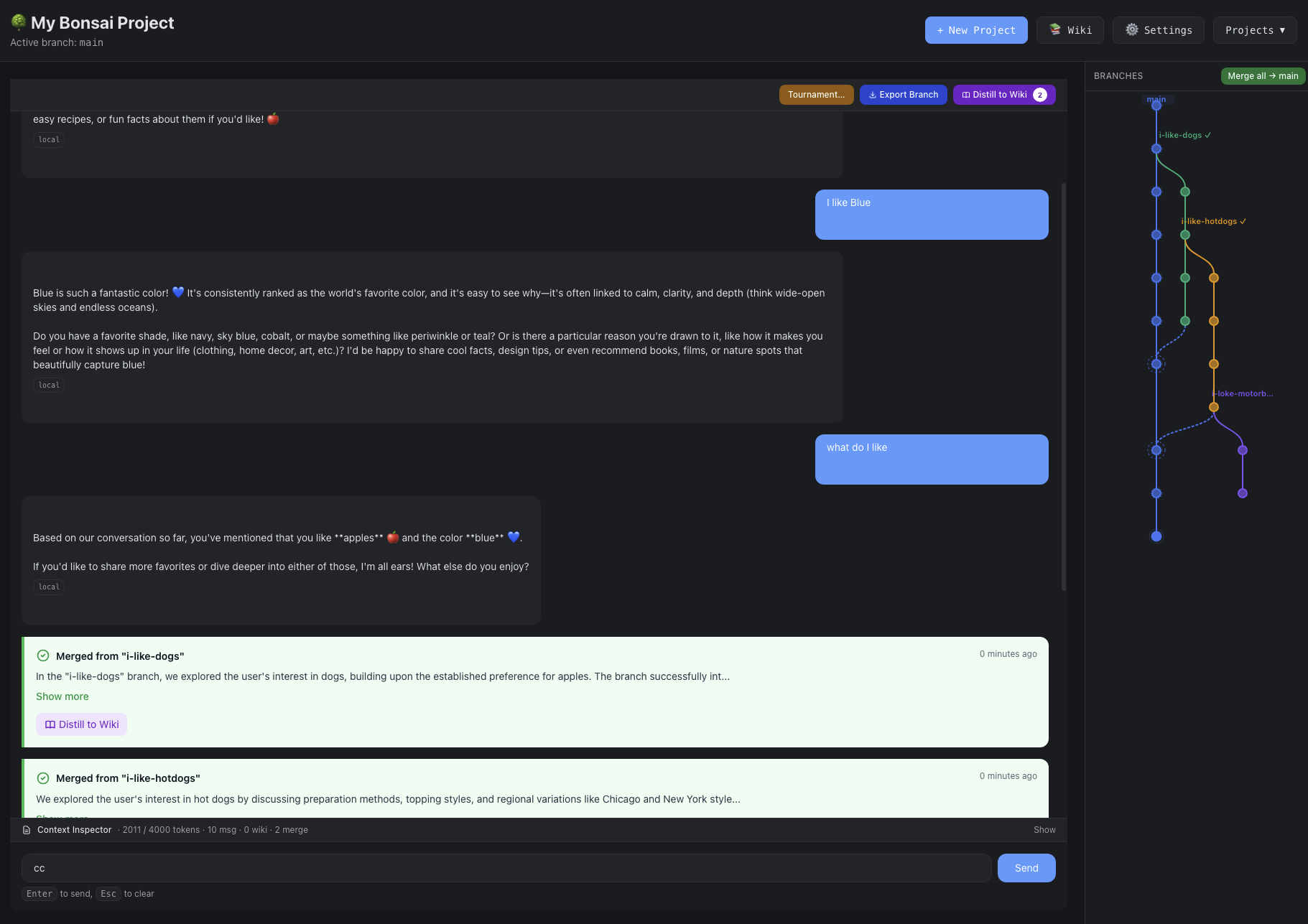
Developers have introduced the Bonsai library—a new tool for building AI applications that replaces linear message history with a tree-based context management model.

What Happened
The Bonsai library has been released, enabling the construction of chat applications with branched dialogue structures. Instead of a single line of messages, the tool implements a tree model where users can create branches to explore new ideas without disrupting the main flow. The functionality includes mechanisms for explicitly merging branch summaries into the main stream and distilling important discussions into Markdown wikis for long-term use.
Context
Traditional AI interfaces use linear message histories, which leads to "context degradation" in long dialogues and the loss of core meaning when topics change. Bonsai proposes a shift from model-level context management to application-level context management, allowing current LLMs to be used effectively without the need for fine-tuning.
Why It Matters for the Industry
For the industry, this signifies the emergence of a new architectural pattern: managing agent memory through structured branches and external knowledge bases (wikis) instead of passing the entire message history. This reduces the load on the context window and could lead to the integration of similar methods into popular frameworks like LangChain or LlamaIndex, shifting the focus from simply increasing context window size to efficient knowledge management.
Why It Matters for Users
Users will be able to interact with smarter and more predictable AI assistants. The branched structure will allow for experimenting with different ideas in separate branches without the risk of ruining the current context, while distillation mechanisms will ensure the effective use of accumulated experience from past sessions.
What Is Not Yet Known / Limitations
There is a noticeable divergence in focus of use: ranging from a purely engineering approach to memory management, to product interface design and questions of corporate implementation.
Sources
Author
Look at AI, Editorial Team