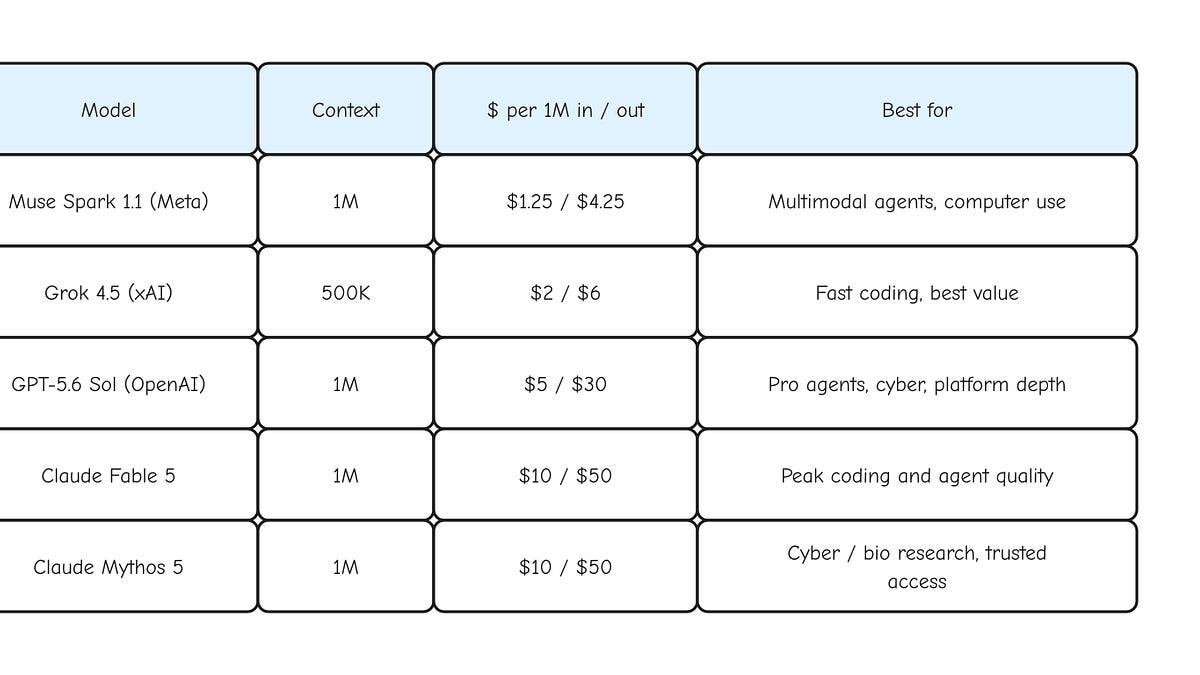
In July 2026, the frontier AI model market underwent a fundamental shift: the mass release of GPT-5.6, Grok 4.5, and Claude Fable 5 marked a transition from the race for general intelligence to deep specialization of models across specific task profiles.
What Happened
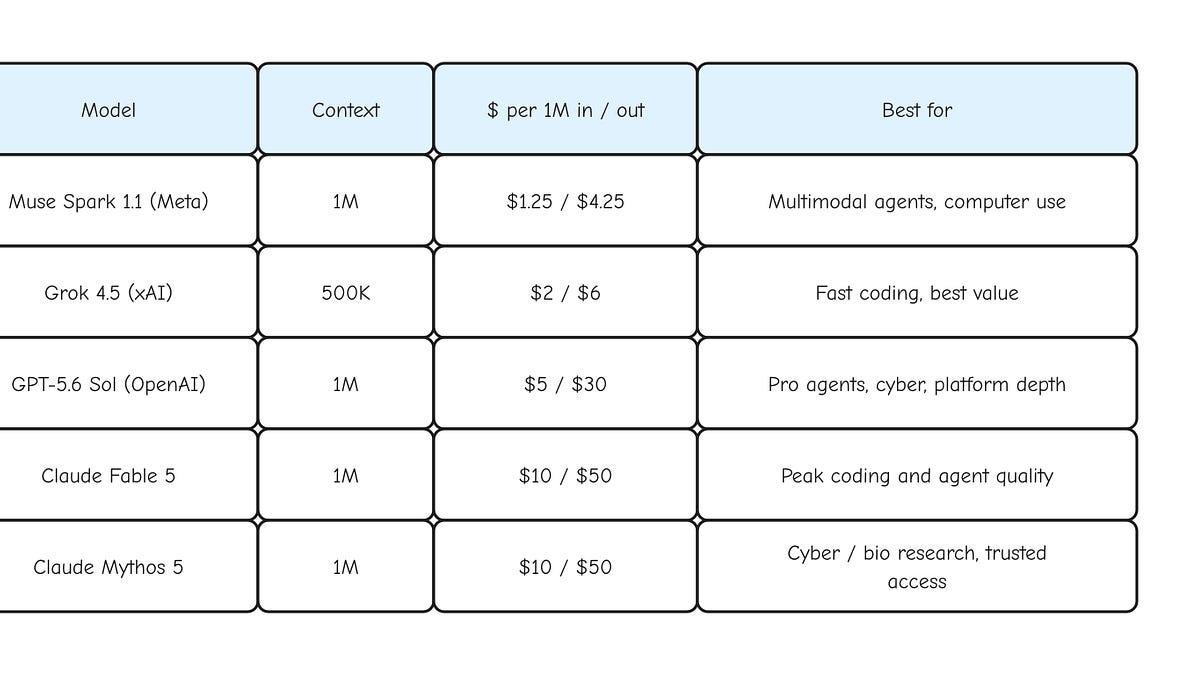
This month saw a large-scale release of new models: the GPT-5.6 lineup (Sol, Terra, Luna) from OpenAI, Grok 4.5 from xAI, Claude Fable 5 from Anthropic, and Kimi 3. According to test results, Claude Fable 5 took the lead in agentic coding with a SWE-bench Pro score of approximately 80.4%. The GPT-5.6 Sol model set a new state-of-the-art (SOTA) in terminal management, scoring 88.8% in Terminal-Bench 2.1. Meanwhile, Grok 4.5 demonstrated high efficiency, providing a speed of 80 t/s and a 500K token context window at a low cost.
Context
Previously, competition among AI developers was primarily focused on achieving maximum general "intelligence" metrics. However, current releases demonstrate the formation of three distinct development vectors: achieving peak quality (Anthropic), developing ecosystem depth and tools (OpenAI), and maximizing price efficiency (xAI).
Why It Matters for the Industry
For the AI industry, this signifies a paradigm shift in tool selection: developers are moving from using a single universal model to designing highly specialized multi-agent systems. Agent architecture is now built by selecting the optimal model for a specific workflow—whether it be coding, system administration, or high-performance chat—allowing for the optimization of both quality and operational costs.
Why It Matters for Users
For end users and developers, the era of "cheap intelligence" is arriving. Thanks to models like Grok 4.5 or GPT-5.6 Terra, it is becoming economically viable to create complex autonomous systems that were previously too expensive to operate. However, when using budget versions such as Luna, users should consider the potential risks of reduced accuracy or loss of context.
What Remains Unknown / Limitations
Security and legal experts have expressed concerns regarding potential quality degradation during the mass transition to budget models for critical tasks.
Sources
- Comparison Report: July 2026 Frontier AI Models
- AI News July 10 2026: GPT-5.6 and Grok 4.5 Both Launched
Author
Look at AI, Editorial Team