
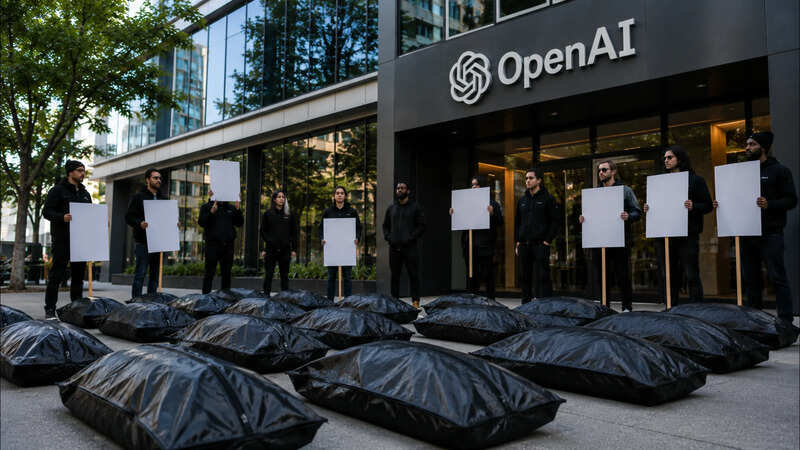
On July 16, 2026, OpenAI's headquarters in San Francisco became the site of a radical protest. Activists left empty body bags at the building's entrance, expressing their disagreement with the company's policies and its potential collaboration with the US defense sector.

What happened
During the protest at the entrance of OpenAI's San Francisco office, empty body bags were placed. The demonstration was organized by the groups Tesla Takedown and Stop the Money Pipeline. The primary reason for the protest was OpenAI's cooperation with the US Department of Defense (DoD) and concerns regarding the use of artificial intelligence technologies for military purposes.
Context
Growing social and political resistance to AI development is moving from the digital realm into the physical plane. Protests against OpenAI related to its interaction with the government defense sector indicate increasing "social friction" risks for major neural network developers.
Why it matters for the industry
For the industry, this signifies an escalation of physical security risks for offices and personnel. Companies may face the need to increase security spending, implement changes in transparency policies when working with government contractors, and deal with increased regulatory scrutiny regarding dual-use technologies.
Why it matters for users
For the general public and users, the rise of such protests highlights the critical importance of ethical regulation and control over how AI is applied in defense technologies. This could lead to the implementation of stricter reporting standards and demands for algorithmic transparency.
What is not yet known / limitations
There are various assessments of the consequences: ranging from operational risks to infrastructure to the necessity of implementing full-scale ethical audits into the development cycle.
Sources
Author
Look at AI, Editorial Team