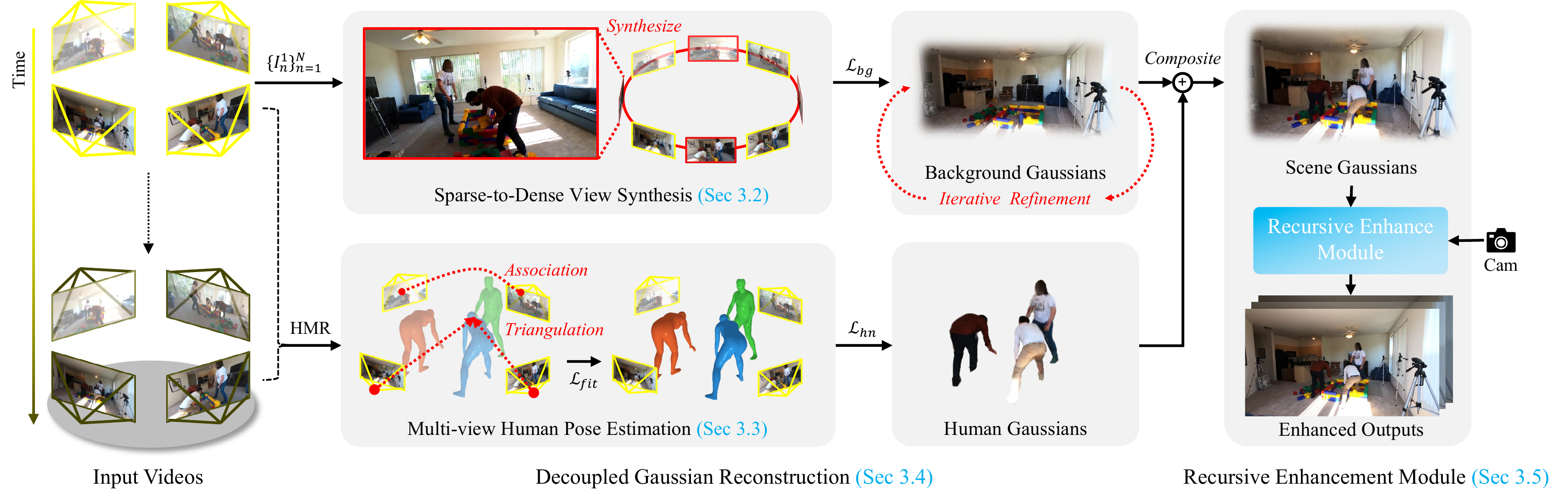
Researchers from Seoul National University have introduced StudioRecon—an innovative pipeline for 4D reconstruction of human scenes, capable of operating under conditions of a limited number of cameras and low viewpoint overlap.
What Happened
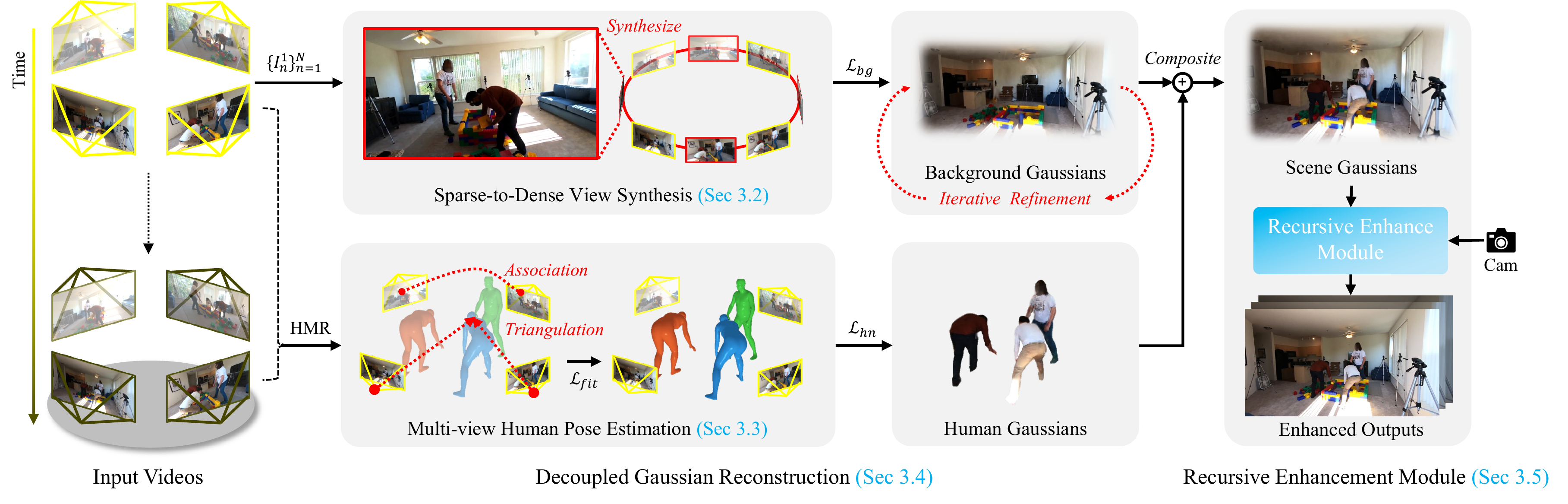
A method called StudioRecon has been developed, which allows for the reconstruction of dynamic 3D scenes with moving people using only four cameras. The technology separates the scene into background and people, applying a video diffusion model to synthesize hundreds of new background viewpoints and the SMPL model for precise capture of human body geometry. To correct visual artifacts in areas with poor visibility, a recursive module with adaptive temporal consistency is used.
Context
Traditional motion capture (MoCap) systems require massive and expensive camera arrays to achieve high-quality rendering. StudioRecon offers a hybrid approach, combining generative models for static elements and parametric models for dynamic objects, which significantly reduces hardware requirements.
Why It Matters for the Industry
For the industry, this means the possibility of achieving bullet-time effects and high-quality 4D rendering using affordable multi-camera setups instead of professional MoCap studios. This paves the way for creating complex content with minimal capital expenditure on data capture infrastructure.
Why It Matters for Users
Content creators and videographers will be able to generate cinematic 3D scenes simply by using several ordinary cameras. The technology also enables the replacement of actors with new characters while maintaining the naturalness and plausibility of the surrounding environment.
What Is Not Yet Known / Limitations
At the moment, the project remains a research prototype: there is no published source code, model weights, or detailed performance data, which makes immediate production implementation difficult.
Sources
Author
Look at AI, Editorial Team