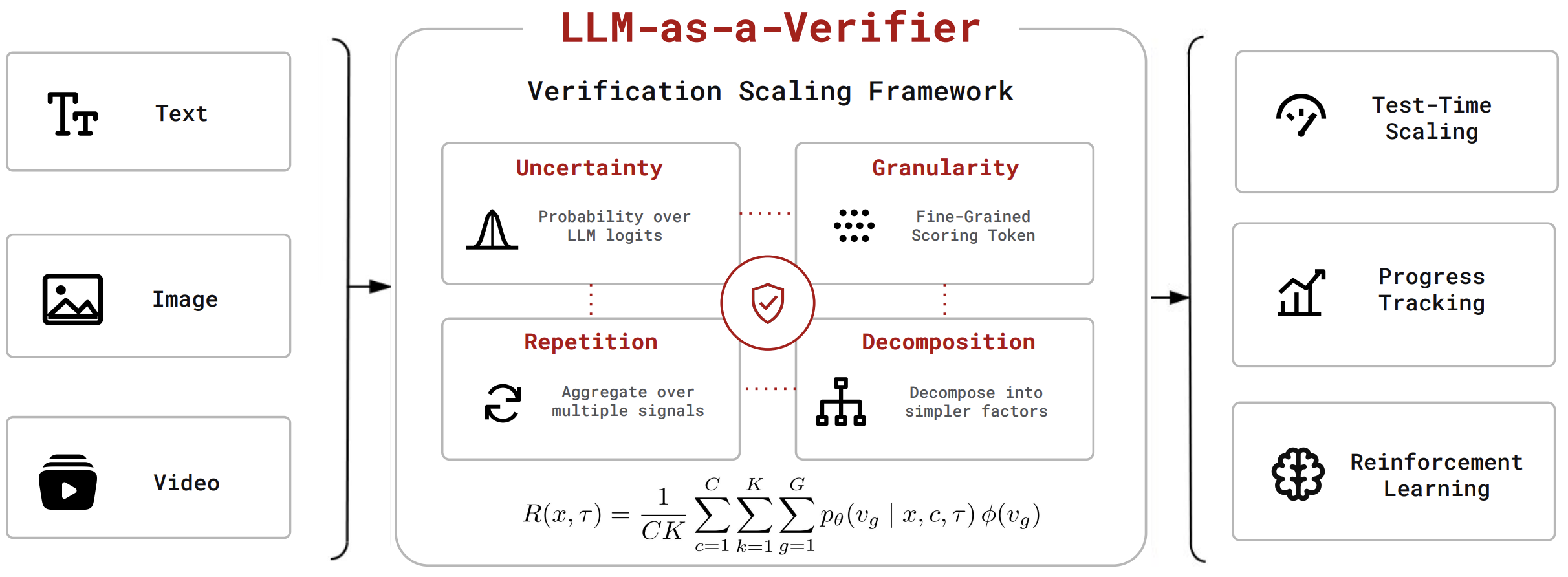
The LLM-as-a-Verifier framework has been introduced, which shifts the process of verifying AI responses from simple binary assessments to granular, continuous probabilistic scoring based on token logprobs.


What Happened
A universal framework, LLM-as-a-Verifier, has been developed to verify AI solutions. Instead of discrete "yes" or "no" answers, the system uses continuous probabilistic scoring based on token logprobs. This allows for scaling verification accuracy through detailed criteria, repeated assessments, and the use of dense feedback for Reinforcement Learning (RL), including algorithms such as GRPO and SAC.
Context
Traditional verification methods often rely on rigid classifiers that provide only a discrete result. The new approach allows LLMs to be used not just as text generators, but as precise measurement tools, providing much richer information regarding the degree of confidence and the correctness of a solution.
Why It Matters for the Industry
For the industry, the transition to granular assessments means the ability to effectively use LLMs as "judges" for training agentic systems and robotics. This creates a foundation for high-quality reward modeling and automated RL, gradually replacing human feedback (RLHF) with scalable automated verification cycles.
Why It Matters for Users
For developers and users, this represents a path toward creating more reliable autonomous agents. The technology enables the minimization of hallucinations through self-correction mechanisms and facilitates the creation of systems capable of more accurately evaluating their own actions in complex tasks.
Sources
Author
Look at AI, Editorial Staff