![[AINews] Codex Usage Surges 10x; AI Agent & Infrastructure Roundup](/assets/tg-news-media/2f/2f3f489521f370bedd73e12ecd142a2958794046014be8f686a9ce25301981d6.jpg)
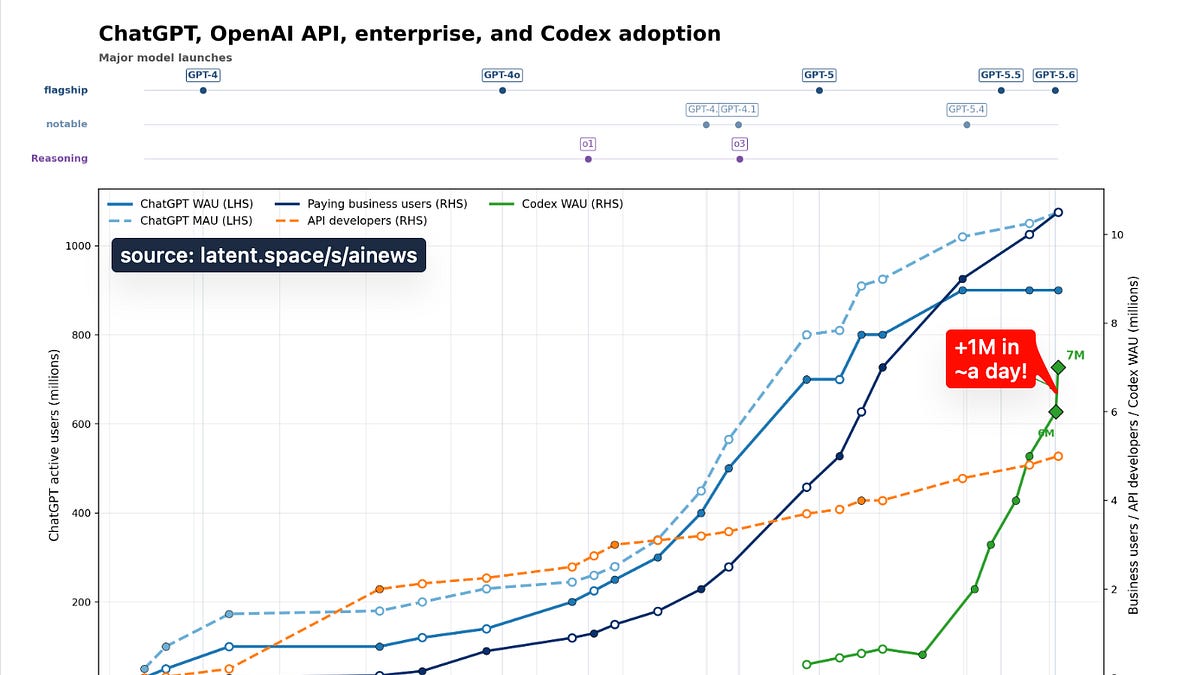
OpenAI is demonstrating unprecedented scaling rates: within 24 hours (July 12-13, 2026), the number of active Codex and ChatGPT Work users grew by 1 million, reaching the 7 million mark. Simultaneously, the company is shifting toward a strategy of strict resource optimization, implementing new inference approaches to maintain system stability.
What Happened
In a single day, the number of Codex and ChatGPT Work users increased from 6 to 7 million. This is part of a massive trend: over the last 6 months, OpenAI's user base has grown more than 10-fold. Alongside audience growth, the GPT-5.6 Sol model was optimized: the company implemented inference optimizations and adjusted the context window size from 372k to 272k tokens to control operational expenses.
Context
Current dynamics indicate a transition of AI agents from the early experimentation stage to a phase of mass industrial use. While OpenAI is betting on the accessibility and scalability of code automation tools, competitors like Anthropic are focusing on providing high-performance but less accessible models (Fable 5).
Why It Matters for the Industry
For the industry, this signifies the standardization of AI agents in developer workflows. Scaling through inference optimization rather than simply increasing parameters indicates a focus on economic efficiency. The growth of Codex could accelerate the formation of the Agentic DevTools market—tools capable of managing full development cycles, from testing to deployment.
Why It Matters for Users
Developers are gaining more stable and cost-predictable automation tools. The rising popularity of Codex accelerates the development of an ecosystem of specialized code-writing tools, making the use of complex AI agents an industry standard and lowering the barrier to entry for creating automated workflows.
What Remains Unknown / Limitations
There are varying assessments of the market strategy: while product specialists see this as a signal of standardization, enterprise segment representatives and architects express concerns regarding the long-term consequences of such a policy.
Sources
Author
Look at AI, Editorial Team