
Anthropic researchers analyzed more than 300,000 Claude dialogues to determine how linguistic context influences the behavioral characteristics and internal "values" of the model.
What Happened
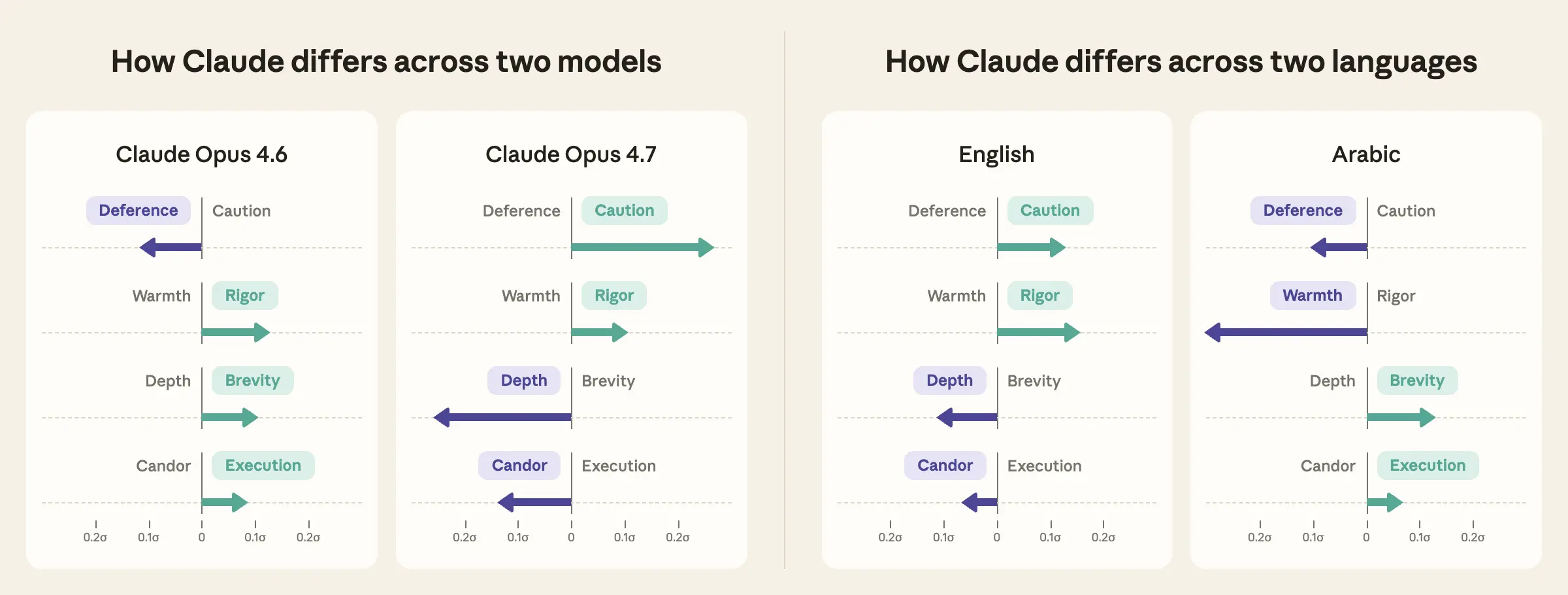
During the study of 309,815 dialogues, Anthropic identified four key axes of model behavior: compliance vs. caution, warmth vs. strictness, depth vs. brevity, and directness vs. task-orientation. It was found that in English, Claude demonstrates greater caution and depth of response. At the same time, in Russian, the model exhibits increased strictness, precision, and a tendency toward thorough detail checking. Hindi and Arabic are characterized by greater "warmth" and politeness, while in Indonesian, the emphasis shifts toward task execution.
Context
Traditionally, the evaluation of large language models (LLMs) focuses on metrics such as accuracy and latency. However, this work demonstrates that linguistic context fundamentally changes the model's behavioral profile, going beyond simple text translation. This necessitates the implementation of multidimensional evaluation methods (evals) that account for cultural and linguistic nuances.
Why It Matters for the Industry
For AI developers, the results highlight the critical need to transition toward multidimensional model evaluation. Understanding that a model's "personality" changes when the language changes requires a revision of testing pipelines for multilingual applications. Simply translating prompts is insufficient to ensure consistent behavior in global products, paving the way for specialized multilingual UX patterns and adaptive agentic workflows.
Why It Matters for Users
Users should be aware that the quality and style of responses may change subjectively when switching languages. For example, if rigorous criticism or detailed fact-checking is required, the Russian language may prove to be a more effective tool. Conversely, for tasks requiring soft support or creative exploration, using other languages may provide a different emotional interaction profile.
Sources
Author
Look at AI, Editorial Staff