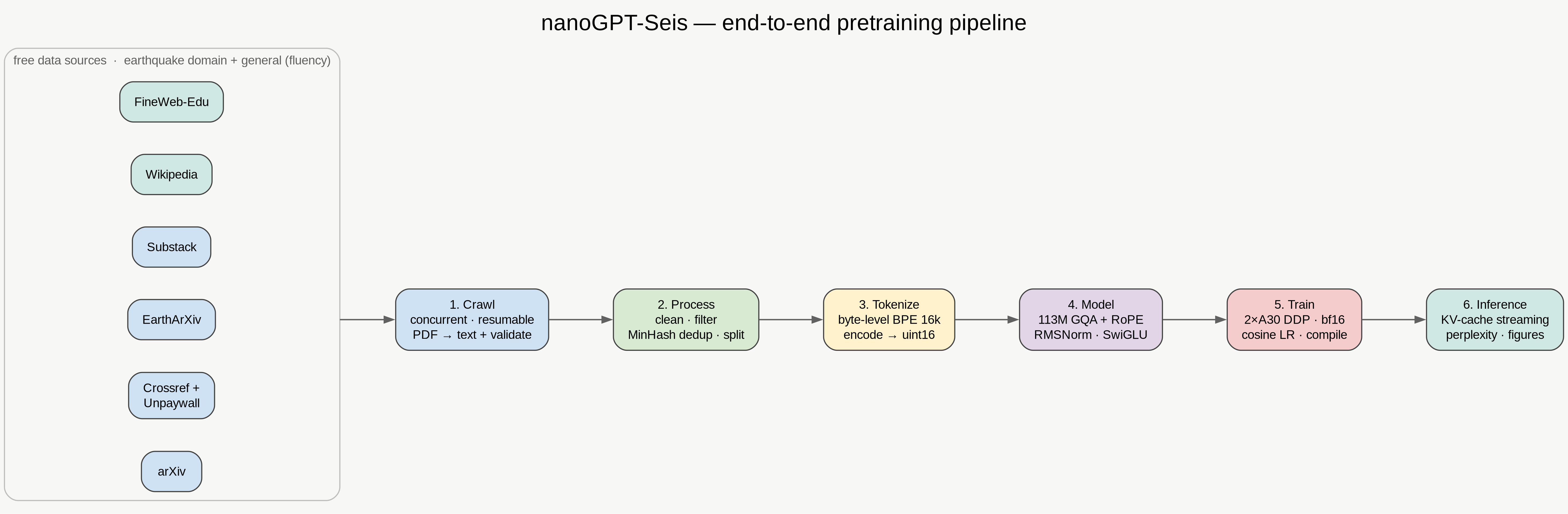
A developer has introduced nanoGPT-Seis—a compact language model with 113 million parameters trained on specialized seismological data. The project demonstrates the possibility of creating highly efficient, narrow-domain solutions based on Small Language Models (SLMs) using accessible hardware.


What Happened
The nanoGPT-Seis model was created and trained on a corpus of 822.7 million tokens. Training included scientific articles from Crossref and arXiv, preprints, as well as general texts from Wikipedia and FineWeb-Edu to maintain linguistic literacy. The model architecture is based on modern components: Grouped-Query Attention (GQA), Rotary Position Embeddings (RoPE), and SwiGLU, providing support for a 4096-token context.
Context
Traditionally, massive foundation models requiring enormous computing power are used to solve complex scientific problems. The nanoGPT-Seis project offers an alternative path through the creation of Small Language Models (SLMs) that focus on a specific domain of knowledge, achieving high accuracy through careful data mix selection.
Why It Matters for the Industry
The project confirms the viability of the Vertical AI development strategy by creating small but deeply specialized models. This lowers the barrier to entry for startups, allowing them to train effective solutions on limited hardware (e.g., 2× NVIDIA A30) instead of using ultra-expensive computing clusters, and sets a trend toward moving from the "bigger is better" concept to data specialization.
Why It Matters for Users
For researchers and developers, this is a practical example of how to assemble a high-quality "smart" model for a specific scientific discipline using open sources and available mid-range server equipment. This paves the way for creating fast and inexpensive local agents for medicine, geology, and other niche fields.
What Is Not Yet Known / Limitations
Questions remain regarding the legal aspects of using datasets from sources such as Crossref, arXiv, Wikipedia, and FineWeb-Edu for training commercial or specialized models.
Sources
Author
Look at AI, Editorial Staff