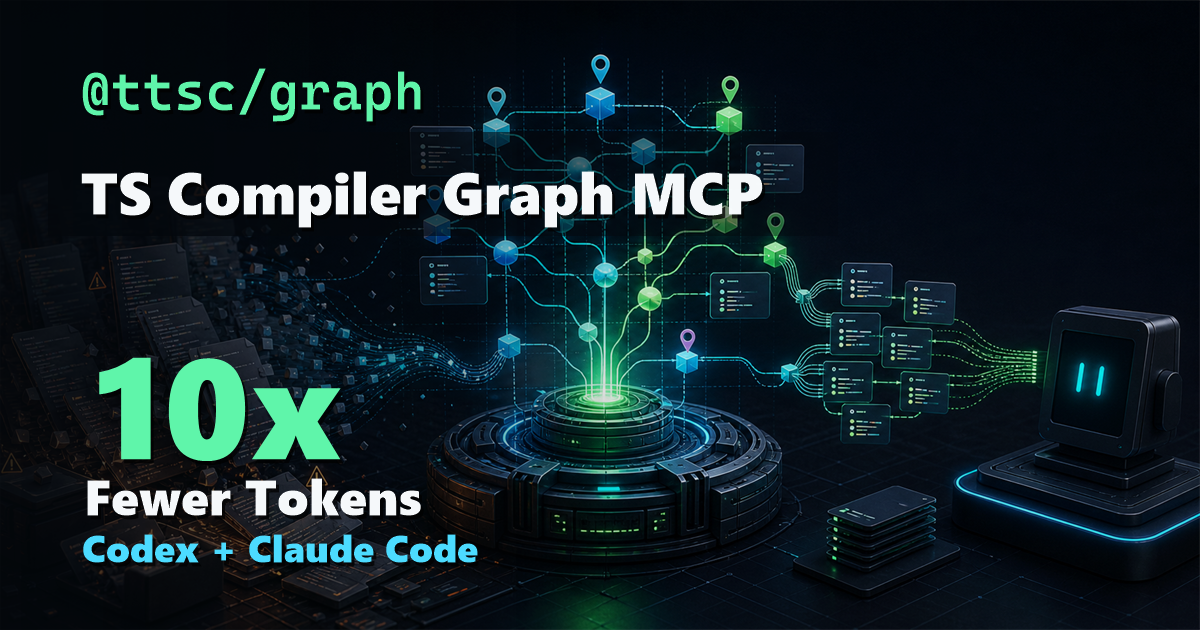
A developer has introduced @ttsc/graph — a Model Context Protocol (MCP) server that provides AI agents with a high-precision graph of TypeScript codebases. By using a real compiler to transmit structural metadata instead of full code text, token costs can be reduced by approximately 10 times.
What Happened
The @ttsc/graph MCP server has been released, utilizing the actual TypeScript compiler to resolve aliases, monorepos, and re-exports. Instead of passing raw file text, the tool provides AI agents only with the necessary structural metadata: names, relationships, and signatures. This allows tools like Claude Code and Codex to work with code much more efficiently.
Context
Traditional methods for AI agents working with large repositories often rely on text-based file searching, which leads to the "token bomb" problem — excessive consumption of the context window and rising query costs. Using the Model Context Protocol (MCP) allows for the standardized transmission of specialized context directly into the LLM.
Why It Matters for the Industry
This technology addresses the scalability problem of AI agents in enterprise environments by replacing resource-intensive text searching with efficient use of the compiler graph. Implementing a strict CoT-compliant (Chain-of-Thought) interface through typed schemas makes agent actions more predictable and accurate, which is critical for the industrial use of development tools.
Why It Matters for Users
Developers using Claude Code, Cursor, or other AI agents will be able to perform deep analysis of complex TypeScript projects without massive token costs and without the risk of hallucinations that arise from reading incomplete or fragmented code.
Sources
Author
Look at AI, Editorial Team