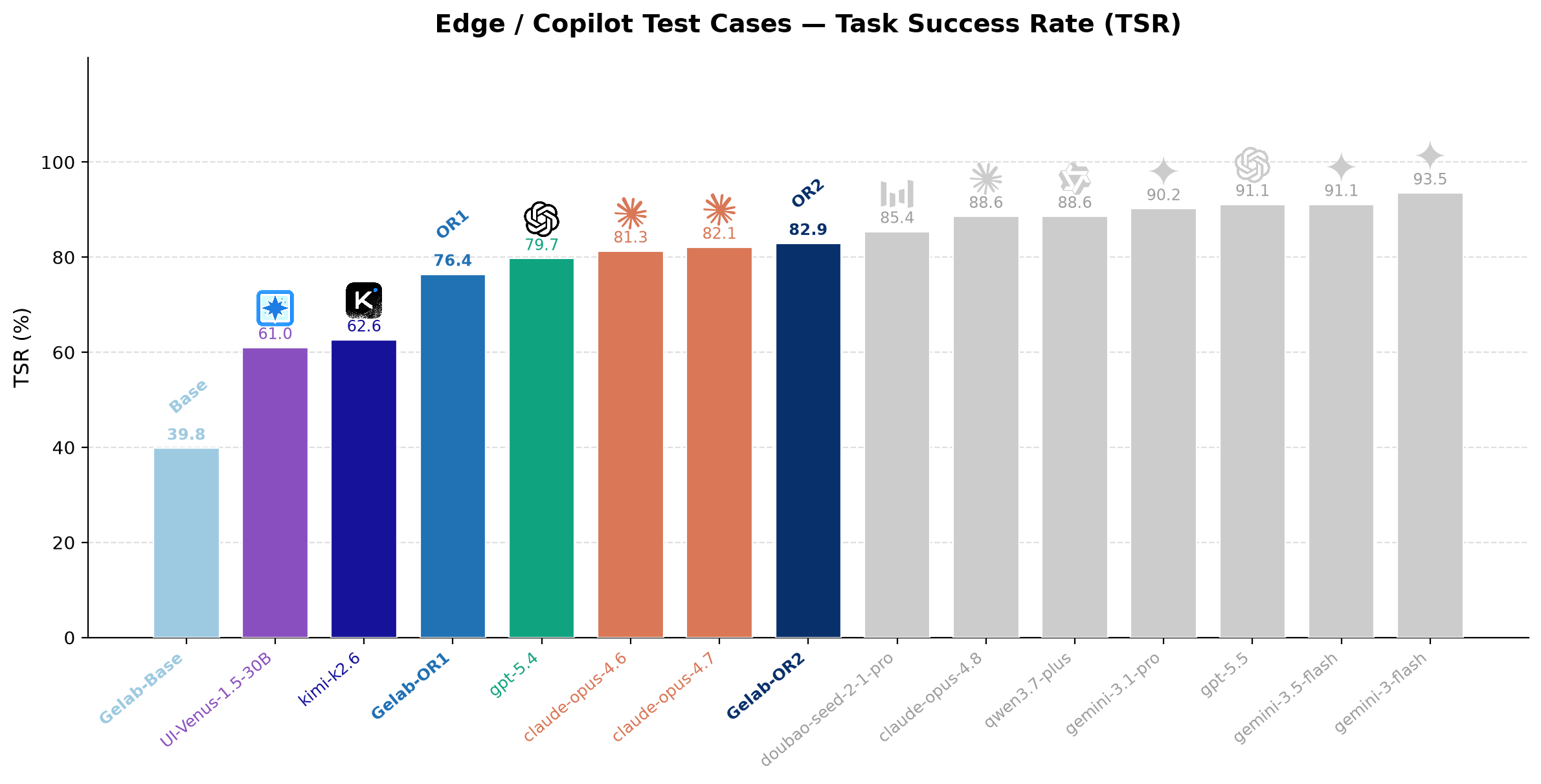
Microsoft has introduced a specialized GUI agent, GELab-Zero-4B-preview-Sico-Evolution, with 4 billion parameters. By utilizing LoRA adaptation on interaction trajectories with Microsoft Edge and Copilot, the model demonstrates outstanding results in interface management, competing with the largest proprietary solutions.


What Happened
Microsoft developers have introduced the GELab-Zero-4B-preview-Sico-Evolution model, designed to automate actions within graphical user interfaces. The application of an iterative GUI model evolution pipeline allowed the Task Success Rate to increase from a baseline of 39.8% to 82.9%. This result outperforms models such as gpt-5.4 (79.7%) and Claude-Opus-4.7 (82.1%) in interface control testing.
Context
The success lies in the LoRA adaptation method, which trains the model on specific interaction trajectories within the Microsoft Edge and Copilot ecosystems. This allows a small model (4B parameters) to achieve high precision in the specialized field of "Computer Use" without requiring the scale of massive, universal LLMs.
Why It Matters for the Industry
This breakthrough confirms the hypothesis that specialized Small Language Models (SLMs) can be more effective than universal giants in Computer Use tasks. This shifts the industry economics, offering a path toward creating cheap, fast, and efficient agents with low latency, which lowers the barrier to entry for AI assistant development and reduces dependency on closed APIs.
Why It Matters for Users
For end users, this signals the approaching era of full-fledged AI assistants capable of running locally on user devices. Such agents will be able to independently perform complex actions in browsers and applications, mimicking human movements and providing high autonomy while maintaining privacy.
What Is Not Yet Known / Limitations
The current version of the project is a preview release, which requires additional verification of reliability in real production environments. There are also privacy and intellectual property risks associated with training models on interaction trajectories within closed ecosystems.
Sources
Author
Look at AI, Editorial Team