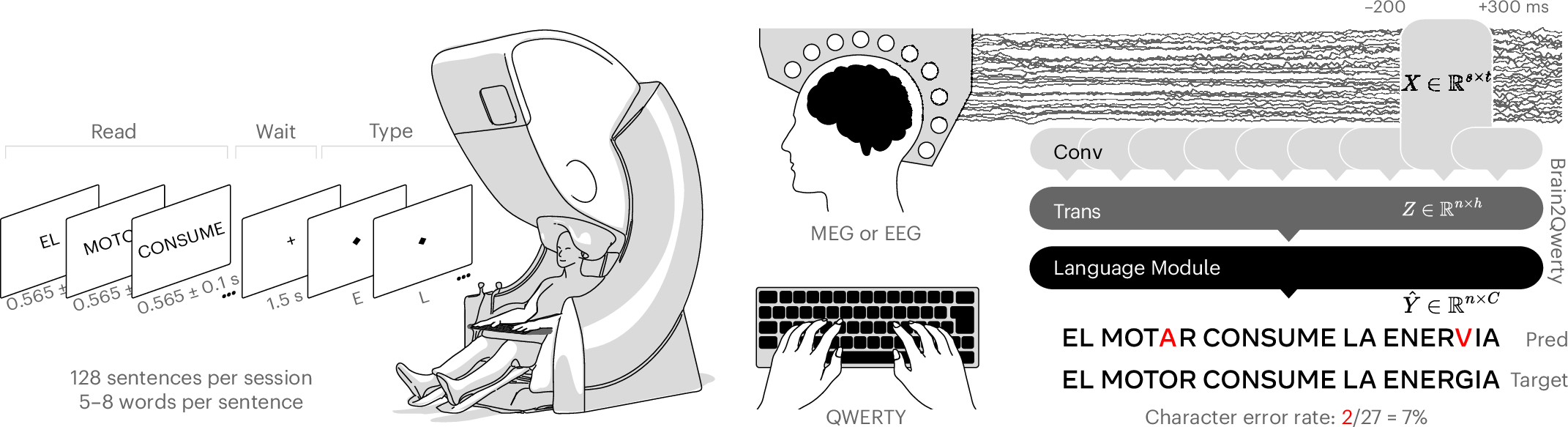
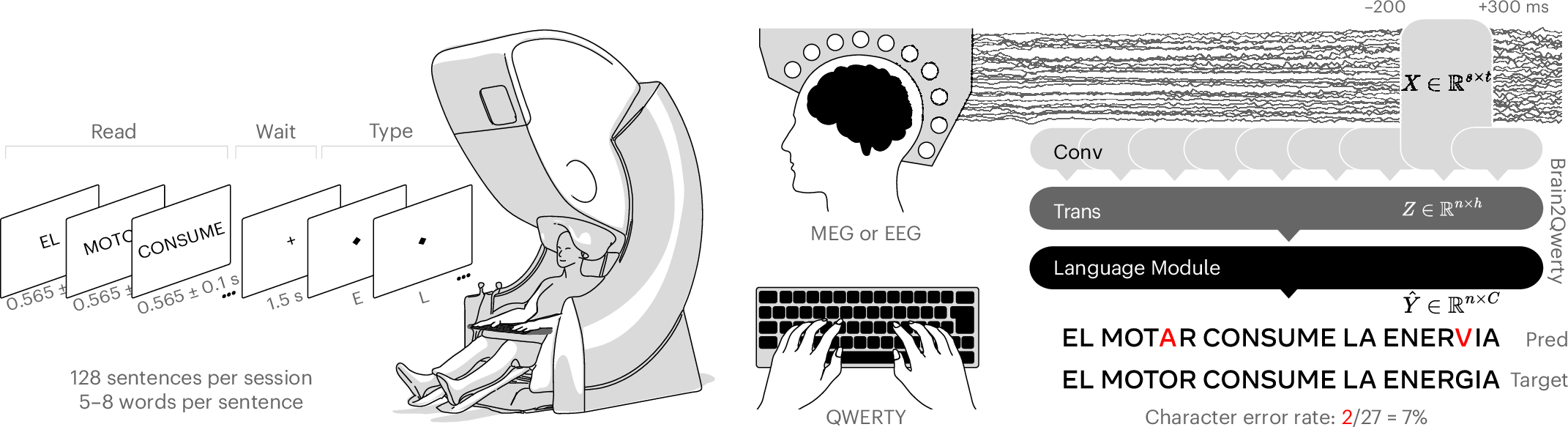
Meta has made a qualitative leap in the field of non-invasive neural interfaces by introducing the Brain2Qwerty v2 system. This new technology allows for the decoding of the meaning of entire phrases directly from brain activity, achieving 61% accuracy using magnetoencephalography (MEG), which is an order of magnitude higher than previous non-invasive methods.
What Happened
Developers from Meta have presented the updated Brain2Qwerty v2 system, which has transitioned from character-by-character key prediction to direct semantic decoding of phrases from raw brain signals. Unlike the first version, the system utilizes deep learning and large language models (LLMs) to extract meaning and correct errors caused by noise in the neural signal. Current tests on MEG equipment showed word decoding accuracy at the level of 61%, whereas previous non-invasive approaches demonstrated results of around 8%.
Context
The development relies on a shift from an architecture that predicts individual keystrokes to end-to-end pipelines that extract semantics (meaning) directly. The study was published in the journal *Nature Neuroscience*, confirming the scientific significance of the transition to semantic decoding within brain-computer interfaces (BCI).
Why It Matters for the Industry
For the AI and neurotechnology industry, this represents a paradigm shift: using LLMs as a "translator" from biological to digital language allows for overcoming limitations associated with the low quality of non-invasive signals. This paves the way for creating high-precision neuroprosthetics without the need for surgical procedures to implant electrodes into the brain.
Why It Matters for Users
For end users, especially people with speech or motor impairments, the technology promises the ability to communicate using standard high-tech devices without medical intervention. In the long term, this could lead to the emergence of wearable interfaces that allow for controlling the digital environment through thought alone.
What Is Not Yet Known / Limitations
Despite the breakthrough, the technology at its current stage is strictly limited by the use of bulky and expensive magnetoencephalography (MEG) equipment. There is a critical technological barrier in attempting to transfer such high accuracy to more compact and affordable wearable devices, such as electroencephalography (EEG).
Sources
Author
Look at AI, Editorial Staff