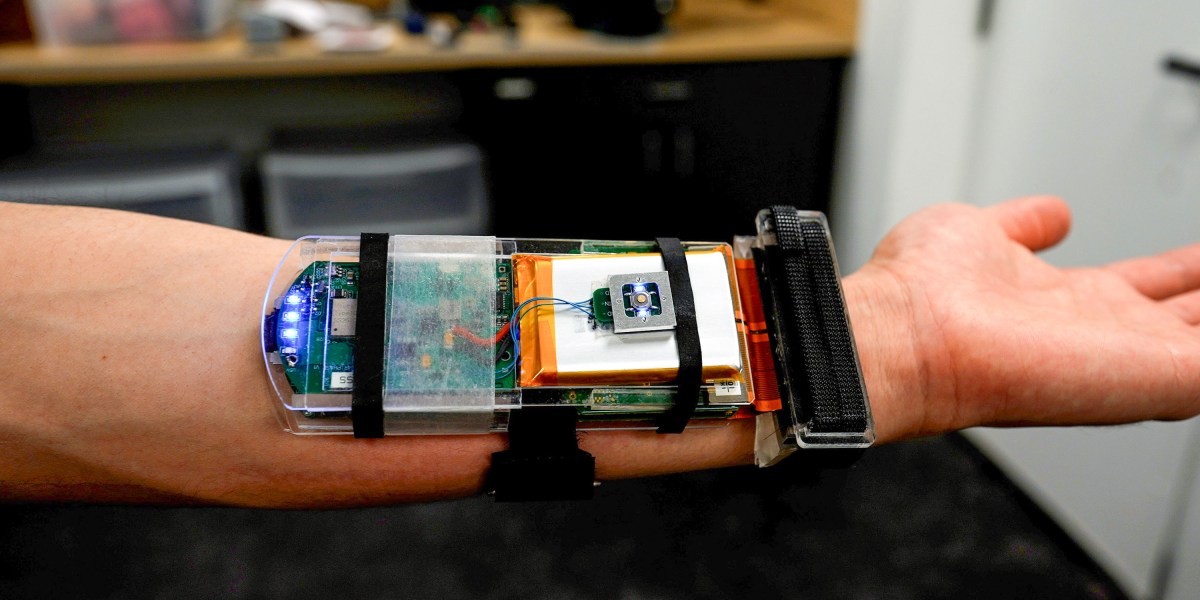
MIT researchers have developed a wearable bracelet based on ultrasound scanning that allows for high-precision control of robotic arms or virtual objects by reading the biomechanics of muscles and tendons.

What Happened
A team of scientists from MIT has created a device that uses miniature ultrasound sensors and hydrogel to monitor the movements of muscles, tendons, and ligaments in the wrist. The collected data is transmitted to an AI algorithm that converts it into precise digital commands or gestures. The system allows for the remote mimicry of complex movements, such as playing the piano or high-precision object grasping.
Context
Traditional tracking methods, such as optical systems (cameras) or accelerometers, are limited to tracking only the surface of the body. The MIT development moves from surface monitoring to internal analysis of soft tissue states, providing much higher detail of biomechanical signals.
Why It Matters for the Industry
This technology offers a fundamentally new control method for the robotics and VR interface industries. It could become a standard in specialized niches, such as high-precision robotic surgery and industrial manipulation, where current tracking methods do not provide the necessary accuracy and reliability.
Why It Matters for Users
For end users, this means a transition to more natural and intuitive interaction with the digital and physical worlds. Human movements will be transmitted to virtual environments or robots with almost no latency and with unprecedented detail in fine motor skills.
What Is Not Yet Known / Limitations
At the moment, the technology is in the laboratory prototype stage. Significant optimization is required for real-time operation, as well as addressing issues of calibration and reducing sensor costs for potential commercial implementation.
Sources
Author
Look at AI, Editorial Staff