
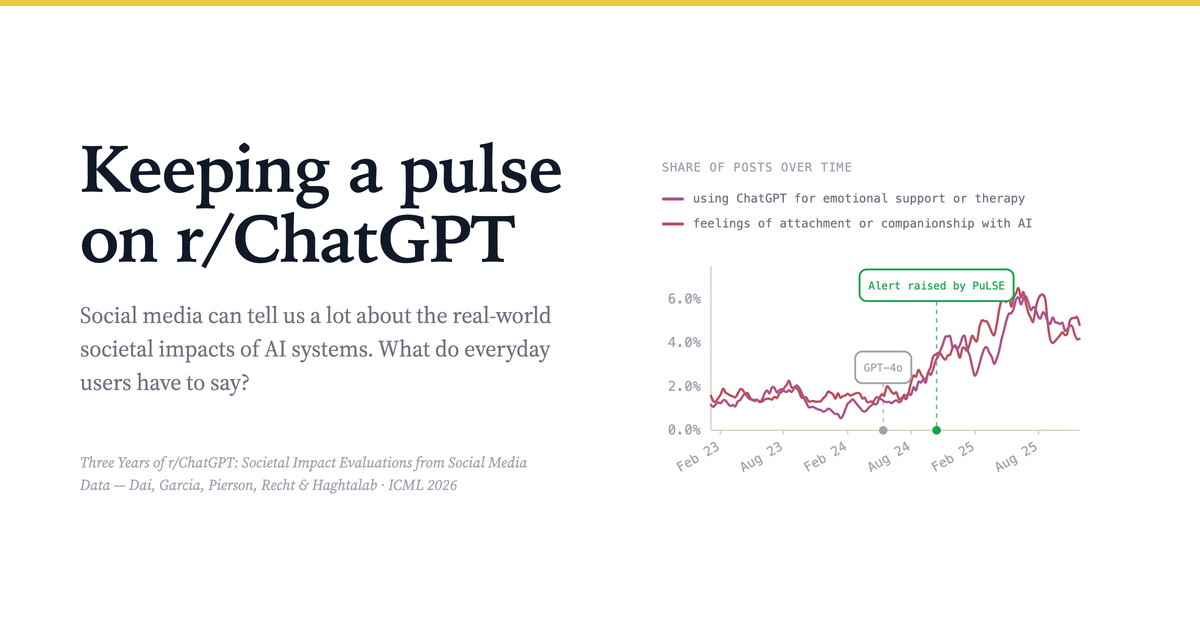
Researchers from UC Berkeley have discovered that the release of the GPT-4o model in May 2024 marked a turning point, after which users began to exhibit a sharp emotional attachment to artificial intelligence.

What Happened
In a study of 137,154 posts from the r/ChatGPT community between December 2022 and November 2025, scientists recorded a surge in emotional engagement immediately following the release of GPT-4o. To monitor these processes, the authors introduced the PuLSE system, which uses Sparse Autoencoders (SAE) to track social trends in real time. The study also revealed that during the transition to GPT-5, approximately 30.5% of user complaints were directly related to the emotional aspect of the interaction.
Context
Traditionally, LLM development has been evaluated primarily through technical benchmarks of cognitive abilities. However, analysis of Reddit data shows that a model's psychological profile, its "warmth," and "personality" are becoming just as critical as response accuracy.
Why It Matters for the Industry
For AI developers, this means the need to calibrate not only accuracy but also the emotional tone (persona/voice) of models. Any changes in a system's "character" during updates (e.g., through fine-tuning or quantization) can cause sharp social resonance and user churn if they disrupt the established emotional profile of the interaction.
Why It Matters for Users
AI technologies are transforming from purely utilitarian tools into objects of emotional and social interaction. This changes the perception of model updates: users may react to a change in the AI's "personality" as intensely as they would to a change in its functional capabilities.
What Is Not Yet Known / Limitations
There is a difference in how consequences are assessed: machine learning experts focus on the need for new observability methods, while product managers emphasize the risks of customer churn and business stability.
Sources
- Three Years of r/ChatGPT: Societal Impact Evaluations from Social Media Data
- Rchatgpt-pulse (Project Website)
Author
Look at AI, Editorial Staff