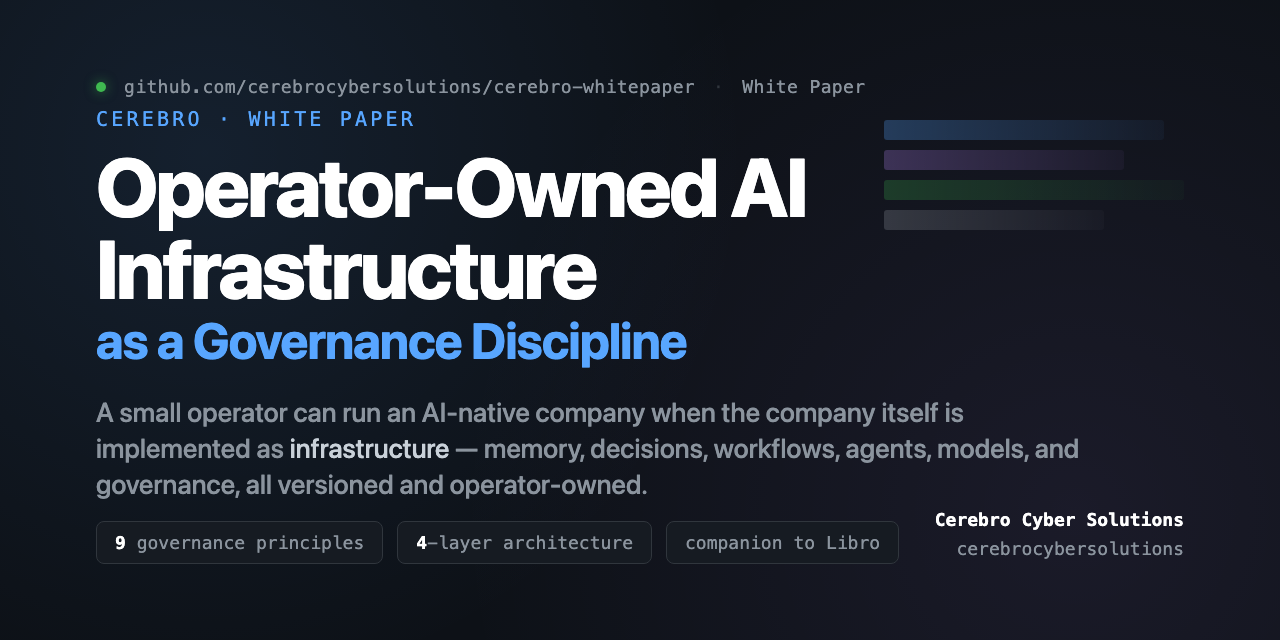
Cerebro Cyber Solutions has released a technical white paper describing the concept of "operator-oriented" AI infrastructure, which shifts the focus from text generation quality to strict lifecycle management and auditing of autonomous agent actions.
What Happened
A four-layer AI management architecture has been developed, including the Brain layer (logic and knowledge), Skills layer (workflows), Agent Runtime layer (executors such as Claude Code), and Fleet layer (compute nodes). A key technical feature is the implementation of the Reversibility principle, which allows for recording every change in memory state and agent actions for subsequent rollback or auditing.
Context
Traditional use of AI agents often boils down to managing a set of disjointed prompts, which creates difficulties in controlling their behavior. The proposed approach treats state and memory as versioned objects, transforming the chaotic use of agents into a structured, verifiable management environment.
Why It Matters for the Industry
For the industry, this signifies a transition toward an AI Governance Infrastructure standard. By enabling a full audit trail, such systems become suitable for deployment in highly regulated sectors, such as defense (GovCon, CMMC) and financial services, where control over automated decisions is a mandatory requirement.
Why It Matters for Users
For developers and entrepreneurs, this provides a methodology for building efficient "one-person" AI companies by using infrastructure as the primary management method. Instead of working with fragmented tools, it offers a unified, verifiable environment where any agent step can be documented and undone in case of an error.
What Is Not Yet Known / Limitations
There is a noticeable divergence in the architecture's focus: ranging from an engineering-oriented view of component modularity to a legal emphasis on compliance with industry security standards.
Sources
Author
Look at AI, Editorial Staff