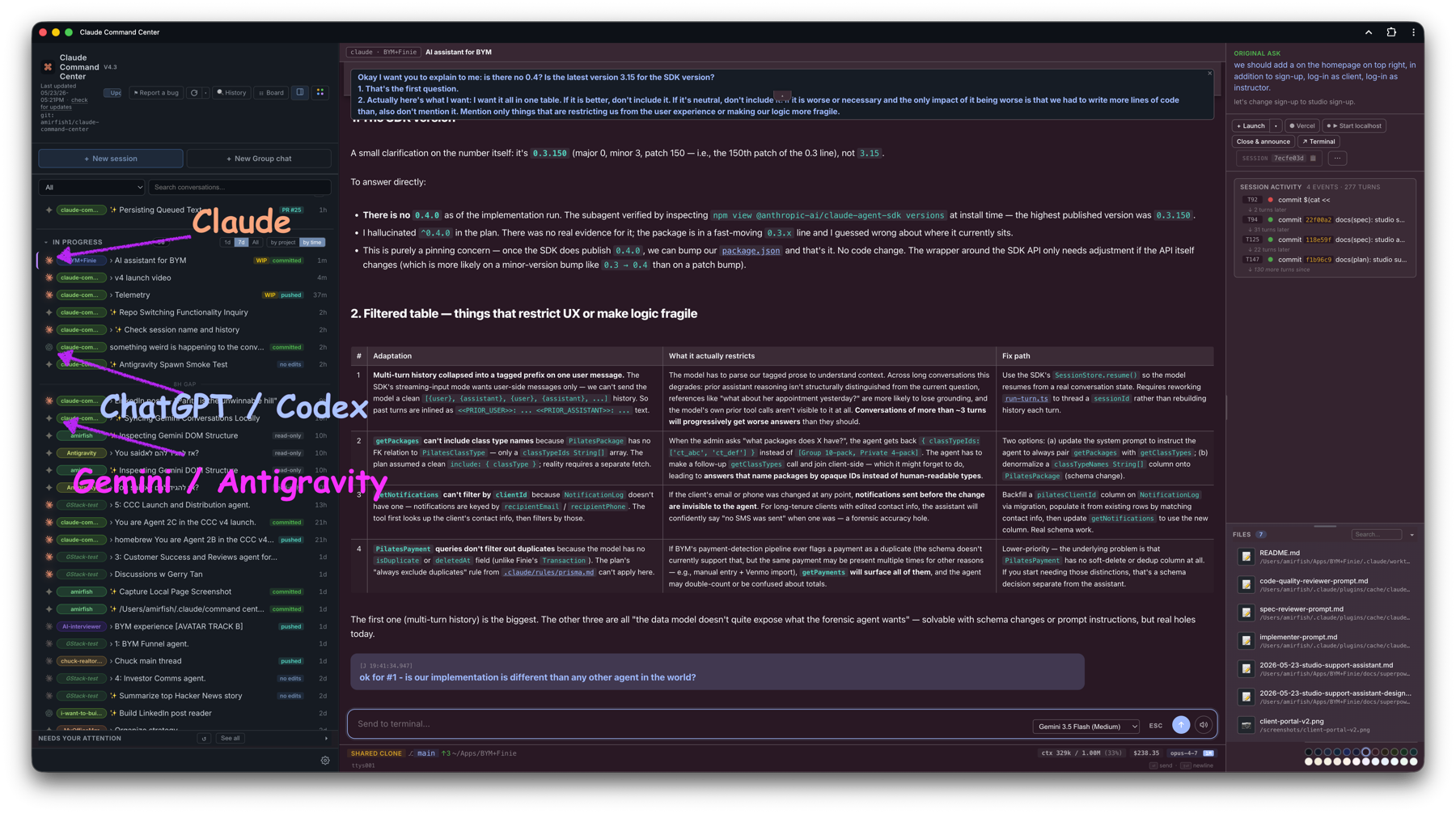
Claude Command Center (CCC) has been introduced — a local tool for orchestrating the work of various AI agents. The project allows for managing sessions of tools such as Claude Code, Codex, Cursor, and Antigravity through a single visual interface.

What Happened
Developer amirfish1 introduced Claude Command Center (CCC), which operates on a local-first principle. The tool reads session states directly from files on the disk, ensuring automatic synchronization between the terminal and a Kanban-style web interface. This allows users to start, resume, and track active processes in one place.
Context
With the evolution of agentic programming tools, developers are increasingly using several specialized CLI agents simultaneously. This leads to fragmented workflows and high cognitive load due to the need to constantly switch between different terminals to monitor parallel tasks.
Why It Matters for the Industry
The emergence of CCC signals the formation of a new niche — Agent Dashboards. The project demonstrates a growing industry need for specialized orchestration layers for local agents that manage their lifecycle and state without replacing the models themselves.
Why It Matters for Users
For developers using a stack of multiple AI tools (such as Claude Code and Cursor), CCC simplifies visual control over parallel tasks. This allows for managing all active processes via a browser, reducing the need to constantly switch between terminal windows.
What Is Not Yet Known / Limitations
There are potential security risks and questions regarding Terms of Service (ToS) compliance when using local files to store session metadata.
Sources
Author
Look at AI, Editorial Team