
Bespoke Labs, in collaboration with the University of Chicago and UC Berkeley Sky Computing Lab, has introduced EnvOpt (arXiv:2611.07372) — a framework that automatically optimizes the "stationary environment" of an LLM agent: file structure, data representations, and the set of available tools, without touching model parameters or the harness. According to the authors, across five benchmarks, this resulted in an average 48% cost savings on unseen test sets while maintaining or increasing the pass rate. The paper and partially open code were published on November 5, 2026.

What happened
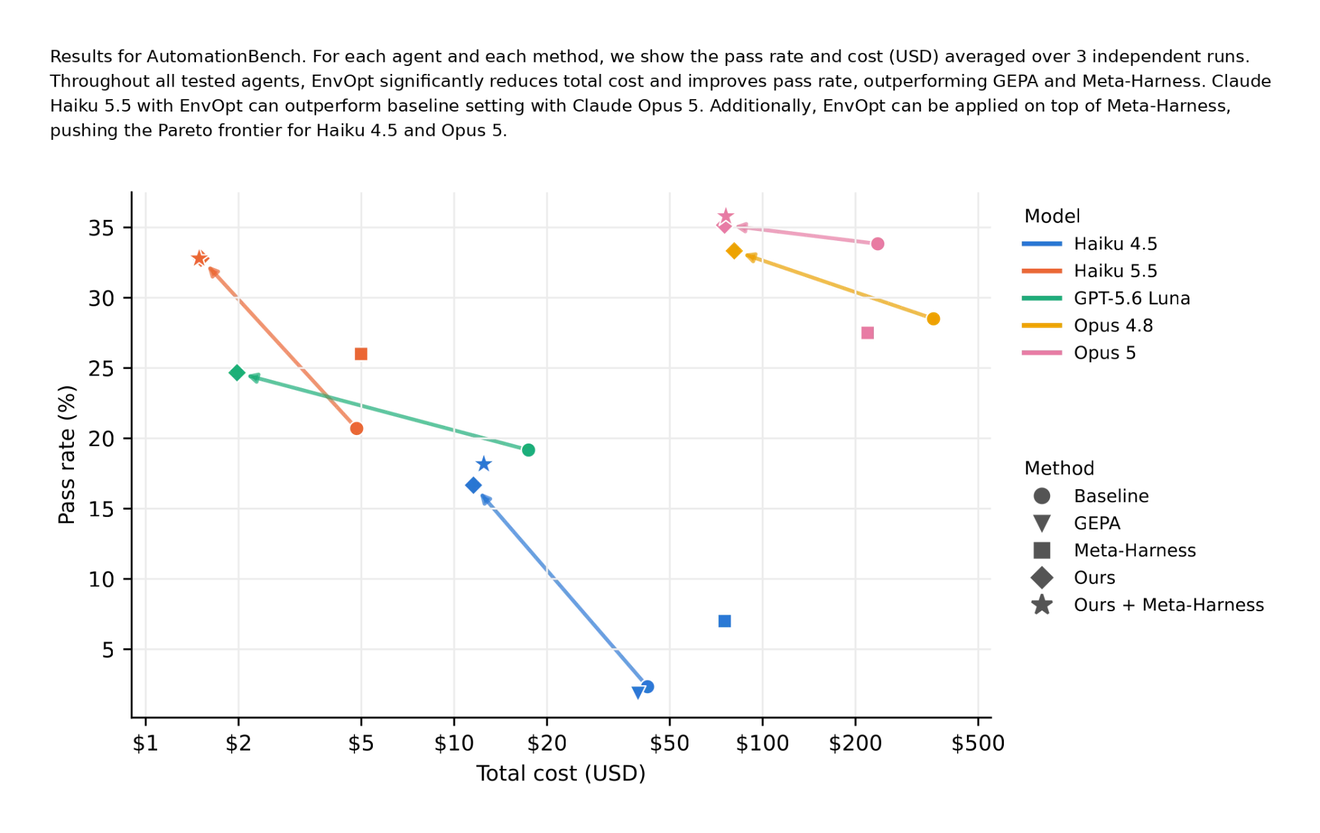
On November 5, 2026, Bespoke Labs, the University of Chicago, and UC Berkeley Sky Computing Lab published a paper on the EnvOpt framework (arXiv:2611.07372) and released part of the code on GitHub. The framework takes on the optimization of what the authors call the agent's "stationary environment": file structures, data representations, and the list of available tools, while model parameters and the harness remain unchanged. A separate Research Agent handles the optimization: it iteratively restructures the environment on training tasks, analyzing the trajectories of the Target Agent. Notably, verifiers are consciously not used at this stage to exclude reward hacking, and quality control is shifted to hidden verification queries. The results were tested on five benchmarks, including AutomationBench, Workspace-Bench, and Data-Eng-Bench, on unseen test sets where the pass rate was maintained or increased. A specific data point on AutomationBench: the cost of the optimization itself was approximately $150, while the savings reached 77.5% of the costs for running Claude Opus 4.8.
Context
EnvOpt adds a third axis of optimization to the LLM agent stack. Previously, the system was mainly tuned along two axes: model parameters and the harness (the wrapper around the model), while the environment in which the agent operates was changed manually. The authors' idea is that a significant portion of the cost of agent inference lies not in the model, but precisely in the environment. The mechanism of savings here is engineering rather than training-based: input tokens in tool call results are reduced. The agent receives file indexes, SQLite table maps, and cheat sheets with API endpoints for services like Jira, Slack, and Xero in advance, and necessary data is loaded via prefetching, instead of searching and reading everything from scratch every time. According to the authors, this environment context engineering is transferable between models and harnesses. For calibrating expectations, it is useful to compare this with Meta-Harness: EnvOpt provides a +9.67% pass rate while costing only 15% of its cost.
Why this matters for the industry
For the industry, EnvOpt legitimizes the environment as a full-fledged engineering object alongside model parameters and the harness. If the figures are confirmed by independent reproductions, "environment tuning" could become a standard step in preparing agent pipelines alongside model selection and prompts, and its own tools and benchmarks will grow around it. The unit economics of agent products can improve without retraining and without changing the model provider: part of the expenses is cut from the environment, not from the model's capabilities. The portability of the optimized environment between models and harnesses is especially valuable for corporate deployments, where the model stack changes periodically, and rebuilding the environment from scratch each time is expensive. It is important to maintain the scale of expectations: this is research work with partially open code, not a finished product, so today it works more as a reference for internal practices than as something that can be switched on in your stack with a single toggle.
Why this matters for users
If you are running LLM agents on real tasks, the main practical takeaway is that part of the expenses can be cut by changing not the model, but how data and tools are presented to it. The techniques themselves can be reproduced manually right now without any framework: provide the agent's environment with file indexes, maps of your database tables, and cheat sheets with API endpoints, and preload the data that is needed most often; this will significantly reduce input tokens. Those interested in automating the process should watch the itea1001/EnvOpt repository on GitHub, where part of the code is published (at the time of publication, the repository had 5 stars): currently, the Workspace-Bench benchmark and environments on Hugging Face (itea1001/EnvOpt-WorkspaceBench) are available, while Data-Eng-Bench is promised to be released after the server is restored. The most substantive part available to everyone right now is the paper on arXiv: techniques can be extracted from it and applied to your own pipelines.
What is still unknown / limitations
All key figures are author-reported and obtained on the team's own benchmarks: there are no independent reproductions yet, nor any community discussions. The code is published partially, so "turning on EnvOpt" in your stack directly is not yet possible, and the effect likely depends heavily on the type of tasks and the structure of the specific environment, so average metrics are not a guarantee for an individual pipeline. A separate caveat concerns the claim that the optimized environment allows a model of the Haiku 5.5 level to catch up with Opus 5: according to the source, such equality is shown on the authors' benchmarks within the optimized environment and does not describe the general capability level of the model. Until independent verification, this cannot be presented to the reader as "a cheap model replaces an expensive one."
Sources
- EnvOpt: Automated Optimization for Agent Environments — Bespoke Labs blog
- EnvOpt: Automated Optimization for Agent Environments (arXiv:2611.07372)
- itea1001/EnvOpt — code repository on GitHub
Author
Look at AI, editorial team